Long before Santa had a sleigh, a kind bishop called Nicholas lived in Myra, a town in what is now Turkey. The story goes that he crept out at night to leave secret gifts of gold for a family who needed help, and in some tellings the gold landed in stockings hung up to dry. It is a lovely story for little ones, and it is the reason kids in Germany, the first stop on our Christmas around the world trip, still put out their boots for St Nicholas Day on 6 December. This guide to Christmas around the world for kids takes children aged 4 to 8 on a passport trip to twelve countries, one for each of the twelve days of Christmas, from Krampus parades in Austria to surfing Santas in Australia. Along the way, they discover that not every child waits until 25 December. Some open their presents on Christmas Eve, some find treats in their boots on 6 December or in their stockings on 6 January, and in Ethiopia, Christmas Day itself is on 7 January. In Australia, it comes in the middle of summer! Everything here is free: the guide, the printable passport and the read-alouds that go with it. No sign-up, no email gate, no paywall.
Your Free Christmas Around the World Passport
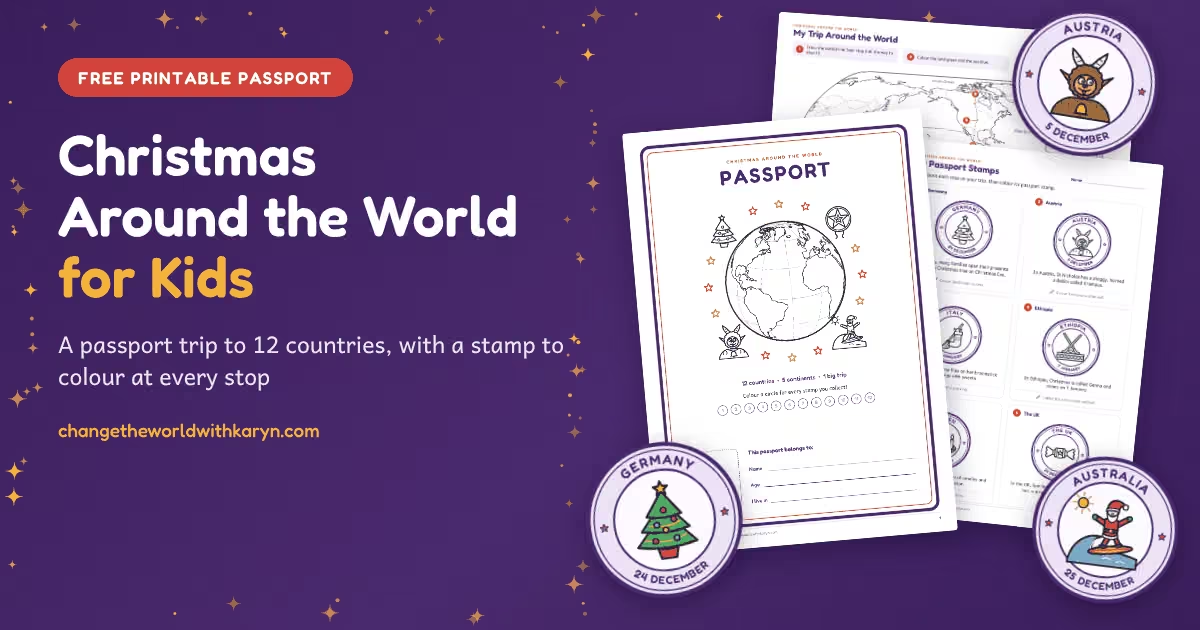
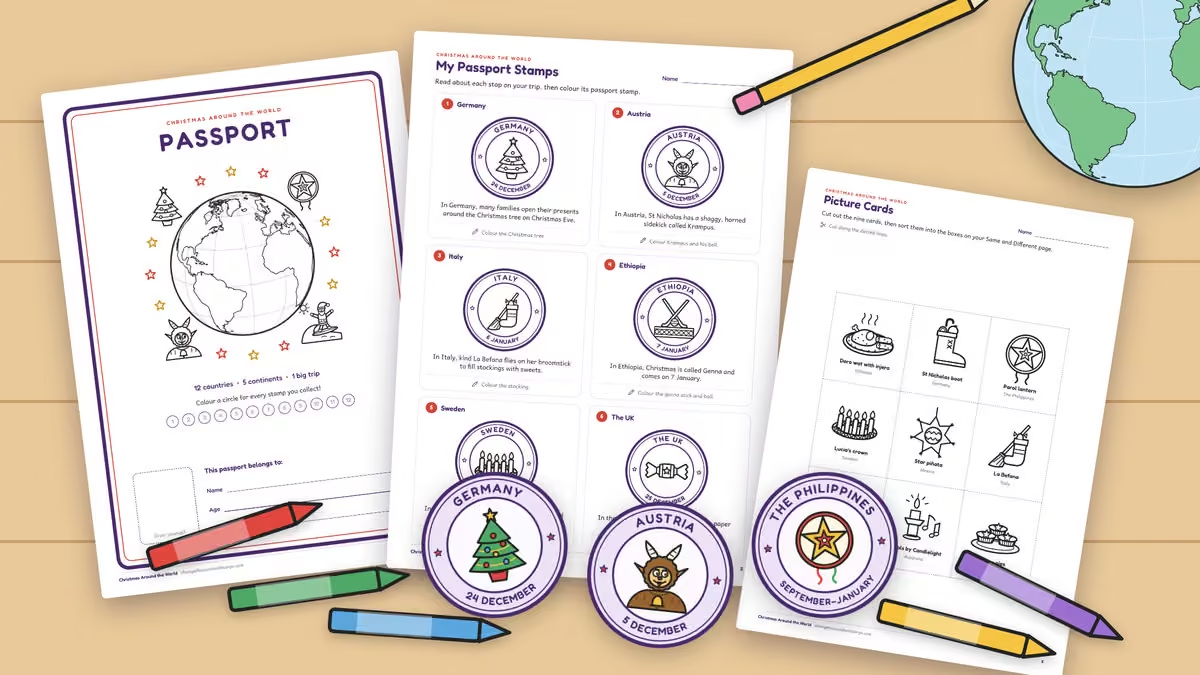
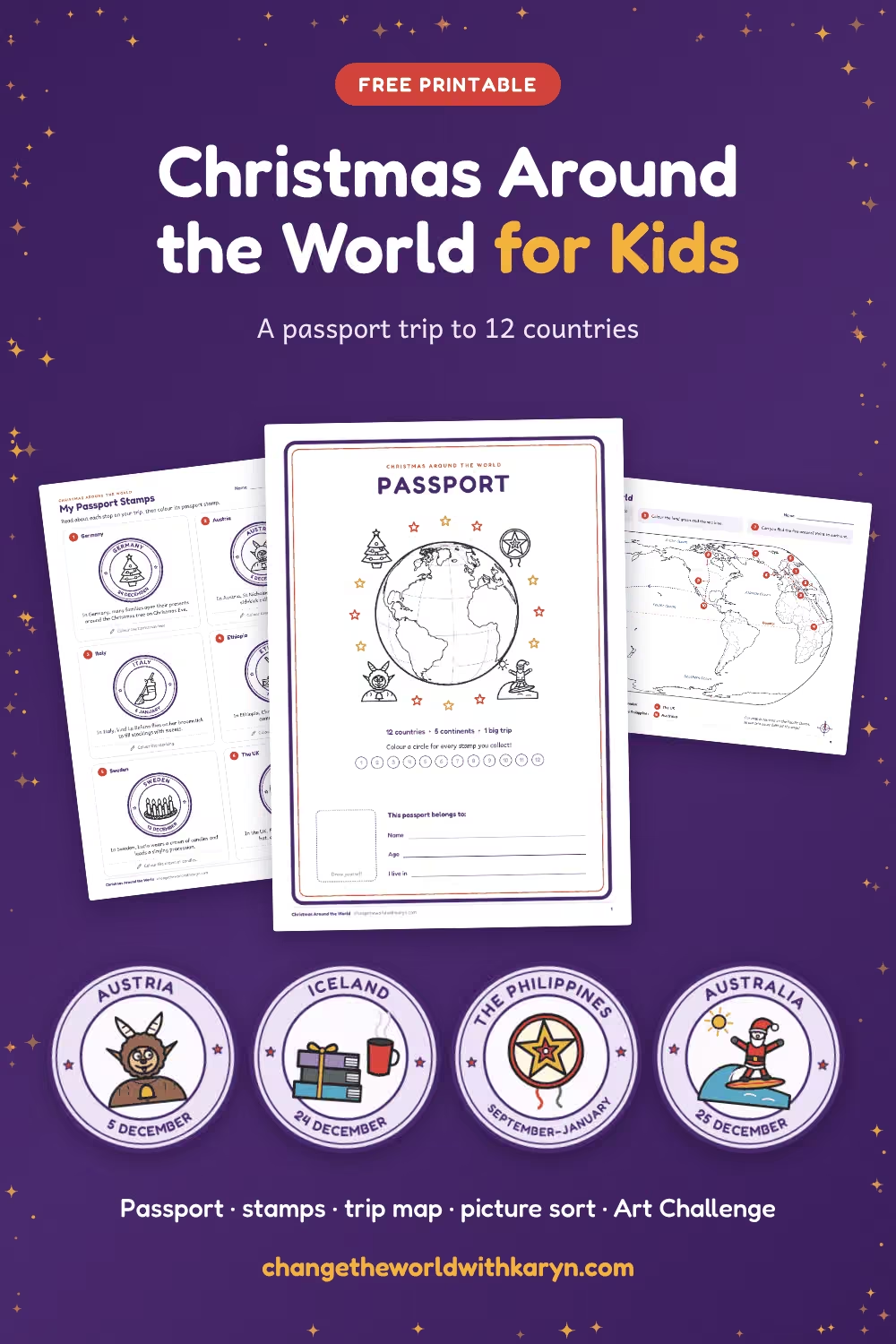
Every good trip needs a passport. Our free printable Christmas Around the World passport lets kids collect a stamp at each stop as you read this guide together. It works just as well in the classroom as it does at the kitchen table. Inside the pack:
- A passport cover for children to name, decorate and make their own.
- Two stamp pages, with a stamp to colour for every country and a one-line fact to read under each.
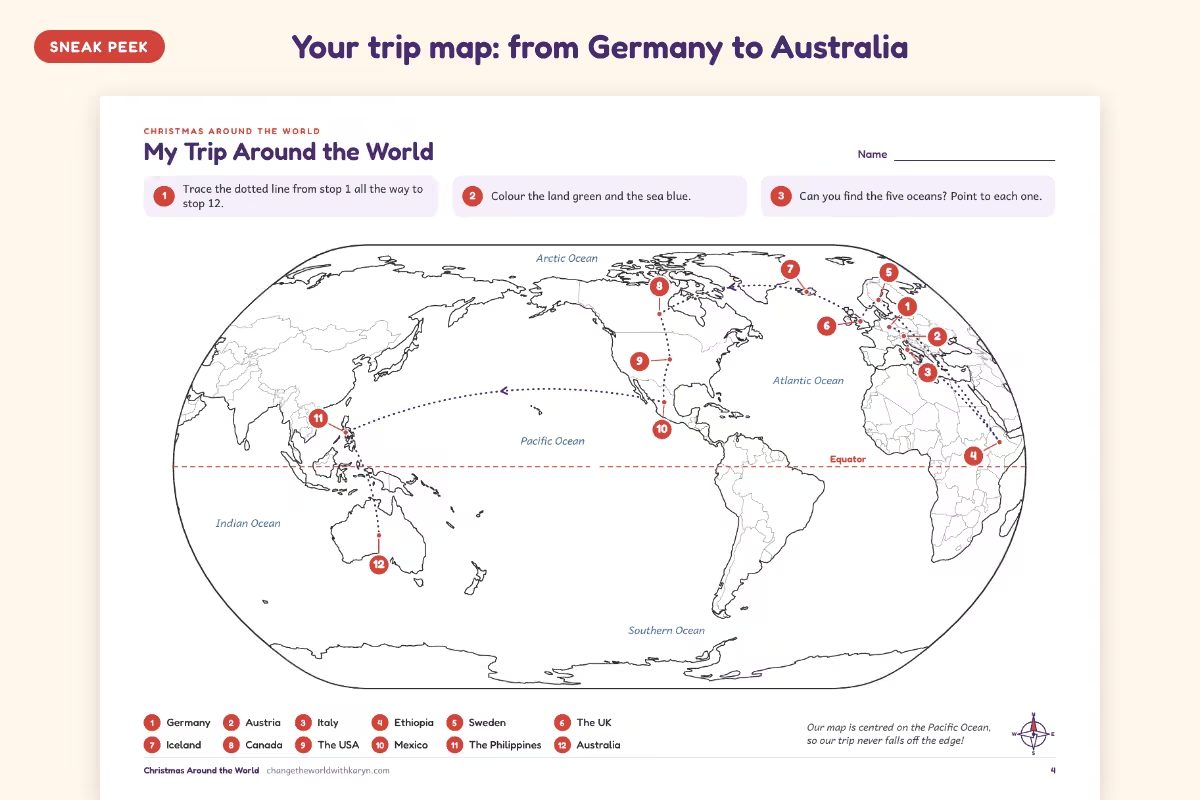
- A trip map to colour, with a dotted line to follow from Germany all the way to Australia.
- A same-and-different sort with picture cards to cut out, so children can spot what the celebrations have in common.
- An Art Challenge: design your own Christmas star lantern, plus a chance to talk about the special days your own family celebrates.
- A short teaching guide with answers, a vocabulary list, lesson ideas and curriculum links for the UK, US, Canada and Australia.
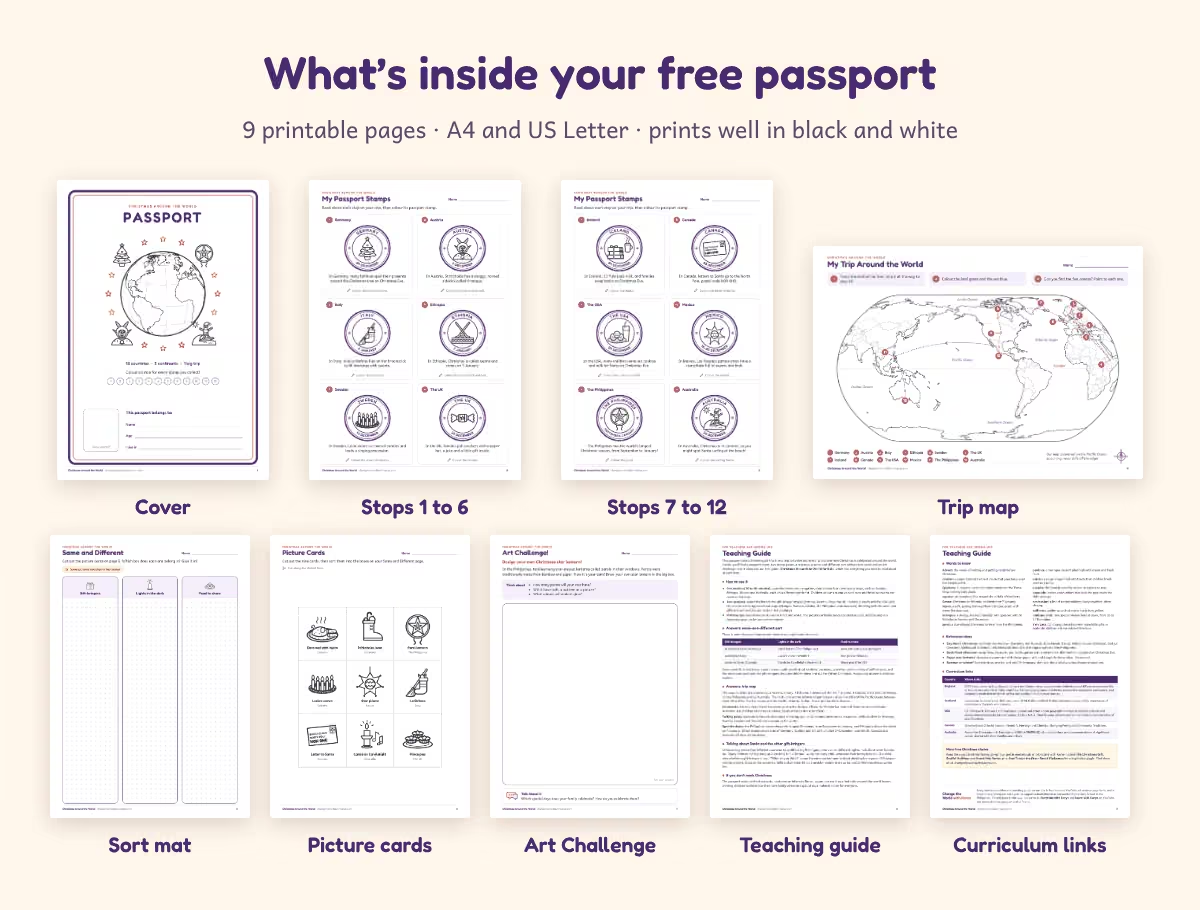
Download the free Christmas Around the World passport: A4 PDF (UK, Ireland, Australia and most other countries, with UK spelling) or US Letter PDF (USA and Canada, with US spelling). It’s nine pages, and everything prints well in black and white.
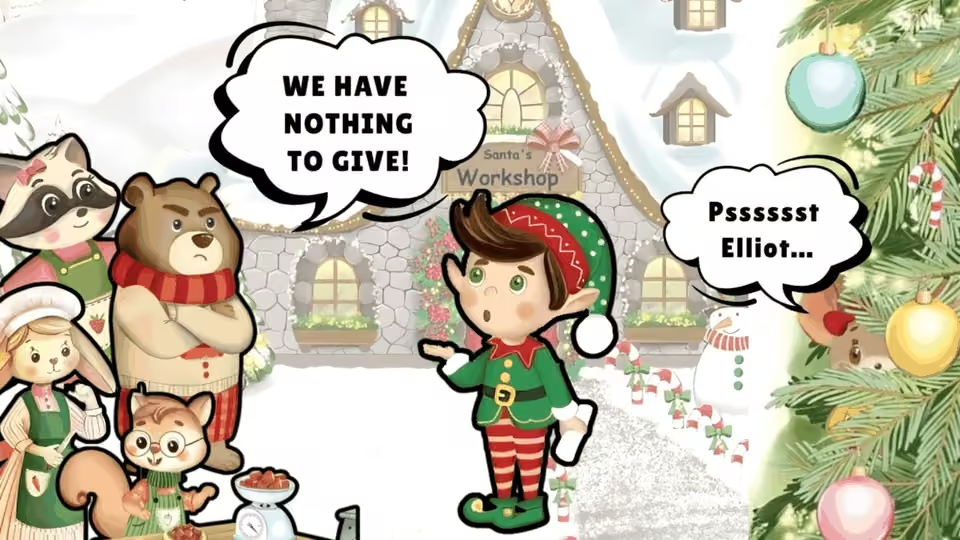
For a cosy Christmas story to go with the trip, watch our gentle read-aloud of The Christmas Gift by Andrea Hyatt. When Santa needs someone to collect a gift from each woodland animal for Ruby, the new baby reindeer, Elliot the elf bravely sets off through the snowy woods, and discovers that the smallest gifts can have the biggest hearts.
Where Did Christmas Begin?
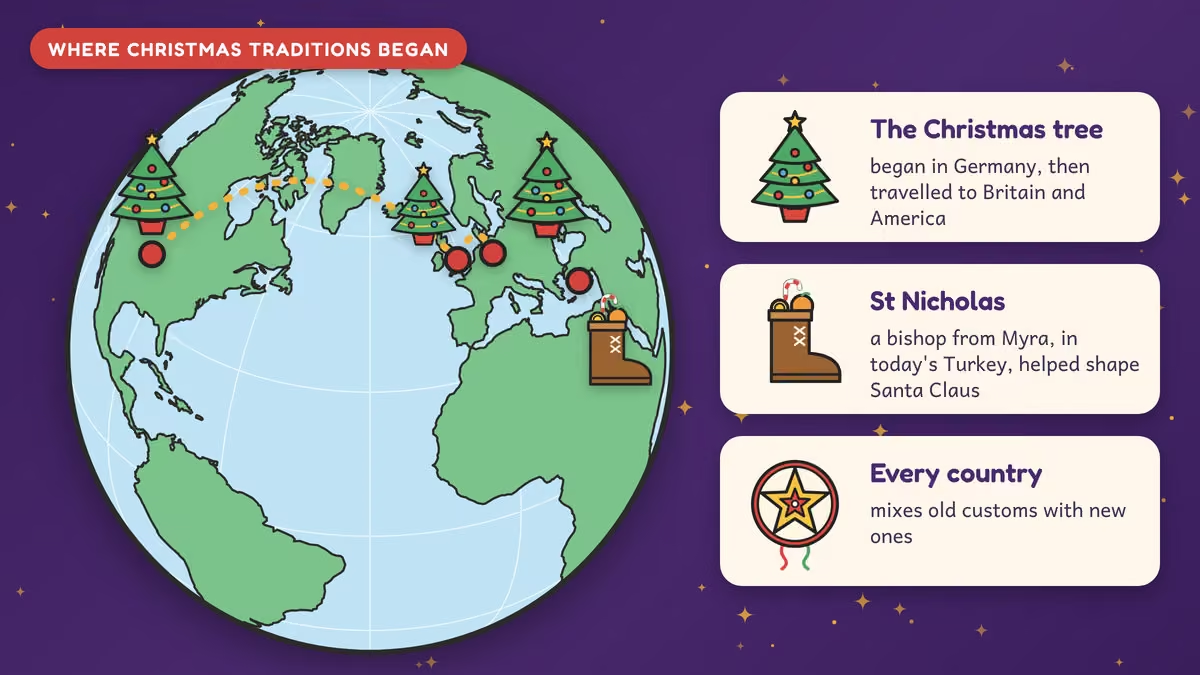
For Christians, Christmas celebrates the birth of Jesus. The oldest record of it being celebrated on 25 December comes from Rome, in the year 336, and the name comes from the Old English Cristes mæsse, meaning Christ’s Mass. Not everyone celebrates on the same day, or in the same way. Many Orthodox churches, including the Ethiopian Orthodox Church, celebrate Christmas on 7 January because they follow a different calendar. Some families celebrate Christmas as a religious festival, some as a time for family and fun, and some celebrate other festivals at this time of year instead, such as Hanukkah or Kwanzaa. Many Christmas traditions have travelled from country to country. The Christmas tree began in Germany and spread to Britain and America, and St Nicholas, known as Sinterklaas in the Netherlands, helped shape Santa Claus. Today, Christmas in different countries mixes old customs with new ones, as our passport trip shows.
The Passport Trip: Christmas Around the World for Kids
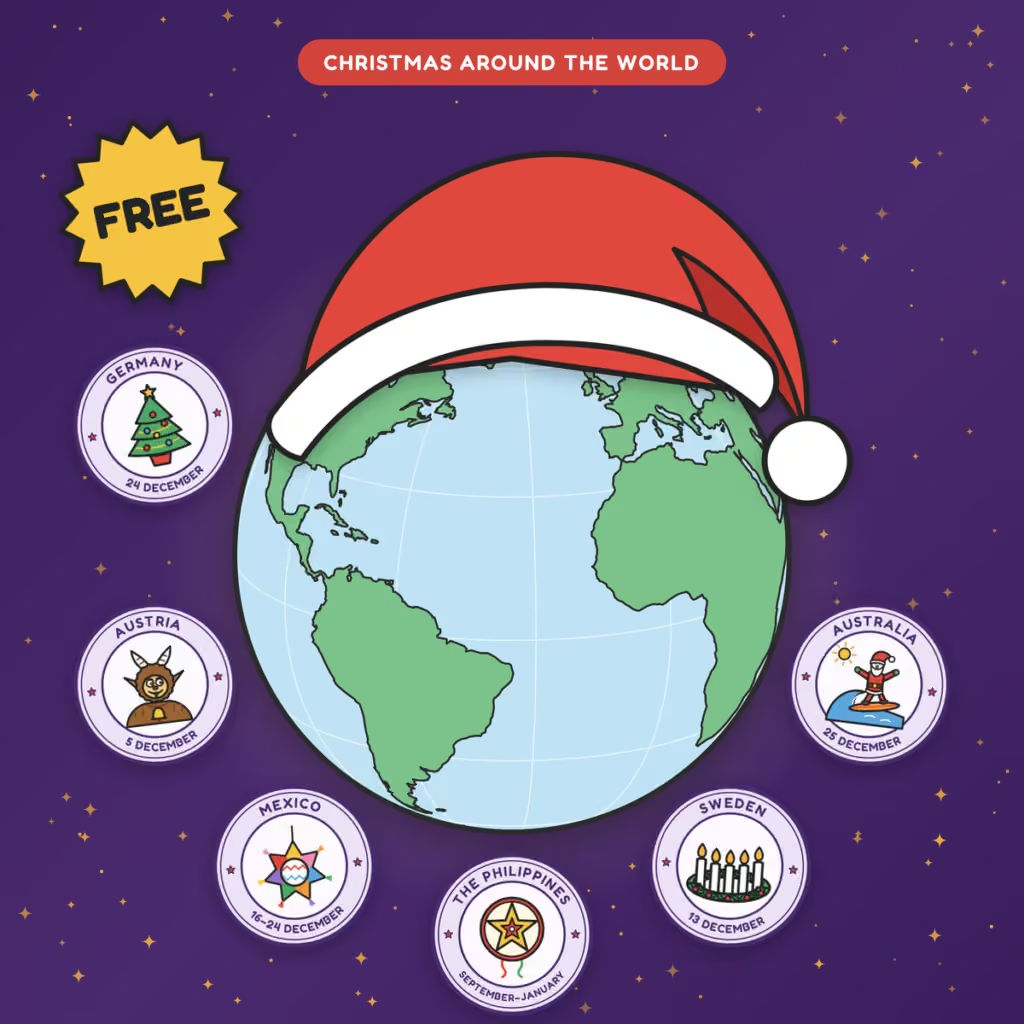
So how is Christmas celebrated around the world? Grab your passport and a pencil, because this trip visits twelve countries on five continents. We start in Germany, head south to Ethiopia, loop back up through Europe to Iceland, cross the Atlantic to Canada, the USA and Mexico, then sail on to the Philippines and Australia.
1. Germany: Advent Calendars, Christmas Trees and St Nicholas Boots
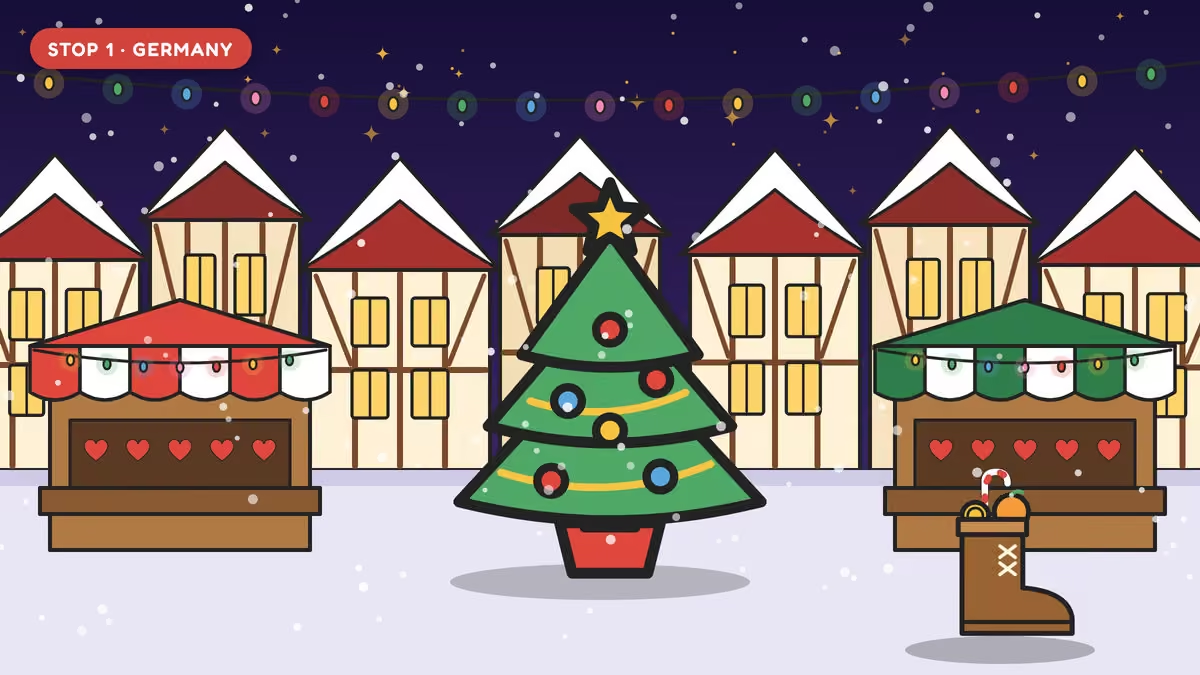
In Germany, the countdown starts early. On the evening of 5 December, children polish a boot and put it outside their door. By the morning of 6 December, St Nicholas Day, it has been filled with treats like nuts, oranges and chocolate. Germany also gave us the Advent calendar. In 1908, Gerhard Lang, a printer in Munich, made what is usually called the first printed Advent calendar, inspired by the countdown his mother made him as a boy, with a little sweet for every day. Christmas markets are an old German tradition too: Dresden’s Striezelmarkt was first held as a one-day market in 1434. On Christmas Eve, many German families open their presents around the Christmas tree. In some regions they are brought by the Christkind, an angel-like figure, and in others by the Weihnachtsmann, the Christmas Man. Did you know? The indoor Christmas tree began in Germany. German-born Prince Albert helped make it popular in Britain, especially after a newspaper printed a picture of the royal family around their tree in 1848. Passport stamp: colour the Christmas tree.
2. Austria: St Nicholas and Krampus
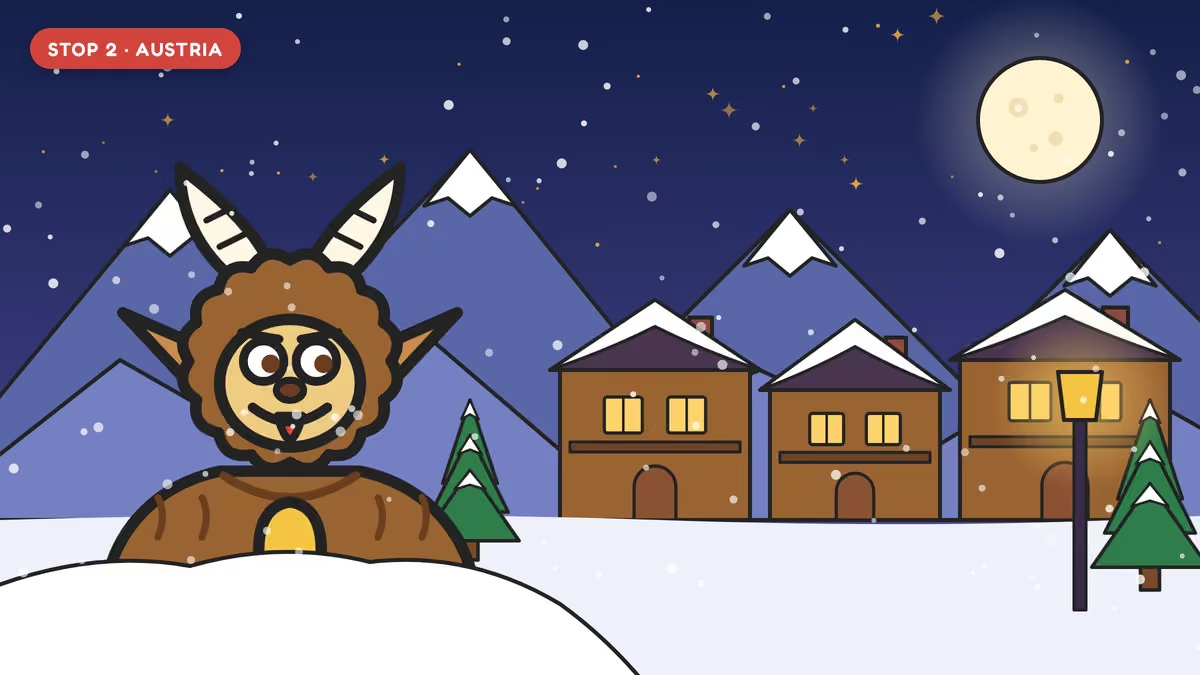
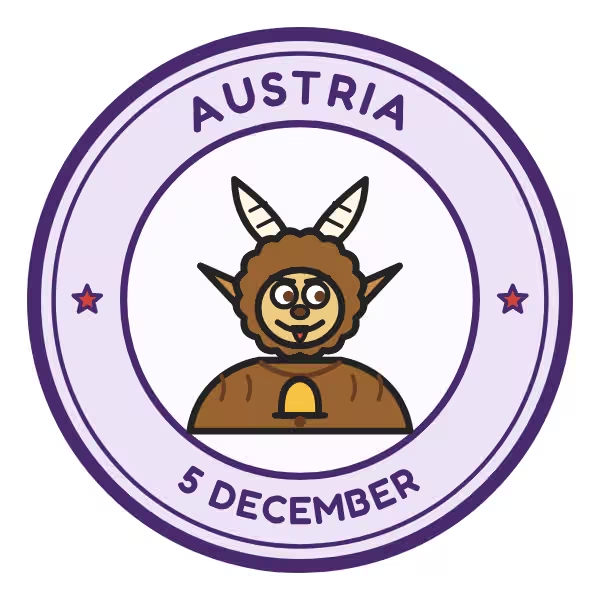
Next door in Austria, St Nicholas has a famous sidekick. On the evening of 5 December, the night before St Nicholas Day, out comes Krampus: a shaggy, horned character covered in fur, with bells that clang as he walks. In towns and villages, people dress up as Krampus in furry costumes and carved wooden masks and march through the streets in noisy parades called Krampus runs. In the Gastein Valley, where the custom is kept in a very traditional way, more than 100 Krampus groups go from house to house on 5 and 6 December. St Nicholas comes along too, and on 6 December he brings sweets and nuts for children who have been good. In the old stories, St Nicholas rewarded children who had been good, while Krampus kept an eye on anyone who had been naughty. Today, he’s mostly part of the winter fun. Did you know? Krampuses wear big, heavy bells, so you can often hear a Krampus run long before you see it! Passport stamp: colour Krampus and his bell.
3. Italy: La Befana, the Kind Christmas Witch
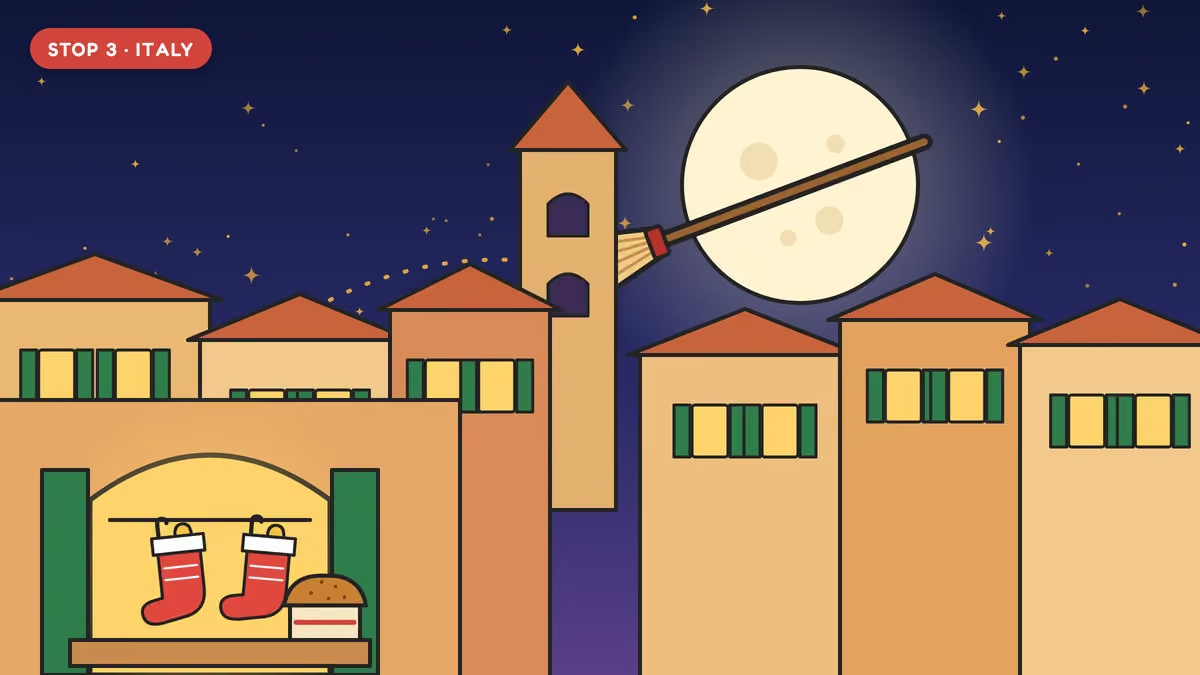
In Italy, Christmas keeps going until 6 January, the Epiphany, twelve days after Christmas Day. On the night of 5 January, children hang up a stocking for La Befana, a kind old woman who flies over Italy on her broomstick and fills it with sweets. The story goes that the Three Kings asked her to come with them to find baby Jesus. She said no, because she was busy, but later she set off to find him, leaving sweets for children along the way. Children who have been a bit cheeky might find coal instead, but these days it’s usually carbone dolce, a black sugar sweet that only looks like coal. Did you know? Families sometimes leave La Befana a treat, like a slice of panettone, a tall, fluffy Christmas bread. Passport stamp: colour the stocking.
4. Ethiopia: Genna on 7 January
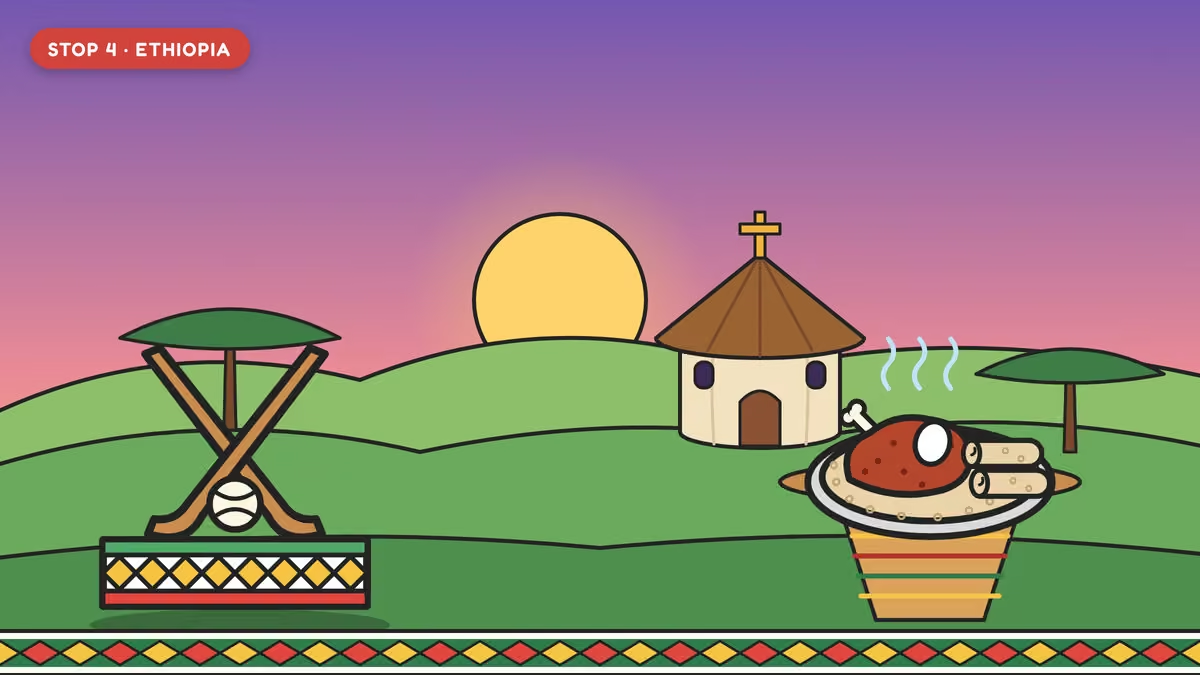
In Ethiopia, Christmas is called Genna and falls on 7 January. Many people fast for weeks beforehand, then go to church services that last through the night, dressed in white, often in a thin cotton shawl called a netela with a bright woven border. Afterwards, families share a feast, often doro wat, a spicy chicken stew eaten with injera, a soft, spongy flatbread. Boys and young men may play a game also called genna, a bit like hockey. Did you know? Ethiopia has its own calendar, with 13 months in a year! Passport stamp: colour the genna stick and ball.

5. Sweden: St Lucia’s Crown of Candles
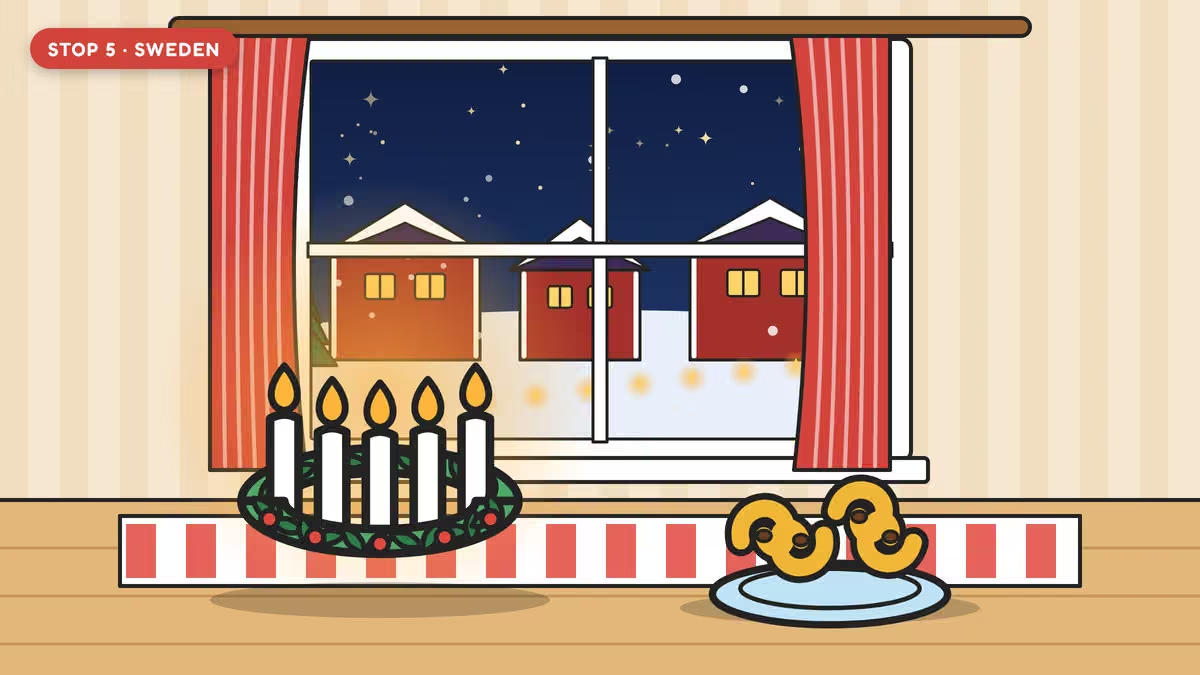
In Sweden, 13 December is Lucia Day, a festival of light in the darkest time of the year. Children in long white gowns walk in a procession and sing, led by Lucia, who wears a crown of candles in her hair. These days, the candles are usually electric. Lucia often carries a tray of saffron buns called lussekatter, shaped like curled-up cats with raisins for eyes, plus gingerbread biscuits. Schools, churches and care homes all hold Lucia celebrations. Did you know? Under the old calendar Sweden used until the 1700s, 13 December was the shortest day of the year, so a festival of light made perfect sense. Passport stamp: colour the crown of candles.
6. The UK: Crackers, Mince Pies and Letters to Father Christmas
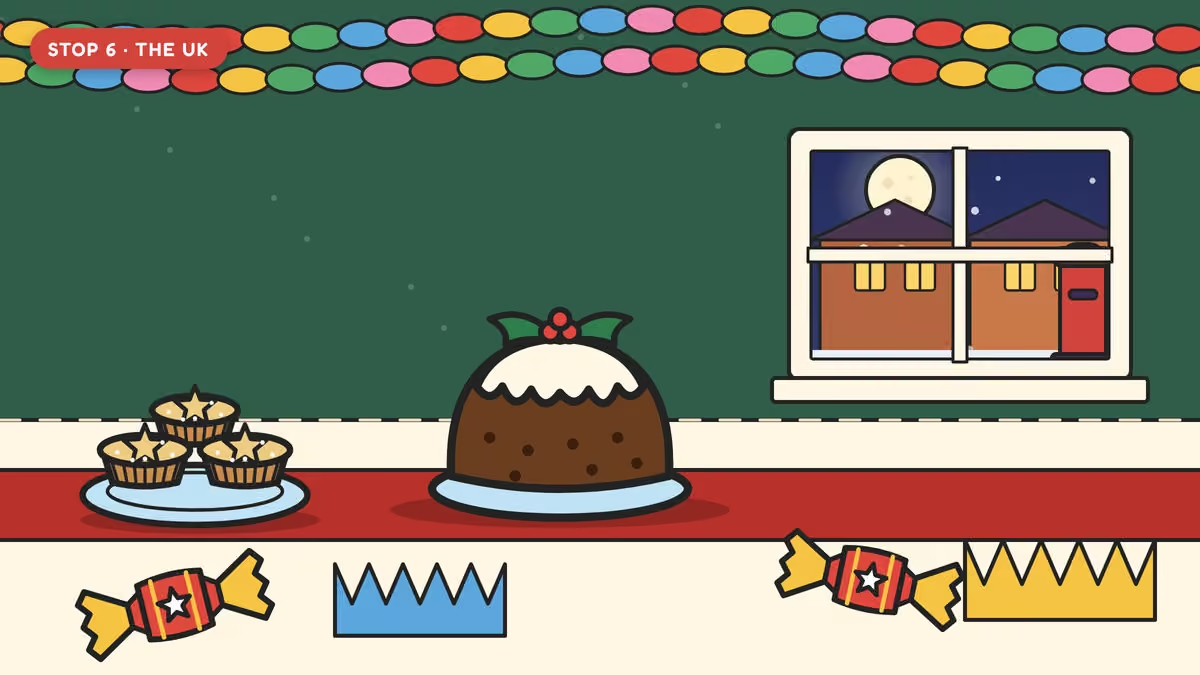
In the UK, Santa is often called Father Christmas. On Christmas Eve, many children leave out a mince pie for him and a carrot for his reindeer, and hang up a stocking before bed. On Christmas Day, families pull Christmas crackers: paper tubes that go bang when two people tug the ends. Inside there’s a paper hat, a joke and a little gift. A London sweet-maker called Tom Smith is usually credited with inventing them in 1847, after he saw sugared almonds wrapped in twists of paper in Paris. Children in the UK can write to Father Christmas too. Royal Mail asks for letters to Santa/Father Christmas, Santa’s Grotto, Reindeerland, XM4 5HQ to be posted with a stamp by Wednesday 9 December 2026, and replies can come in Welsh, Braille, large print or British Sign Language as well as English. Did you know? The first Christmas card was made in London in 1843. Henry Cole was too busy to write Christmas letters to all his friends, so he asked an artist to design a card he could send instead. Passport stamp: colour the cracker.
Flip, giggle, write! Love a cracker joke? Our Christmas flipbook notebooks are packed with Christmas jokes and fun facts, and a Santa flipbook animation in the corner of each page springs to life when you flick through. Each one has 140 pages with red and green lines, so there’s room for wish lists, letters to Father Christmas and stories. They come in four festive covers, so pick your favourite, or go straight to Santa’s Band on Amazon UK or Amazon US.
7. Iceland: 13 Yule Lads and a Christmas Book Flood
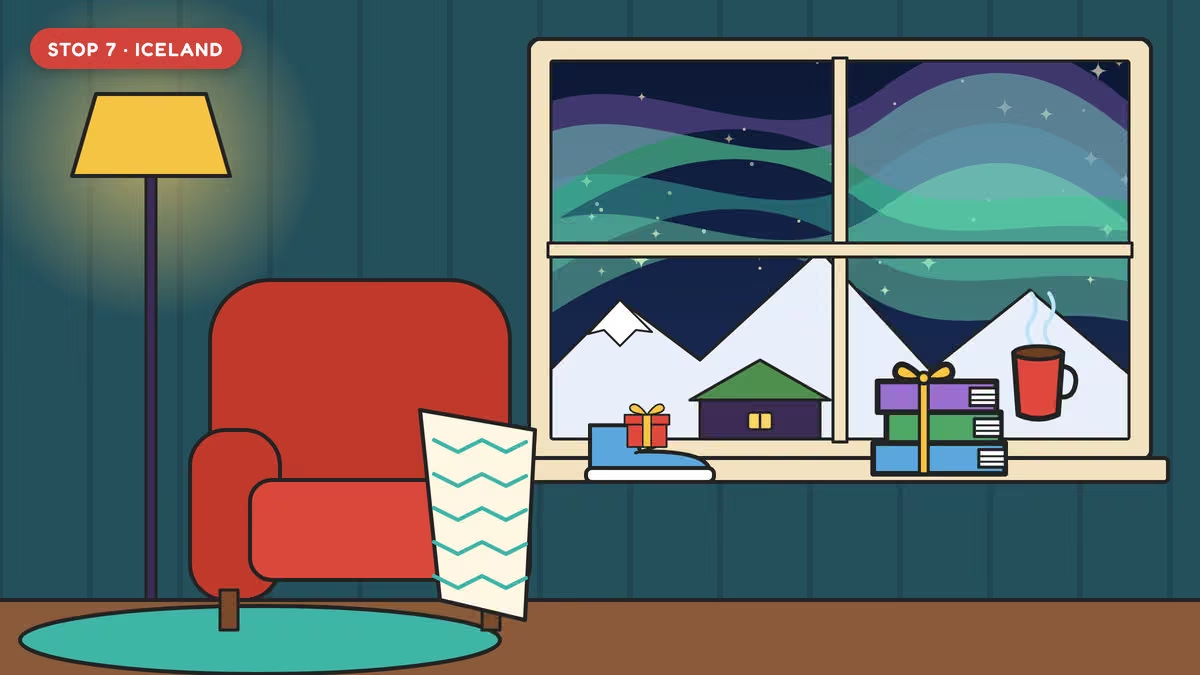
In Iceland, children don’t wait for one Santa, but thirteen. From 12 December, the 13 Yule Lads come down from the mountains, one each night, and leave a small gift in a shoe that children put on their windowsill. On Christmas Eve, many Icelanders give each other books and spend the evening reading. It’s called Jólabókaflóð, the Christmas Book Flood, and every November a catalogue of the year’s new books, Bókatíðindi, arrives at homes across the country. Why not have a Book Flood of your own? Snuggle up with a warm drink and a pile of books, or pick a story from our free online kids book club. Did you know? The Yule Lads have funny names, like Spoon Licker, Door Slammer and Sausage Swiper. Passport stamp: colour the books.
Join our free online kids book club! Looking for stories for your Book Flood? On Story Time with Karyn, calm, animated read-alongs bring picture books by independent authors to life, always with the author’s permission. Every story in our free online kids book club comes with a free worksheet for reading, feelings and art, and you can browse the stories by theme, from bedtime to friendship. Like all our free educational resources, it needs no sign-up. So press play on Story Time with Karyn and turn screen time into reading time.
8. Canada: Letters to Santa at the North Pole
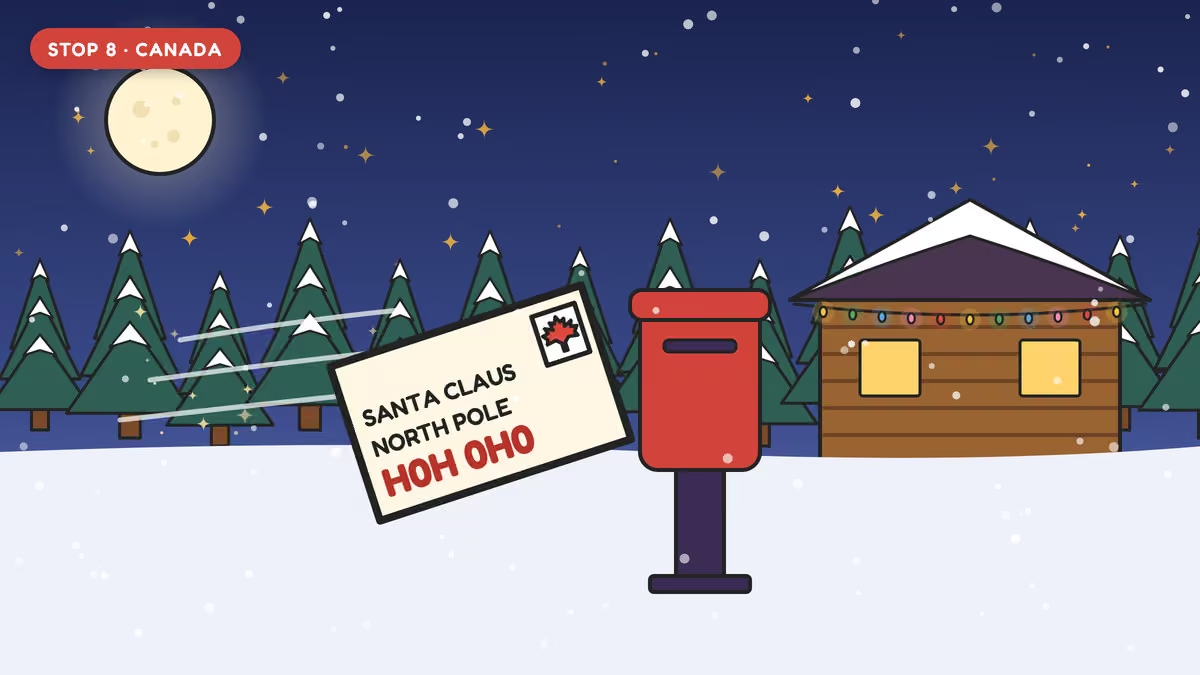
In Canada, children hang up stockings and wait for Santa on Christmas Eve, and Canada has its own Santa magic too. Santa’s postal code is H0H 0H0, and Canada Post says letters to Santa Claus, North Pole, H0H 0H0, Canada need no stamp within Canada. Its volunteer postal elves have helped Santa answer over a million letters a year for more than 40 years, and this year’s posting date is 9 December 2026. Writing a wish list? Our Learn with Karyn episode Needs and Wants for Kids is a gentle way to start the conversation. Karyn gets her first-ever job and wants to spend all her money, and children play along, pointing up for a need and down for a want. Then try the free needs and wants worksheets that go with it. Did you know? Read Santa’s Canadian postal code out loud, with the zeros as Os, and you get H-O-H, O-H-O! Passport stamp: colour the letter to Santa.
9. The USA: Cookies, Milk and a Santa Tracker
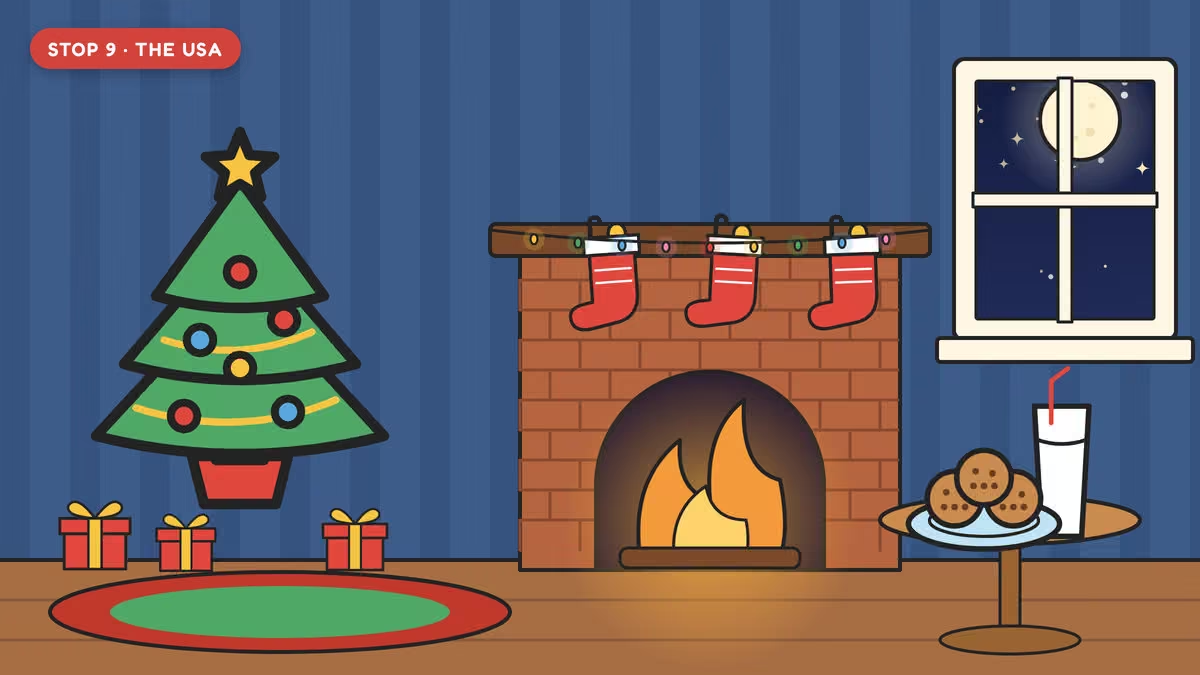
In the USA, children hang up stockings, and many leave out cookies and milk for Santa on Christmas Eve. Then the tracking begins. In 1955, a newspaper advert printed a phone number for children to call Santa, but the number had a mistake in it. The calls went to a military command centre in Colorado, where Colonel Harry Shoup and his team played along and told children where Santa was. That mix-up grew into NORAD Tracks Santa, which still follows Santa’s journey every Christmas Eve. Many families celebrate more than one festival in December. In our read-aloud of Soulful Holidays by Ciara L. Hill, a family celebrates both Christmas and Kwanzaa, which runs from 26 December to 1 January, with soul food, carols by the tree and the candles of the kinara. Did you know? On Christmas Eve, more than 1,000 volunteers answer phone calls at NORAD from children asking where Santa is. Passport stamp: colour the cookies and milk.
10. Mexico: Las Posadas and the Star Piñata
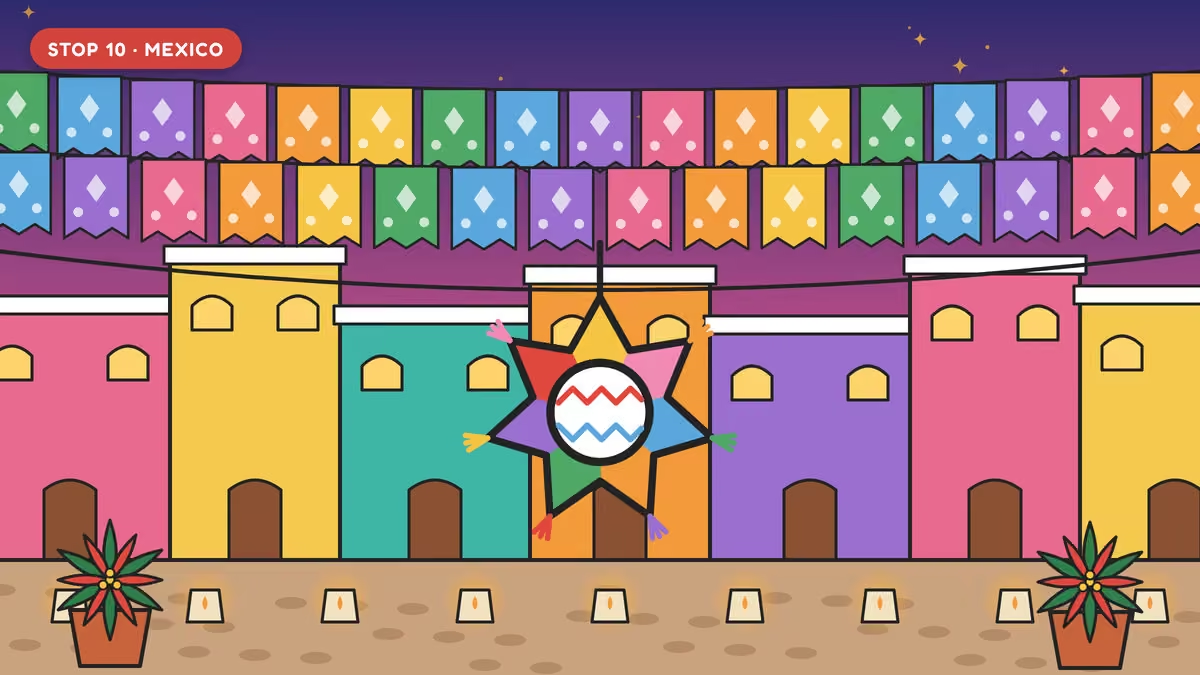
In Mexico, Christmas begins with Las Posadas, nine nights of celebration from 16 to 24 December. Posada means inn, or a place to stay. Each night, families and neighbours act out Mary and Joseph’s search for somewhere to stay before Jesus was born, walking from house to house with candles and singing to ask for shelter. The people inside sing back, until at last the guests are welcomed in. Then the party begins, with tamales, warm fruit punch called ponche and a piñata, traditionally shaped like a star with seven points. Children take turns, blindfolded, to break it open and share the sweets and fruit that tumble out. Did you know? The poinsettia, the bright red Christmas plant, comes from Mexico, where it is called flor de Nochebuena, the Christmas Eve flower. The Aztecs called it cuetlaxochitl. Passport stamp: colour the piñata.
11. The Philippines: Parol Lanterns and Simbang Gabi
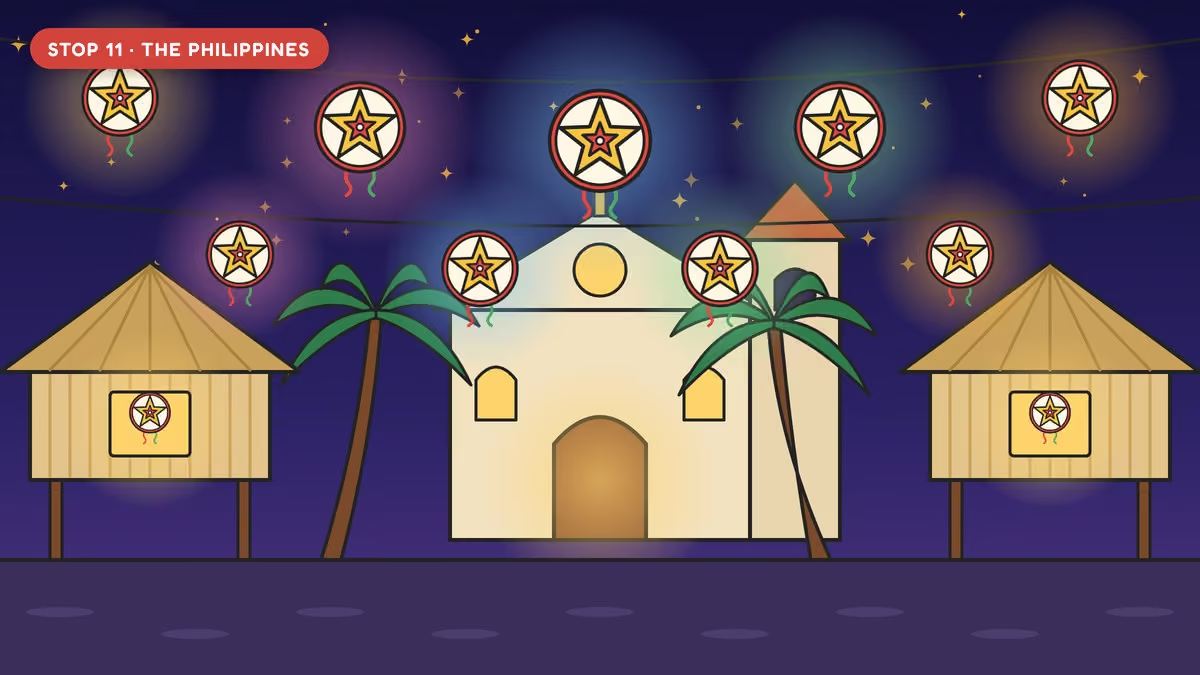
The Philippines is famous for having the longest Christmas season in the world. As soon as the “ber” months begin in September, Christmas songs start playing, and the celebrations carry on into January. The best-loved decoration is the parol, a star-shaped lantern that glows in windows and along streets. Parols were traditionally made from bamboo and paper, and the name comes from farol, the Spanish word for lantern. In San Fernando, Pampanga, the Giant Lantern Festival shows off enormous parols, some around 6 metres (20 feet) tall. From 16 to 24 December, many families go to Simbang Gabi, nine special Masses held at dawn. Afterwards, stalls outside the churches sell rice cakes called bibingka and puto bumbong, with hot chocolate for breakfast. On Christmas Eve, families gather for a big feast called Noche Buena. Did you know? Simbang Gabi and Mexico’s Las Posadas both run from 16 to 24 December. For 250 years, from 1565 to 1815, Spanish ships called the Manila galleons sailed across the Pacific between the Philippines and Mexico, and in both countries the nine days began as special Christmas Masses called misas de aguinaldo. Passport stamp: colour the parol.
12. Australia: Surfing Santas and Christmas in Summer
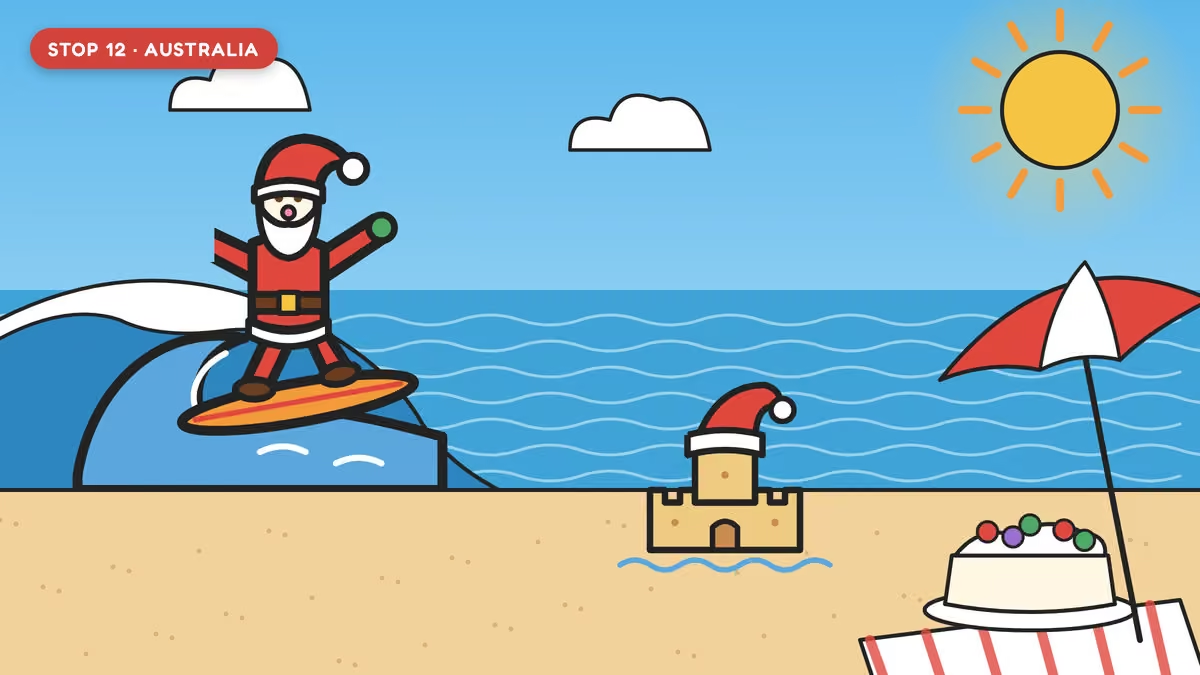
In Australia, Christmas falls in the middle of summer, so Christmas Day often means sunshine, a swim at the beach or a barbecue with the family. Lots of families finish their Christmas meal with pavlova, a meringue dessert piled high with cream and fresh fruit. Keep an eye on the waves, too, because you might spot Santa on a surfboard! Surfers in Santa suits are a favourite Christmas sight at Sydney’s Bondi Beach, and on 15 December 2015, 320 surfing Santas paddled out there together and set a Guinness World Record for the biggest surfing lesson ever. On Christmas Eve, crowds gather in Melbourne for Carols by Candlelight, singing carols in the warm evening air. Radio announcer Norman Banks started it in 1938, and today it raises money for Vision Australia’s services for children who are blind or have low vision. Did you know? The seasons are flipped on the other side of the world, so while children in Sweden celebrate Lucia in the dark, children in Australia are enjoying the longest days of the year. Shiny Christmas beetles come out around Christmas time too, buzzing around the lights. Passport stamp: colour the surfing Santa.
What Do These Celebrations Share?
Look closely at these Christmas traditions around the world and the same three ideas keep popping up. Spotting them helps children see similarities and differences, which is exactly what the same-and-different sort in the passport pack asks them to do.
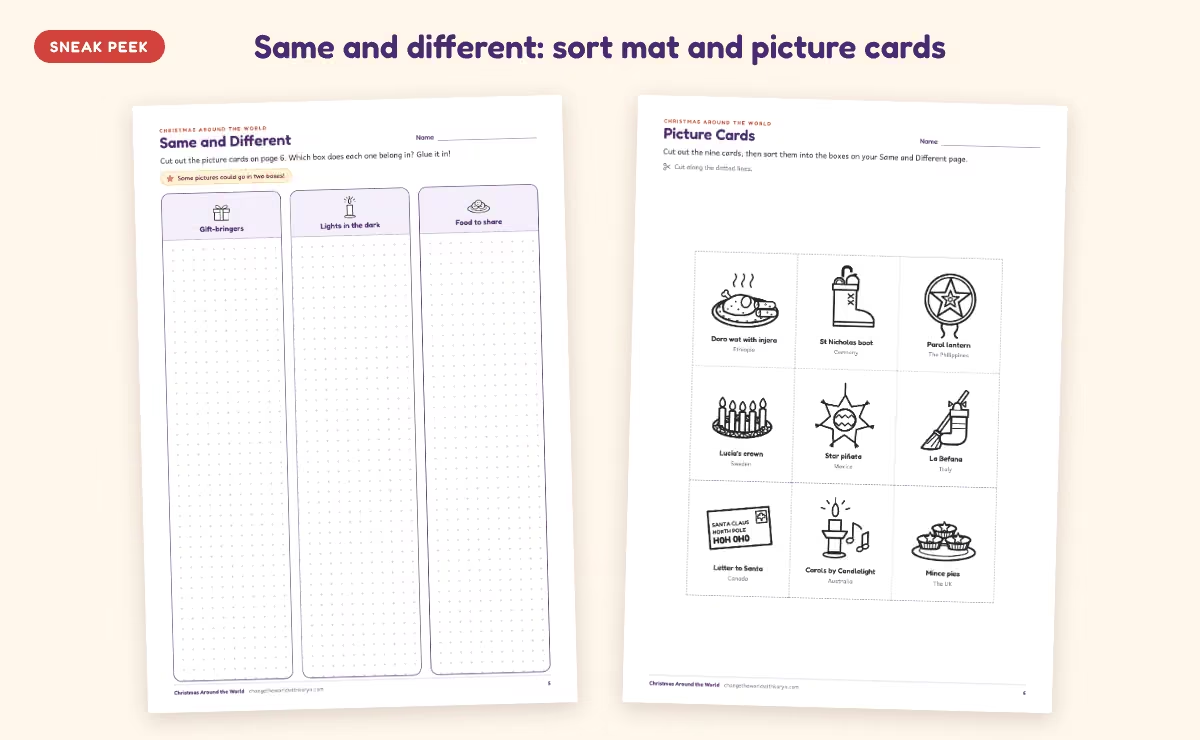
- Gift-bringers. St Nicholas filling boots in Germany and visiting with Krampus in Austria, La Befana’s stockings in Italy, the 13 Yule Lads in Iceland, Father Christmas in the UK and Santa in Canada and the USA. They visit on different nights, from 5 December all the way to 5 January.
- Lights in the dark. Lucia’s crown of candles in Sweden, the parol lanterns of the Philippines, the candles at Carols by Candlelight and the twinkling lights on Christmas trees everywhere.
- Food to share. Saffron buns in Sweden, doro wat with injera in Ethiopia, mince pies in the UK, cookies and milk for Santa in the USA, a piñata full of sweets and fruit in Mexico, rice cakes after Simbang Gabi in the Philippines and pavlova in Australia.
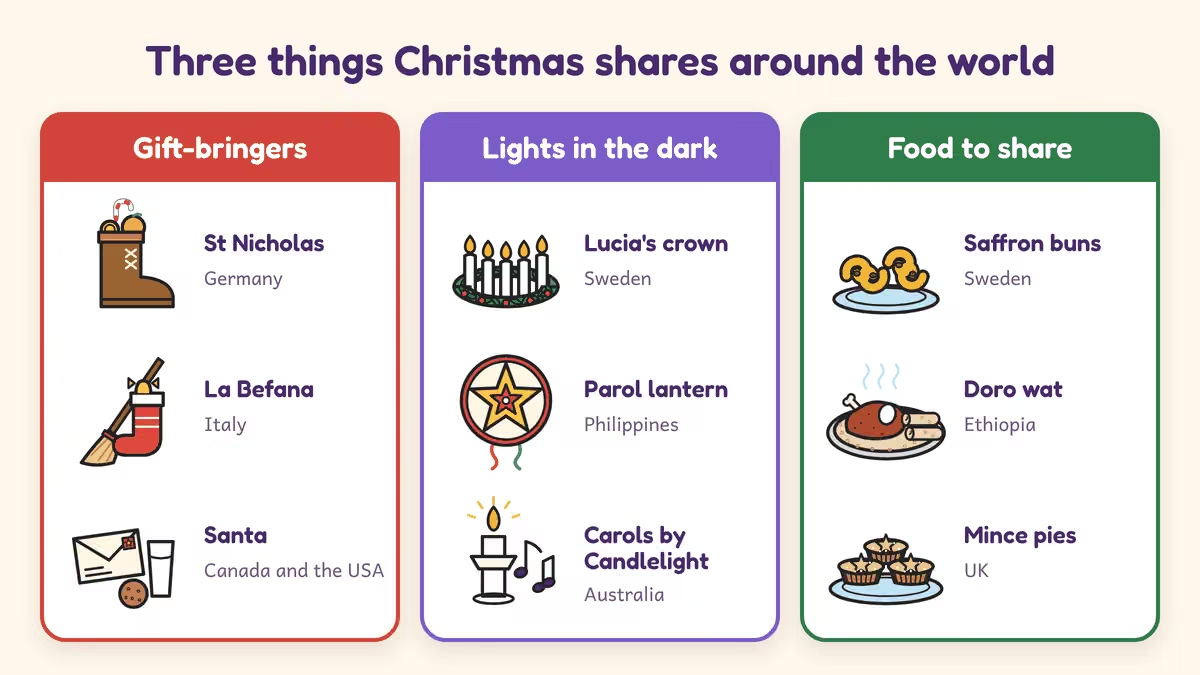
Ask children which of these ideas they can spot in their own family’s special days, whatever they celebrate.
Meet Bobbie the robot dog! On our sister channel, Learn with Karyn, Bobbie and I turn curriculum topics into interactive videos where children point, move and join in. Planning a class Christmas party? In What Do My Friends Eat?, I’m planning a party too, and Bobbie helps me learn what words like vegetarian, vegan and gluten-free mean, and how to keep friends with a nut allergy safe. When December gets busy, Box Breathing and Positive Affirmations helps children calm down by tracing a square in the air and saying kind words like “I can do hard things.” Both lessons come with free printables. If you enjoy them, subscribe to Learn with Karyn for more educational videos for kids.
Talking With Little Ones About Santa and the Other Gift-Bringers
A trip like this can bring up big questions. If Santa comes to our house, why does La Befana go to Italy? Why do some children get their presents on a different day? A few simple habits keep the magic for the children who have it, and include everyone else.
- Talk about what families do. “Many children in Italy hang up a stocking for La Befana” works for every child, whatever their family believes. Let each family lead on Santa.
- Turn big questions back gently. If a child asks whether a gift-bringer is real, “What do you think?” keeps the conversation open without deciding for anyone.
- Keep Krampus friendly. If Krampus sounds a bit much for some children, focus on the costumes, bells and parades. He’s a character people dress up as, and St Nicholas always comes too.
- Remember that some families don’t celebrate Christmas. Invite children to share any special day their family celebrates, and make sure no child feels left out because Santa doesn’t visit their home.
- Swap “What did you get?” for “What was your favourite moment?” Presents vary a lot between families. Child Poverty Action Group found that some children can’t join in with school dress-up days because of the cost, which can leave them feeling embarrassed and left out. A favourite moment is something every child can share.
The passport is designed with this in mind: it needs no costumes, presents or letters to Santa, just a pencil and some colours.
Teaching Christmas Around the World
With the passport, Christmas around the world for kids is easy to fit into a busy December, in the classroom or at home.
- One session (30 to 45 minutes): read the introduction together, then choose four contrasting stops, such as Sweden, Ethiopia, Mexico and Australia, each on a different continent. Children colour a stamp at each stop and finish by tracing the route on the map.
- Two sessions: spend the first on the gift-bringer stops (Germany, Austria, Italy, the UK, Iceland, Canada and the USA) and the second on the light and food stops (Ethiopia, Sweden, Mexico, the Philippines and Australia), finishing with the same-and-different sort and the star lantern Art Challenge.
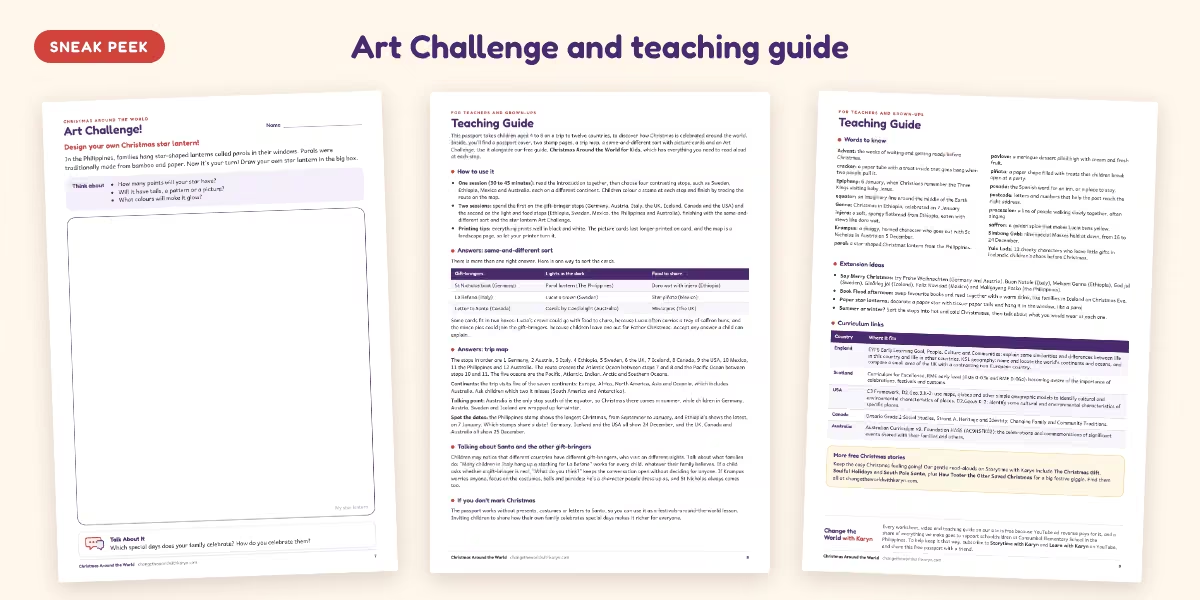
The topic fits the curriculum in all four countries. In England, it supports the Early Learning Goal for People, Culture and Communities, which asks children to explain similarities and differences between life in this country and life in other countries, and the KS1 geography focus on the world’s continents and oceans and a contrasting non-European country. In Scotland, it links to the early level RME outcomes on the importance of celebrations, festivals and customs (RME 0-03a and RME 0-06a). In the US, it supports the C3 Framework standards D2.Geo.3.K-2 and D2.Geo.6.K-2 on maps and the cultural characteristics of places. In Ontario, it fits the Grade 2 Heritage and Identity strand on changing family and community traditions, and in Australia it matches the Foundation HASS content description on celebrations and commemorations shared with families and others (AC9HSFK02). A note for schools and families who don’t mark Christmas: the passport works without presents, costumes or letters to Santa, so you can use it as a festivals-around-the-world lesson. Inviting children to share how their own family celebrates special days makes it richer for everyone.
Help Keep These Resources Free
Here’s the honest part. Every worksheet, video and teaching guide on this site is free because YouTube ad revenue pays for it, and a share of everything we make goes to support schoolchildren at Cansumbol Elementary School in the Philippines. So when you watch, it genuinely helps. If this trip around the world has been useful, the kindest thing you can do is subscribe to Story Time with Karyn and Learn with Karyn on YouTube, and share this page with one teacher or parent who would enjoy it. Thank you. 💛
Find Out More: Free Resources We Love
- NORAD Tracks Santa opens on 1 December with a countdown, games and music, then follows Santa’s journey live on Christmas Eve.
- Royal Mail’s Letters to Santa page has Santa’s UK address and this year’s posting date, plus a separate page for schools sending a whole class’s letters.
- Canada Post’s Write a letter to Santa page has free letter templates for younger and older children, plus Santa’s address and this year’s posting date.
- Visit Iceland’s guide to the Christmas Book Flood tells the story of Jólabókaflóð and the book catalogue that has gone out every year since 1944.
Frequently Asked Questions
Where did Christmas start?
For Christians, Christmas celebrates the birth of Jesus, and the oldest record of it being celebrated on 25 December comes from Rome in the year 336. Over the centuries it picked up traditions from many countries, like the German Christmas tree and the British cracker.
Who was St Nicholas?
St Nicholas was a bishop in Myra, in what is now Turkey, in the fourth century. Stories about his secret gifts to people in need made him famous, and his story helped shape Santa Claus. Children in Germany and many other countries still celebrate St Nicholas Day on 6 December.
Who is Krampus?
Krampus is a shaggy, horned character from Austria and the Alps who goes out with St Nicholas on 5 December, the night before St Nicholas Day. In the old stories, St Nicholas rewarded good children and Krampus kept an eye on naughty ones. Today, people dress up as Krampus in furry costumes, masks and bells for noisy winter parades called Krampus runs.
What are the Yule Lads?
The Yule Lads are 13 cheeky characters from Icelandic folk tales. From 12 December, one comes down from the mountains each night until Christmas Eve and leaves a small gift in the shoe children put on their windowsill. Children who have been naughty might find a potato instead! Each Yule Lad has a name that gives away his favourite mischief, like Spoon Licker, Door Slammer and Sausage Swiper.
Does everyone celebrate Christmas on 25 December?
No. In Germany, many families open their presents on Christmas Eve, 24 December. In Italy, La Befana brings treats on the night of 5 January, and in Ethiopia, Christmas, called Genna, is on 7 January. Some families don’t celebrate Christmas at all and have their own special days instead.
How is Christmas celebrated in Australia?
Christmas falls in summer in Australia, so many families head to the beach, have a barbecue and finish with pavlova. You might even see Santa surfing at Bondi Beach! On Christmas Eve, crowds in Melbourne gather for Carols by Candlelight, a tradition that began in 1938.
What is a parol?
A parol is a star-shaped Christmas lantern from the Philippines. Traditionally made from bamboo and paper, parols hang in windows and along streets, and the city of San Fernando in Pampanga holds a Giant Lantern Festival every December.
How do you say Merry Christmas around the world?
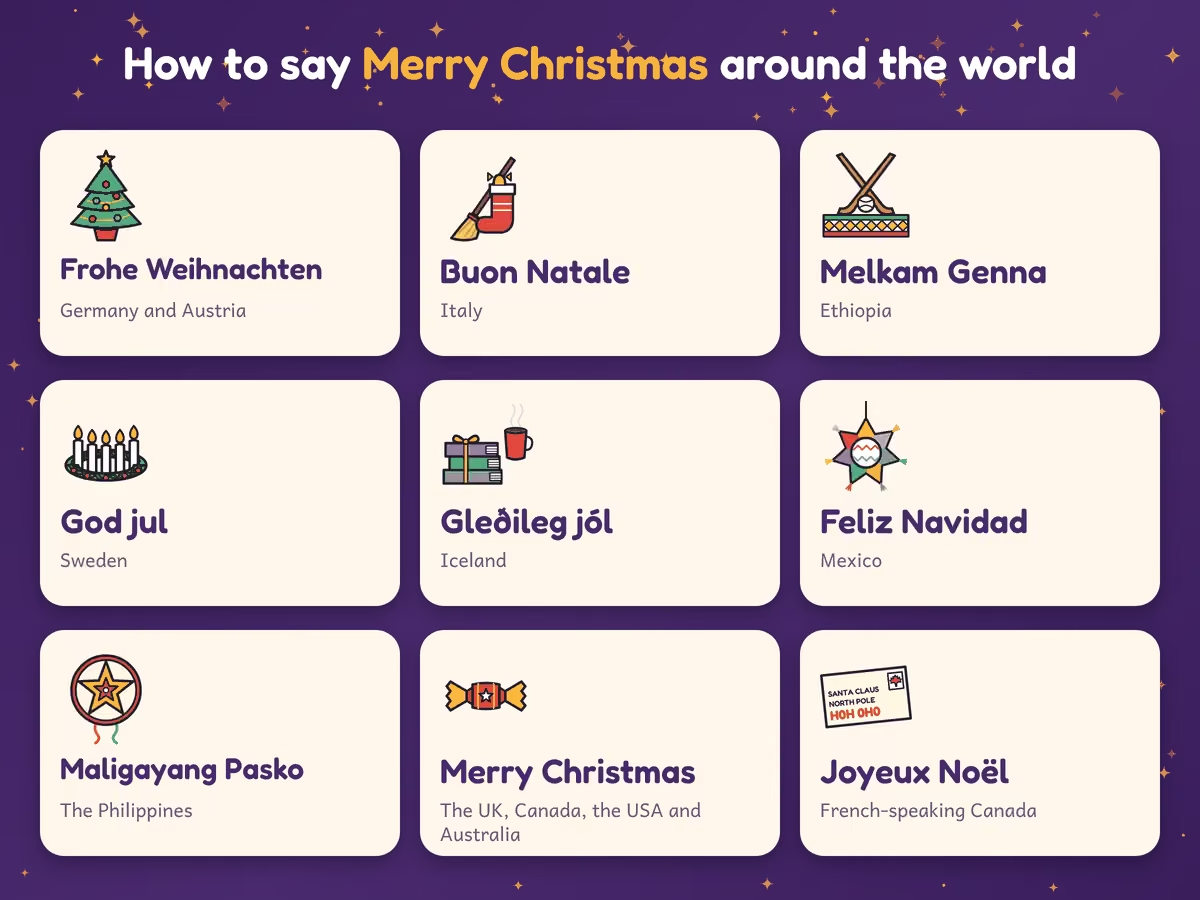
Here’s how to say it at each stop on our trip: Frohe Weihnachten in Germany and Austria, Buon Natale in Italy, Melkam Genna in Ethiopia, God jul in Sweden, Gleðileg jól in Iceland, Feliz Navidad in Mexico and Maligayang Pasko in the Philippines. In the UK, Canada, the USA and Australia, it’s Merry Christmas, and in French-speaking parts of Canada, it’s Joyeux Noël.
How can I teach Christmas around the world in Reception or kindergarten?
Keep it hands-on and short. Choose three or four contrasting stops, read a little about each and let children colour a passport stamp as they go. Finish by finding the countries on a map and talking about what is the same and what is different. That links directly to the EYFS Early Learning Goal for People, Culture and Communities in England and to the C3 Framework in the US. Our free passport pack has everything you need.
You Might Also Enjoy
Free Christmas Stories and Quizzes
Finished your trip around the world? Keep the cosy Christmas feeling going with our gentle read-alouds on Story Time with Karyn: The Christmas Gift, Soulful Holidays and South Pole Santa, plus How Tooter the Otter Saved Christmas for a big festive giggle. Tooter’s book has even travelled the world itself: it’s available in Spanish, French, German, Italian and Portuguese. Then test what your little travellers remember with our Christmas Around the World Quiz for ages 6 to 9, or our Christmas Quiz for ages 4 to 7, which has picture answers, so no reading is needed. And if they loved collecting stamps, our Halloween Around the World passport takes them on another passport trip, this time to nine countries.
Our Christmas Flipbook Notebooks
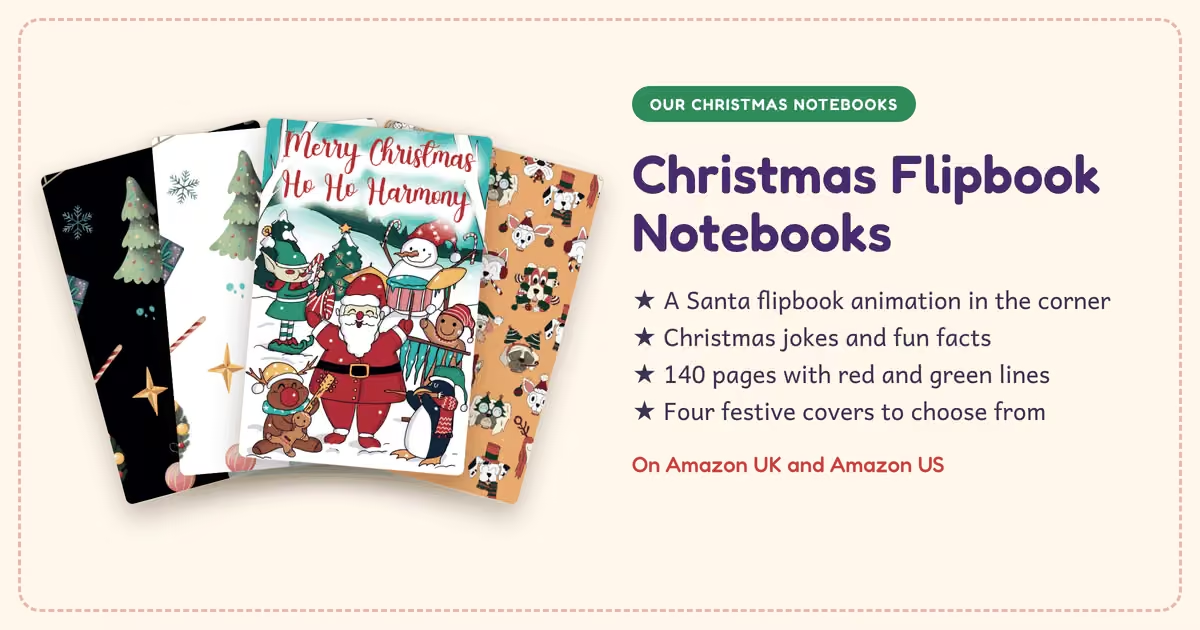
Every good traveller needs a notebook! Our Christmas notebooks are packed with Christmas jokes and fun facts, and a Santa flipbook animation in the corner of each page springs to life when you flick through. Each one has 140 pages with red and green lines, so there’s plenty of room for wish lists, stories and notes from your trip around the world. They make a lovely stocking filler, or a sweet-free treat for class parties. Pick your favourite of our four festive covers:
- On Amazon UK: Santa’s Band, White Festive Pattern, Black Festive Pattern or Christmas Dogs
- On Amazon US: Santa’s Band, White Festive Pattern, Black Festive Pattern or Christmas Dogs
Join the Free Online Kids Book Club
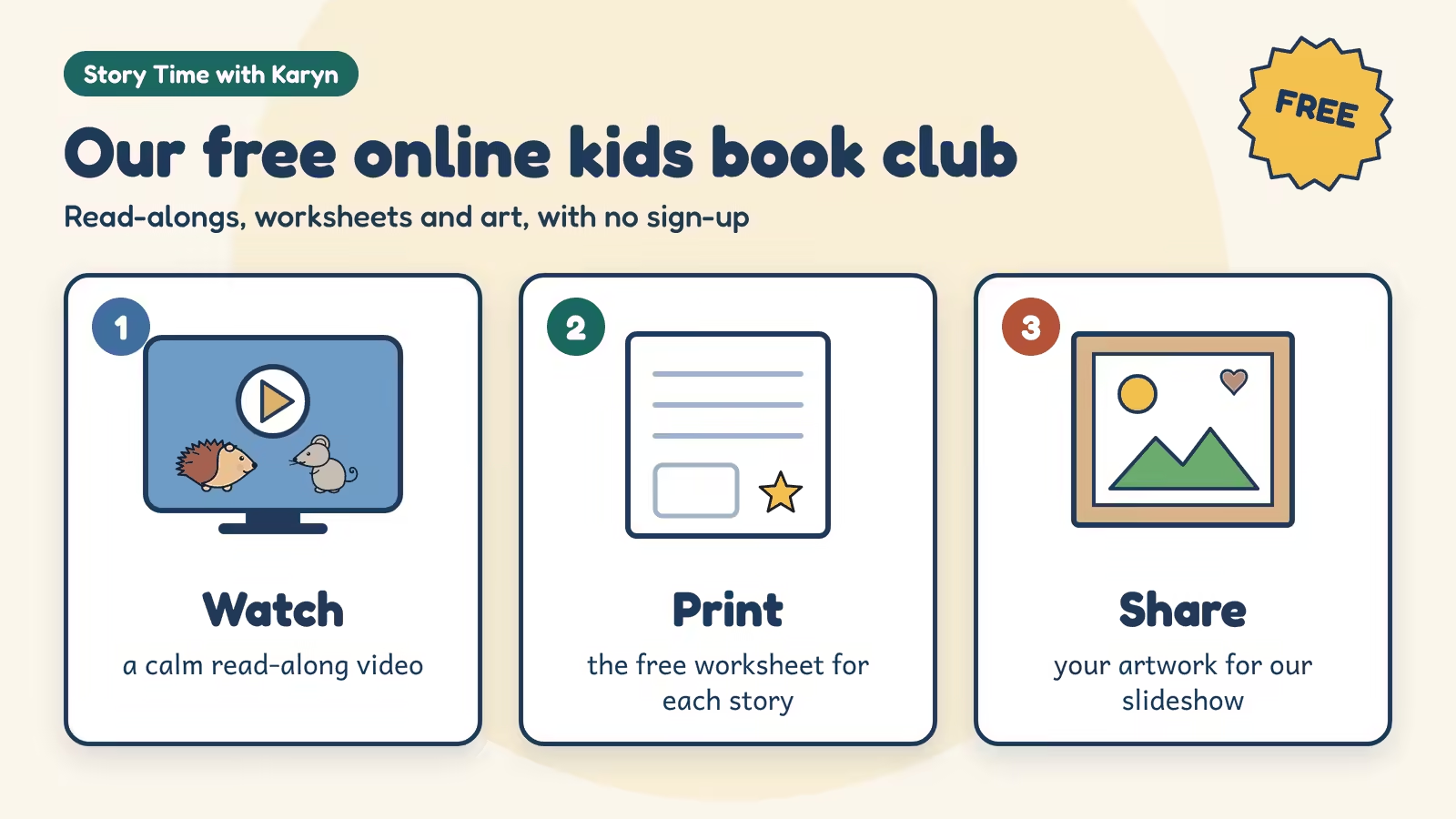
If you’ve enjoyed this trip around the world, the best way to keep these resources coming is to join our free online kids book club. Watch the read-alongs on Story Time with Karyn, download each story’s free worksheet from our website, and then explore Learn with Karyn for interactive lessons with Bobbie the robot dog. And if you love a story, please support its author by buying the book. Share your star lanterns! Did your class design a Christmas star lantern for the Art Challenge, or fill a whole passport with stamps? Ask a grown-up to send us a photo of the artwork (no faces, please) through our Connect page, and it could appear on our homepage. Wishing you a cosy, happy December, wherever in the world you are! With magic, Karyn
ChangeTheWorldWithKaryn makes free educational videos and printable resources for young children. Learn with Karyn creates curriculum-aligned videos and worksheets for ages 5 to 7, and our sister channel, Story Time with Karyn, brings children’s books to life through gentle, low-stimulation read-alouds with free reading comprehension worksheets. Visit changetheworldwithkaryn.com for all of our free resources.