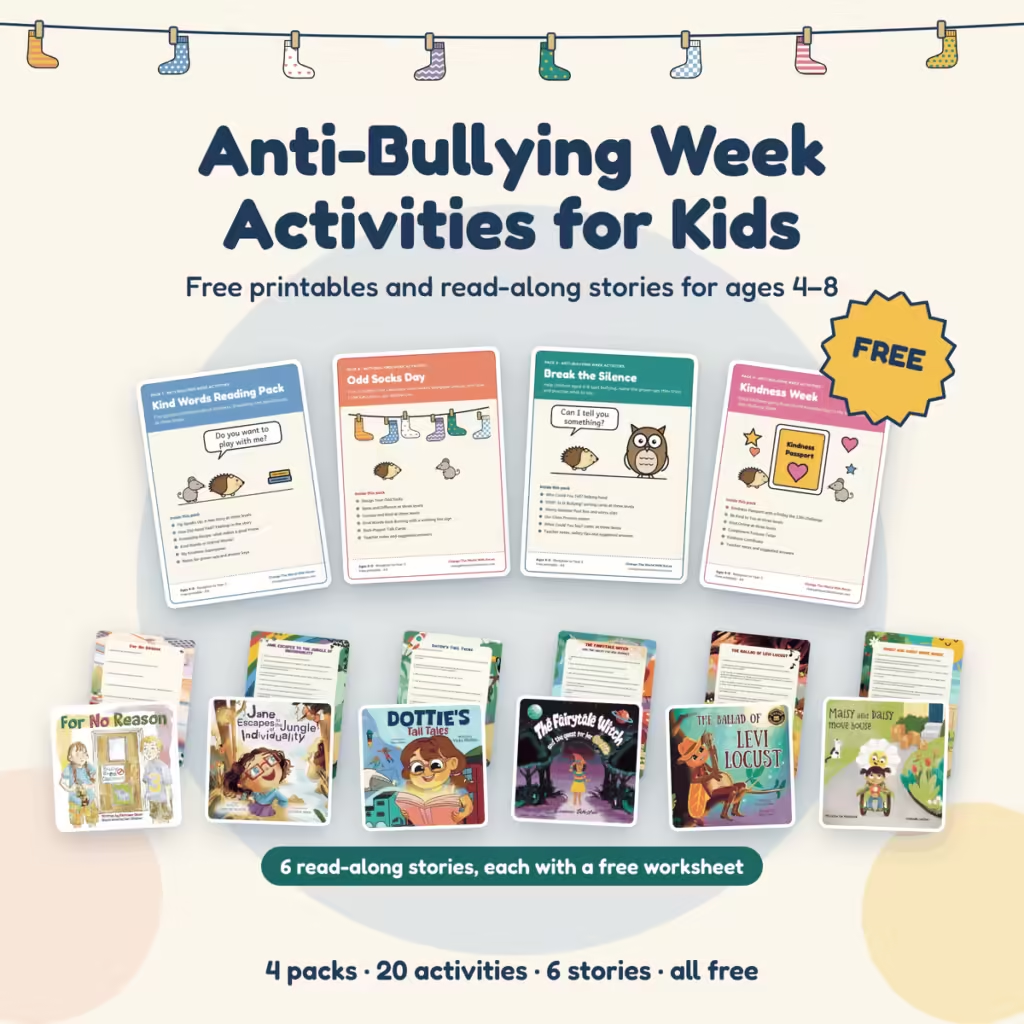
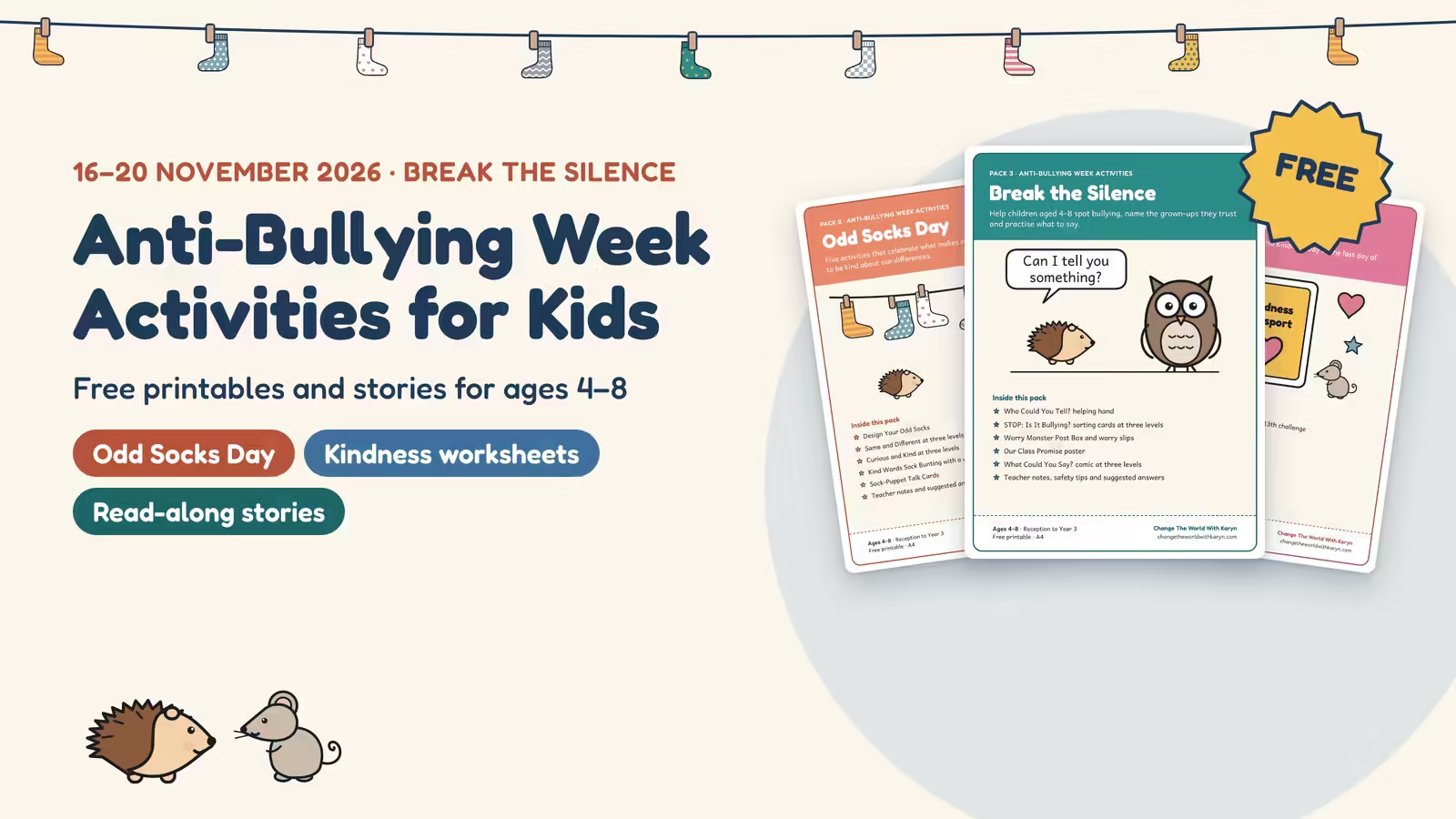
Hi lovely teachers, parents and homeschoolers, and welcome! If you’re planning Anti-Bullying Week, you’ll find everything you need right here: free Anti-Bullying Week activities for ages 4–8 (Reception to Year 3, or pre-K to 2nd grade in the US), from Odd Socks Day ideas to kindness worksheets and gentle read-along stories about bullying, friendship and belonging.
This year’s Anti-Bullying Week theme is Break the Silence, so these activities help little ones notice unkindness, put their feelings into words and tell a grown-up they trust. There are twenty free activities in four packs, with three levels on most worksheets so every child gets one that fits, and suggested answers at the back. Every pack comes in both A4 and US Letter. You’ll also find six of my favourite Story Time read-alongs, each with its own free worksheet and a little about its author. There’s no sign-up and no paywall, so just print and go.
Our gentle promise: no frightening scenes, no shaming and no labelling. We talk about bullying behaviour rather than calling any child “a bully”, and we focus on kind choices, brave words and trusted grown-ups, so the activities feel safe for sensitive children too.
Short on time? Jump to the at-a-glance table or the ready-made Monday to Friday plan, since ten to twenty minutes a day covers the whole week.
Some links below are affiliate links (Ad), which help keep our resources free.
Last updated: 9 November 2026
At a Glance: Free Anti-Bullying Week Activities for Ages 4–8
Here are all our free Anti-Bullying Week activities on one page, so you can pick the right pack or story in seconds. Every pack is a free PDF in both A4 and US Letter.
Free Anti-Bullying Week activity packs
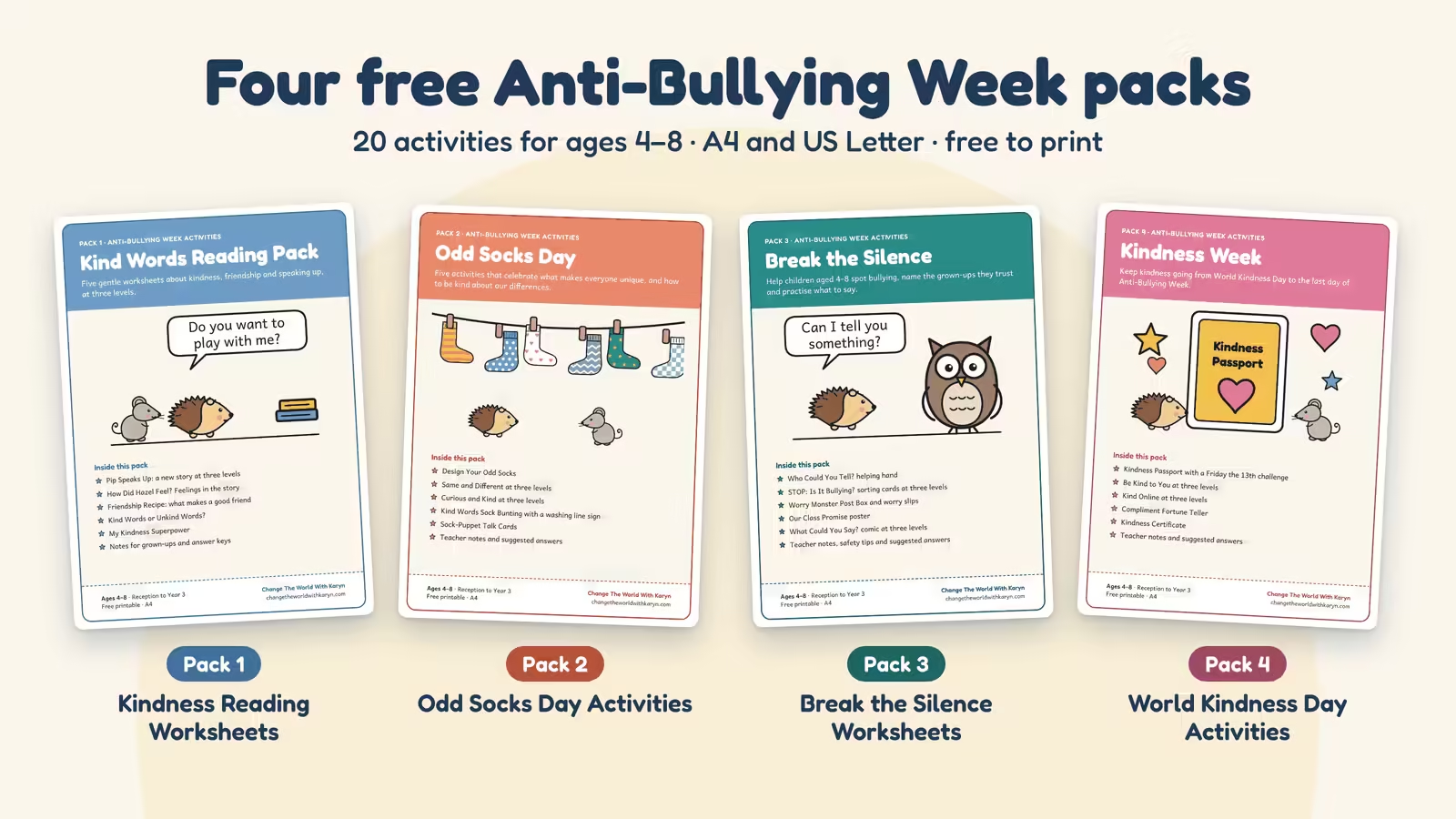
| Pack | What’s inside | Main skills | Free download |
|---|---|---|---|
| Pack 1: Kind Words Reading Pack | Pip Speaks Up, How Did Hazel Feel?, Friendship Recipe, Kind Words or Unkind Words, My Kindness Superpower | Reading for meaning, naming feelings, friendship, kind language | Download Pack 1: A4 · US Letter |
| Pack 2: Odd Socks Day Activities | Design Your Odd Socks, Same and Different, Curious and Kind, Kind Words sock bunting, sock-puppet talk cards | Celebrating differences, respect, kind curiosity, speaking up | Download Pack 2: A4 · US Letter |
| Pack 3: Break the Silence Worksheets | Who Could You Tell?, STOP sort, Worry Monster post box, Our Class Promise, What Could You Say? comic | Spotting bullying, telling a trusted grown-up, being an upstander | Download Pack 3: A4 · US Letter |
| Pack 4: Kindness Week Activities | Kindness Passport, Be Kind to You, Kind Online, compliment fortune teller, kindness certificate | Kind acts, calming big feelings, kindness online, friendship | Download Pack 4: A4 · US Letter |
Read-along stories for Anti-Bullying Week
| Story | What happens | Main skills | Video and worksheet |
|---|---|---|---|
| For No Reason by Kathleen Gauer | Jamie keeps getting picked on by the new boy, Brad, until she finds a brave way to make it stop | Recognising bullying, courage, forgiveness | Watch and download |
| Jane Escapes to the Jungle of Individuality by Jennifer Nestor | A colourful jungle adventure about embracing your own unique quirks | Self-esteem, celebrating differences | Watch and download |
| Dottie’s Tall Tales by Vicky Phillips | Dottie tells tall tales to hide that she’s fostered, until she finds the courage to share her secret | Speaking up, self-acceptance, different families | Watch and download |
| The Fairytale Witch and the Quest for Her Sparkle by Leanne Weston | Bon, an autistic little witch, goes on a rhyming quest to find her own sparkle | Empathy, inclusion, being yourself | Watch and download |
| The Ballad of Levi Locust by Janice Hostetter | Levi keeps getting shooed away when he plays his banjo, but never gives up on finding where he belongs | Being left out, resilience, belonging | Watch and download |
| Maisy and Daisy Move House by Michelle De Robillard | Maisy and her wheelchair, Daisy, face new challenges as they settle into a new home | Disability, inclusion, empathy | Watch and download |
All packs and stories suit ages 4–8, because the levels let you stretch a sheet down for Reception or up for Year 3.
Anti-Bullying Week 2026: Dates, Theme and Odd Socks Day
Anti-Bullying Week 2026 runs from Monday 16 to Friday 20 November, and the theme is Break the Silence. It starts with Odd Socks Day on Monday 16 November, so get your odd socks ready!
| Date | What’s happening |
|---|---|
| Friday 13 November 2026 | World Kindness Day, a lovely warm-up for the week ahead |
| Monday 16 November 2026 | Odd Socks Day: wear odd socks to celebrate what makes everyone unique |
| Monday 16 to Friday 20 November 2026 | Anti-Bullying Week: Break the Silence |
The Anti-Bullying Week 2026 theme: Break the Silence
The Anti-Bullying Alliance (ABA) shaped Break the Silence with more than 200 children and young people, many of whom talked about the silence that can surround bullying and how hard it can be to ask for help. So the week encourages children and adults to start conversations about bullying, speak up, listen and act together (National Children’s Bureau).
Who runs it: the ABA is coordinated by the National Children’s Bureau, which says Anti-Bullying Week reaches over 7.5 million children and young people through activities in over 80% of schools (National Children’s Bureau). The ABA also releases its own free films, lesson plans, assemblies and activities in the run-up to Anti-Bullying Week, so sign up for their updates too.
Odd Socks Day and World Kindness Day
Odd Socks Day: led by ABA patron Andy Day and his band, Andy and the Odd Socks, it’s the day when children and grown-ups wear odd socks to celebrate what makes us all unique. Nobody needs to buy anything or wear a costume, because odd socks from the drawer are perfect.
World Kindness Day: it falls on 13 November every year and began with the World Kindness Movement in 1998. Because it lands just before Anti-Bullying Week, many schools treat the two as one block of activities (Awareness Days), and our Kindness Passport is designed to start that day.
Teaching in the US or Canada? Then see Kindness All Year for Unity Day and Pink Shirt Day.
Anti-Bullying Week Activities: A Ready-Made Plan for the Week
These Anti-Bullying Week activities take just ten to twenty minutes a day, including one story, one activity and one question to talk about. Either pick and mix or follow the plan as it is. It also works in any other week of the year.
| Day | Focus | Story | Do | Talk about |
|---|---|---|---|---|
| Friday 13 November (World Kindness Day) | Kindness warm-up | Any story from the list below | Start the Kindness Passport (Pack 4) | “What kind thing could you do today?” |
| Monday 16 November (Odd Socks Day) | Celebrating differences | Jane Escapes to the Jungle of Individuality | Design Your Odd Socks, then Same and Different (Pack 2) | “What makes you, you?” |
| Tuesday 17 November | What bullying is | For No Reason | The STOP sort (Pack 3), then the story’s free worksheet | “How is bullying different from a one-off unkind moment?” |
| Wednesday 18 November | Break the Silence | Dottie’s Tall Tales | Who Could You Tell?, then the Worry Monster post box (Pack 3) | “Who could you tell?” |
| Thursday 19 November | Everyone belongs | The Fairytale Witch, Maisy and Daisy Move House or The Ballad of Levi Locust | What Could You Say? (Pack 3), then Curious and Kind (Pack 2) | “How can we make sure everyone can join in?” |
| Friday 20 November | A kind class | Pip Speaks Up, read together (Pack 1) | Our Class Promise (Pack 3), then a Kindness Certificate for everyone (Pack 4) | “What will we keep doing next week?” |
More Anti-Bullying Week activity ideas
Want a Friday the 13th challenge? Turn an “unlucky” day into a kind one: can your class do or spot 13 kind things before home time? It’s an idea we spotted on Awareness Days, and the Kindness Passport also has a page for it.
Meanwhile, early finishers can pick from the compliment fortune teller, the Kind Words sock bunting, the Friendship Recipe and Be Kind to You.
Add a Learn with Karyn video: our interactive lessons with Bobbie the robot dog make lovely warm-ups for your Anti-Bullying Week activities, for example What Do My Friends Eat? on Monday, for respecting differences; Community Helpers on Wednesday, before Who Could You Tell?; and finally Box Breathing and Positive Affirmations on Friday, or any time feelings get big. Each one also comes with free printables.
Pack 1: Kindness Reading Comprehension Worksheets for Anti-Bullying Week (Ages 4–8)
Pack 1 gives you five gentle Anti-Bullying Week activities about kindness, friendship and speaking up, and all but the draw-and-write page come at three levels. They all grow from one brand-new story about Pip the hedgehog, who finds the courage to tell a grown-up when Hazel the mouse keeps being left out.
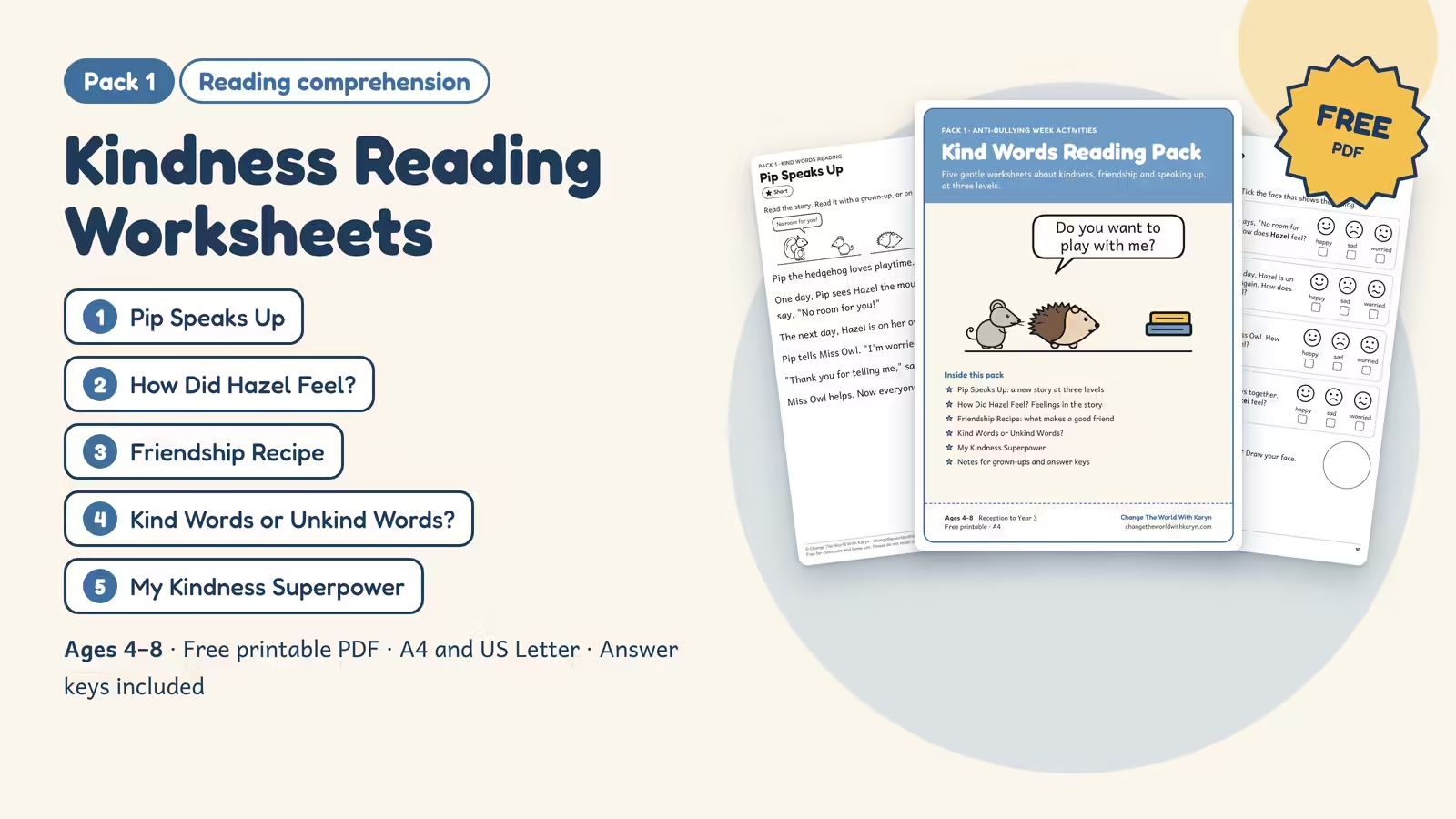
Download Kind Words Reading Pack (free PDF, answer keys included):
A4 (UK spelling) · US Letter (US spelling)
What’s in Pack 1
| Worksheet | What children do | England | US standards |
|---|---|---|---|
| Pip Speaks Up (story, 3 levels) | Read how Pip notices Hazel the mouse being left out again and again, then talk about feelings and what Pip could say to a grown-up | EYFS to Y2: retelling, making inferences from what characters say and do, predicting | RL.K.1, RL.1.1, RL.2.1, RL.1.3, RL.2.3 |
| How Did Hazel Feel? (3 levels) | Name how Hazel and Pip feel at each point in the story, then find the words that show it | RSHE: recognising and talking about feelings; reading: inferring how characters feel | RL.K.3, RL.1.3, RL.2.3 |
| Friendship Recipe (3 levels) | Pick out what a good friend does, then fill in or write a recipe for a good friend | RSHE: what makes a good friendship, such as kindness, trust and sharing | W.K.2, W.1.2, W.2.2 |
| Kind Words or Unkind Words? (3 levels) | Sort words and sentences, then turn an unkind sentence into a kind one | Spoken language: choosing words with care | L.K.5.c, L.1.5.c, L.2.5.a |
| My Kindness Superpower (draw and write) | Draw and write about a time you were kind, or a kind thing you will do this week | Saying a sentence out loud before writing it | W.K.3, W.1.3 |
The US codes are Common Core, although some states use their own standards. The England column paraphrases the national curriculum, EYFS and the statutory RSHE guidance, so check the exact wording on gov.uk before quoting it in a plan.
Three levels, one pack
- ★ Short: picture clues and mostly circle-or-tick answers, so it’s ideal for Reception and Year 1.
- ★★ Medium: a mix of “who and what” questions and “how do you know?” questions.
- ★★★ Longer: inference, word meanings and a find-the-evidence question, especially for confident readers in Years 2 and 3.
Teacher tips: helping children find the words
- Pause when Pip decides to tell, and ask “What could Pip say?” Model a starter such as “I’m worried about Hazel because…”
- Then talk about the difference between telling to get someone into trouble and telling to keep someone safe.
- Let younger children say their answers before they write, or scribe for them.
- Finally, thank every child who shares an idea, because “Thank you for telling me” is the message we want them to remember.
Join our free online kids book club! Looking for stories that make kindness click? In our free online kids book club, calm, animated read-alongs bring picture books by independent authors to life, always with the author’s permission, and every story also comes with a free worksheet of reading, feelings and art activities. Browse by theme to find free educational resources on friendship, feelings and belonging, then send us your child’s artwork for our slideshow. So press play on Story Time with Karyn and turn screen time into reading time.
Pack 2: Odd Socks Day Activities for Anti-Bullying Week (Ages 4–8)
Pack 2 turns Odd Socks Day, the first day of Anti-Bullying Week, into five activities that celebrate what makes everyone unique, and how to be kind about our differences. Same and Different and Curious and Kind come at three levels, while the art, display and role-play activities work for every age as they are.
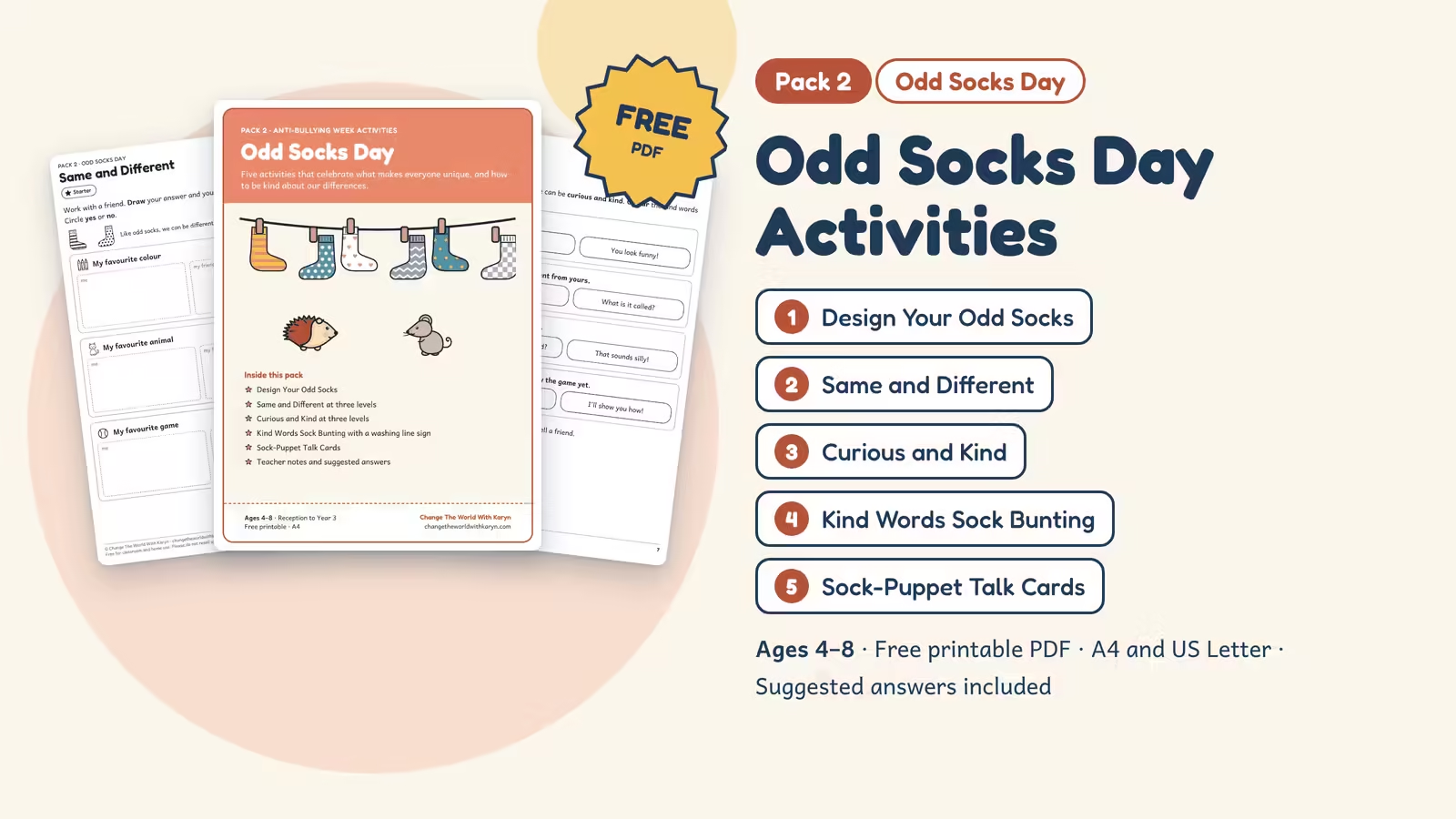
Download Odd Socks Day Pack (free PDF, suggested answers included):
A4 (UK spelling) · US Letter (US spelling)
What’s in Pack 2
| Activity | What children do | England | US standards |
|---|---|---|---|
| Design Your Odd Socks | Design two socks that don’t match: one shows something you love, the other something that makes you, you | RSHE: respecting differences and building self-esteem; art: drawing to share ideas | CASEL: self-awareness |
| Same and Different (3 levels) | Find out what you share with a friend and what makes each of you unique: draw it, then use sentence starters, then interview a friend | RSHE: respecting others and noticing what we share | SL.K.1, SL.1.1, SL.2.1; CASEL: social awareness |
| Curious and Kind (3 levels) | Choose or write kind, curious replies when someone is different, such as new glasses, a different lunch, another language or a new classmate | RSHE: respecting people who are different from us; teasing about differences can be bullying | CASEL: social awareness, relationship skills |
| Kind Words Sock Bunting | Write or draw a kind word for a classmate on a sock-shaped flag, then hang the flags on a washing line | RSHE: caring friendships and kindness | CASEL: relationship skills |
| Sock-Puppet Talk Cards | Turn a spare sock into a puppet, then practise brave words such as “Stop, I don’t like that” and “Can I tell you something?” | RSHE: being assertive and knowing how to get help; spoken language: role play | SL.K.1, SL.1.1; CASEL: relationship skills |
Odd Socks Day ideas for class and home
- A washing line of kindness: peg up the Kind Words bunting, or real odd socks, under a sign that says “Different and together”.
- Keep a spare-sock box so nobody feels left out if they forget, and let children who dislike certain textures join in with their sock drawings instead.
- Then talk about the line: “None of our socks match, and that’s what makes the line fun. People are like that too.”
- Puppet practice: sock puppets give shy children a safe way to try out brave words before they need them.
- Different lunches, same table: watch What Do My Friends Eat? on Learn with Karyn, where Bobbie the robot dog helps me plan party food for friends who are vegetarian, vegan, gluten-free or have a nut allergy. Then talk about how to make everyone feel welcome at lunch.
Odd Socks Day isn’t just for the UK, because these activities suit any celebrate-differences day, whenever it falls.
Pack 3: Break the Silence Worksheets for Anti-Bullying Week (Ages 4–8)
Pack 3 is the heart of this year’s Anti-Bullying Week theme: five activities that help children spot bullying, name the grown-ups they trust and practise what to say. Both the sorting cards and the comic come at three levels.
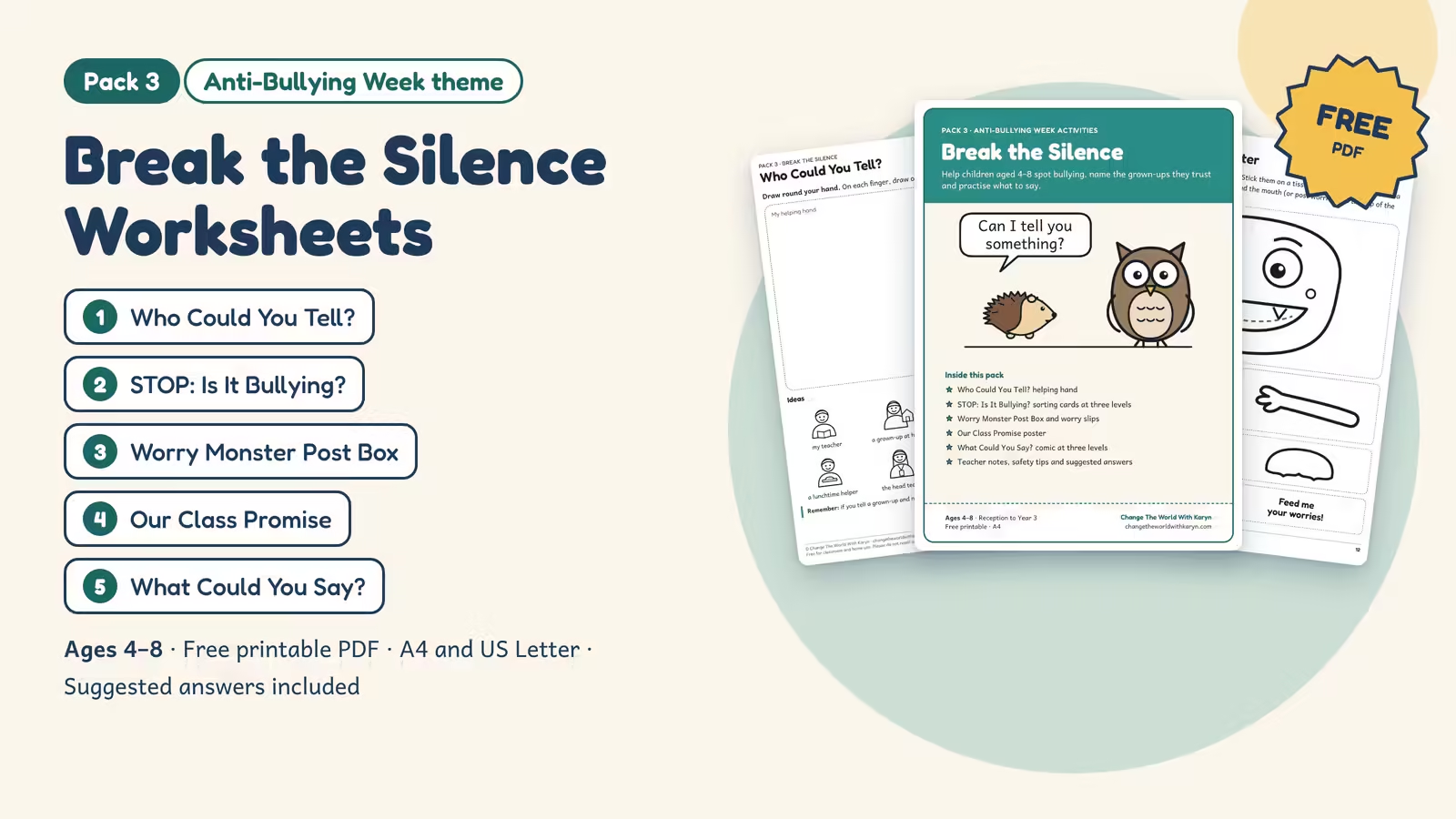
Download Break the Silence Pack (free PDF, suggested answers included):
A4 (UK spelling) · US Letter (US spelling)
What’s in Pack 3
| Activity | What children do | England | US links |
|---|---|---|---|
| Who Could You Tell? | Draw round your hand, then draw or write a trusted grown-up on each finger, with a picture word bank for younger children | RSHE: how to ask for help, and to keep trying until you are heard | CASEL: relationship skills |
| STOP: Is It Bullying? (sorting cards, 3 levels) | Learn STOP (Several Times On Purpose, so Start Telling Other People), then sort cards: kind or unkind, then one-off or several times on purpose, then “what could you do?” | RSHE: types and impact of bullying, and what bystanders should do | CASEL: social awareness, responsible decision-making |
| Worry Monster Post Box | Make a friendly monster from a box or paper bag, then “feed” it worries drawn or written on slips for a grown-up to read | RSHE: no shame in talking about feelings; how to seek help | CASEL: self-management |
| Our Class Promise | Agree four or five kind class rules together, decorate the promise and sign it | RSHE: kindness, courtesy and respect | CASEL: relationship skills |
| What Could You Say? (comic, 3 levels) | Finish a comic about Hazel the mouse being left out: choose a speech bubble, then finish the sentence, then write your own words | RSHE: being assertive, and what bystanders should do | SL.K.1, SL.1.1, W.1.3; CASEL |
Before you start: keeping it safe
- Know your school’s procedures, because talking about bullying can lead a child to share something real. In fact, the statutory RSHE guidance warns these lessons can lead to more safeguarding reports, and says staff should never promise to keep a report secret. If you’re worried about a child, speak to your designated safeguarding lead.
- Check the worry box every day, and tell children which grown-up reads it, so they know someone will see their message.
- Practise the brave response, not the unkind behaviour. Role-play what to say and who to tell, rather than acting out the hurtful part.
- STOP is a mnemonic many UK primary schools already use in their child-friendly anti-bullying policies (for example Swanwick Primary School), so check whether your school has its own words.
Flip, giggle, write! Our flipbook notebooks have a little animation in the corner that springs to life when you flick the pages, plus jokes and fun facts on every page. They also make a lovely kindness journal for the week: one kind thing a day, and a doodle to go with it. Find them on Amazon UK.
Pack 4: Kindness Week Activities for World Kindness Day (Ages 4–8)
Pack 4 keeps kindness going from World Kindness Day on Friday 13 November until the last day of Anti-Bullying Week, with activities for kindness to others, kindness online and kindness to yourself. Be Kind to You and Kind Online also come at three levels.
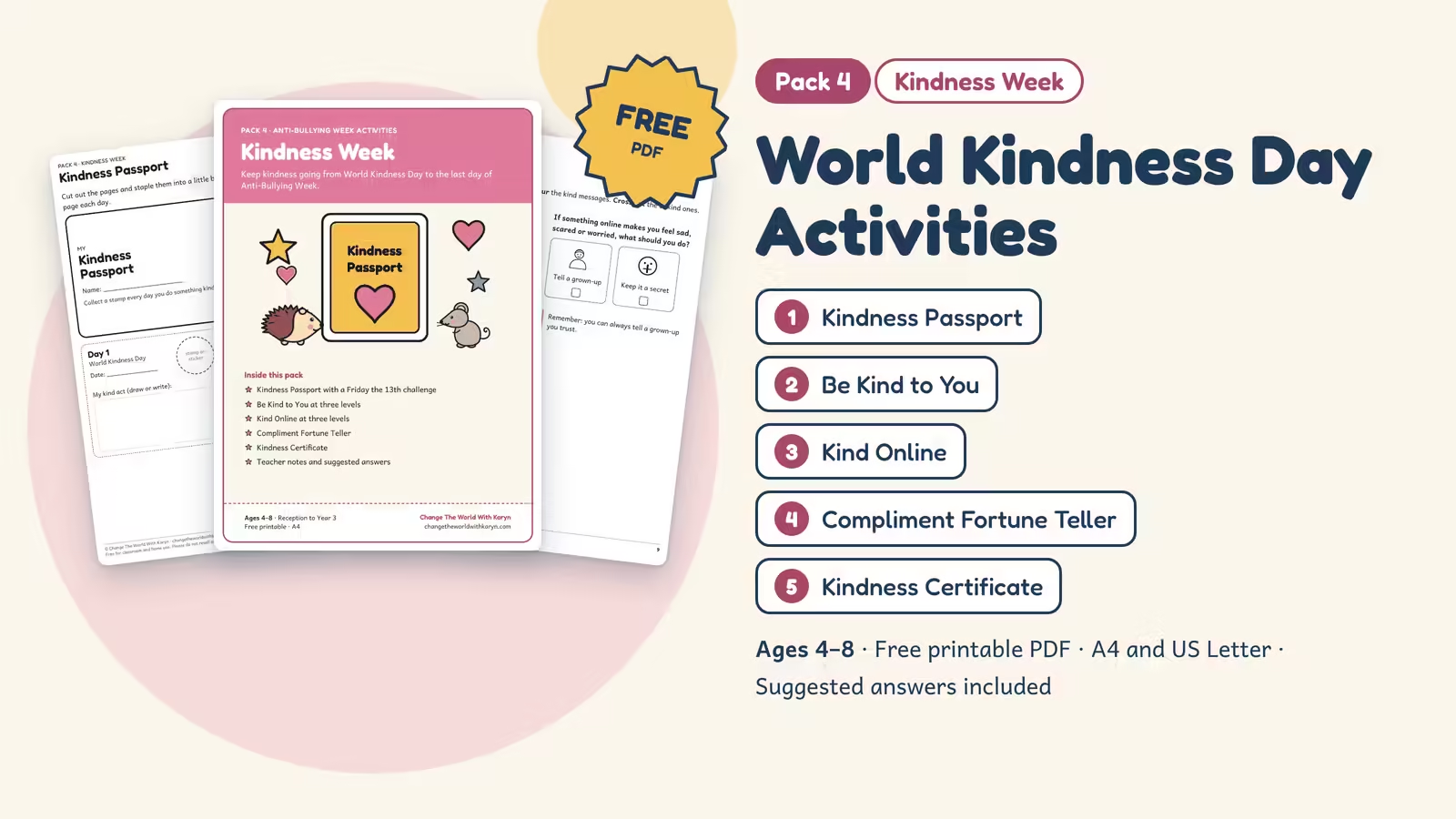
Download Kindness Week Pack (free PDF, suggested answers included):
A4 (UK spelling) · US Letter (US spelling)
What’s in Pack 4
| Activity | What children do | England | US standards |
|---|---|---|---|
| Kindness Passport | Collect a stamp for each day from World Kindness Day to the Friday of Anti-Bullying Week, with a bonus Friday the 13th page of 13 kind things to spot | RSHE: helping others is good for wellbeing and happiness | CASEL: relationship skills |
| Be Kind to You (3 levels) | Pick ways to calm big feelings, make a calm plan with box breathing, and turn unkind thoughts about yourself into kind ones | RSHE: simple self-care, talking about feelings and asking for help | CASEL: self-awareness, self-management |
| Kind Online (3 levels) | Spot kind and unkind messages, sort online choices, and decide what to do if something online is upsetting | RSHE: being kind online, online bullying and how to get help | CASEL: responsible decision-making |
| Compliment Fortune Teller | Fold a paper fortune teller with kind messages inside, then play it with a friend | RSHE: courtesy and kindness | CASEL: relationship skills |
| Kindness Certificate | Celebrate every child’s kindness at the end of the week | RSHE: self-respect and self-esteem | CASEL: self-awareness |
Kindness tips that stick
- Name the kind act. “Thank you for waiting for Sam” tells a child exactly what to repeat, while “good job” doesn’t.
- Count kindness to yourself too. Taking a deep breath or asking for help is a kind choice, and it matters especially for anxious children.
- Send the passport home for the weekend, so families can add a kind act or two.
Meet Bobbie the robot dog! On our sister channel, Learn with Karyn, Bobbie and I turn curriculum topics into interactive videos where children point, move and join in. Three lessons go beautifully with this week, and each one also comes with free printables: Box Breathing and Positive Affirmations, for calming big feelings and practising “I can do hard things” (a perfect partner for Be Kind to You); What Do My Friends Eat?, where children learn to respect different diets and keep friends with allergies safe and included (great with Curious and Kind); and finally Community Helpers, where we video-call 13 people who help us (lovely with Who Could You Tell?). If you enjoy them, subscribe to Learn with Karyn for more educational videos for kids.
Stories About Bullying and Kindness: Free Read-Alongs With Worksheets
Six of my Story Time with Karyn read-alongs fit Anti-Bullying Week beautifully, and each one comes with its own free worksheet of activities. Every story is animated with the author’s permission, at a calm pace that works especially well for sensitive children. Several of the authors have also shared the real stories behind their books. You can watch each one right here and then download its worksheet in one click.
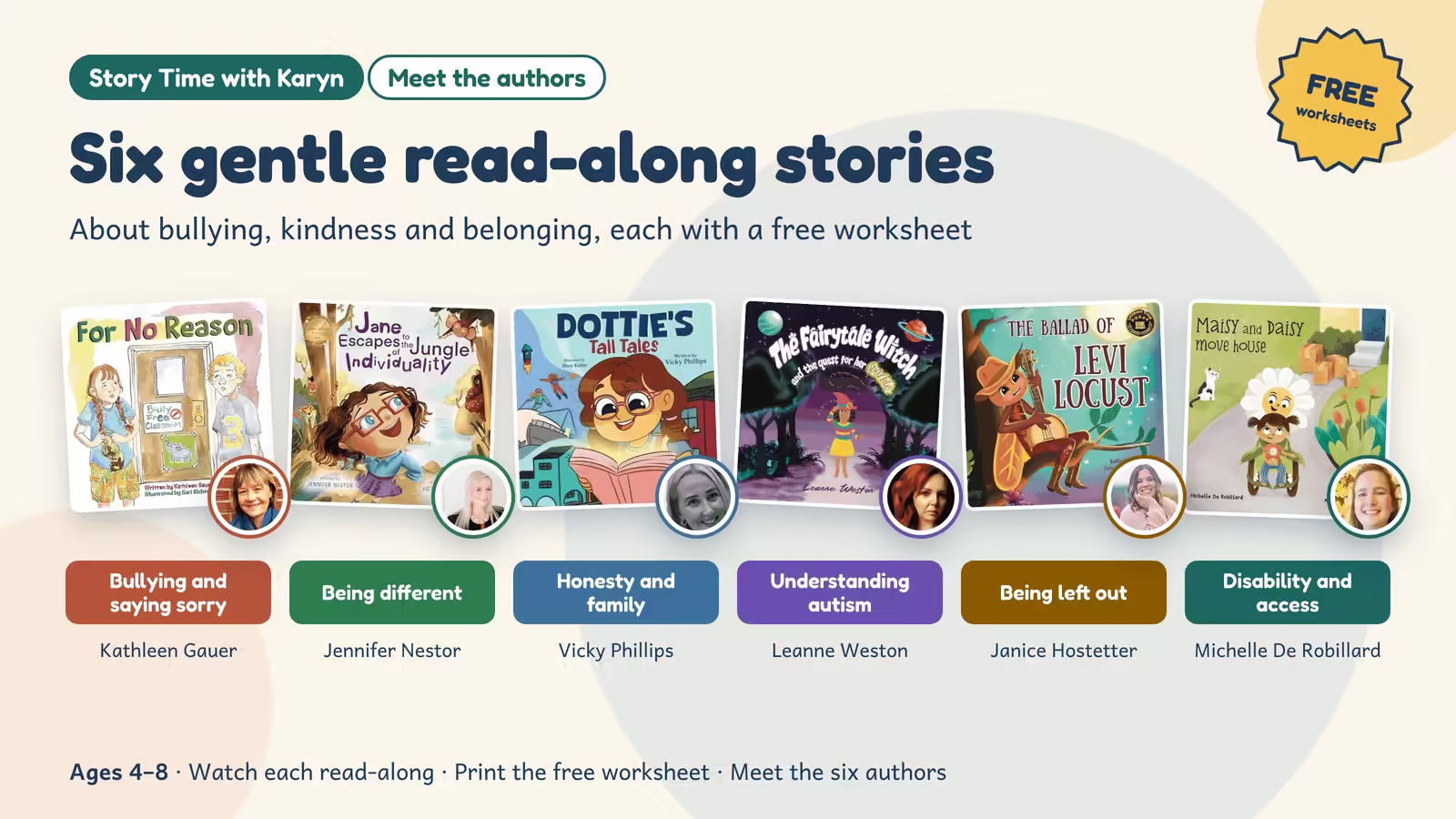
For No Reason by Kathleen Gauer
Jamie Higgins has a problem: the new boy in her class, Brad, keeps picking on her, for no reason at all. Jamie comes up with a brave idea to make it stop, and when Brad realises he was wrong and says sorry, she chooses to forgive him.
- SEL focus: responsible decision-making as well as relationship skills.
- Talk about it: “Who could Jamie tell?”
- Good to know: forgiveness is lovely in a story, but in real life the first step is telling a grown-up, and no child ever has to be friends with someone who hurt them.
What’s in the free worksheet: 9 questions about the story, then an Art Challenge on page 2: draw yourself being kind to someone at school. Questions include the following:
- “Why do you think Brad was mean to Jamie?”
- “What would you do if you saw your classmate being bullied?”
- “Jamie chose to forgive Brad. How do you think forgiveness made BOTH of them feel?”
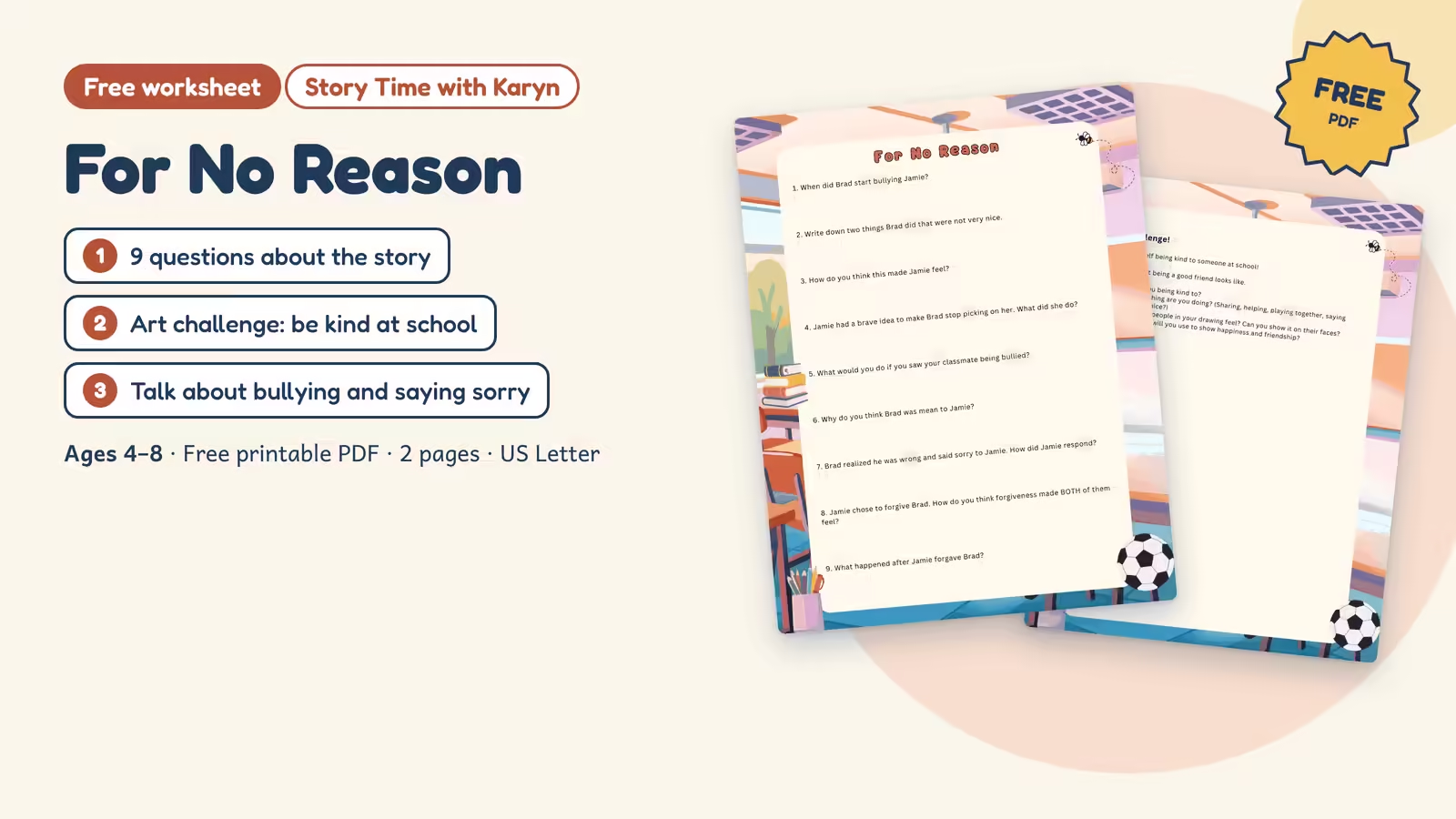
Free printable worksheet
Download the free For No Reason worksheet (PDF, 2 pages)
Meet the author: Kathleen Gauer
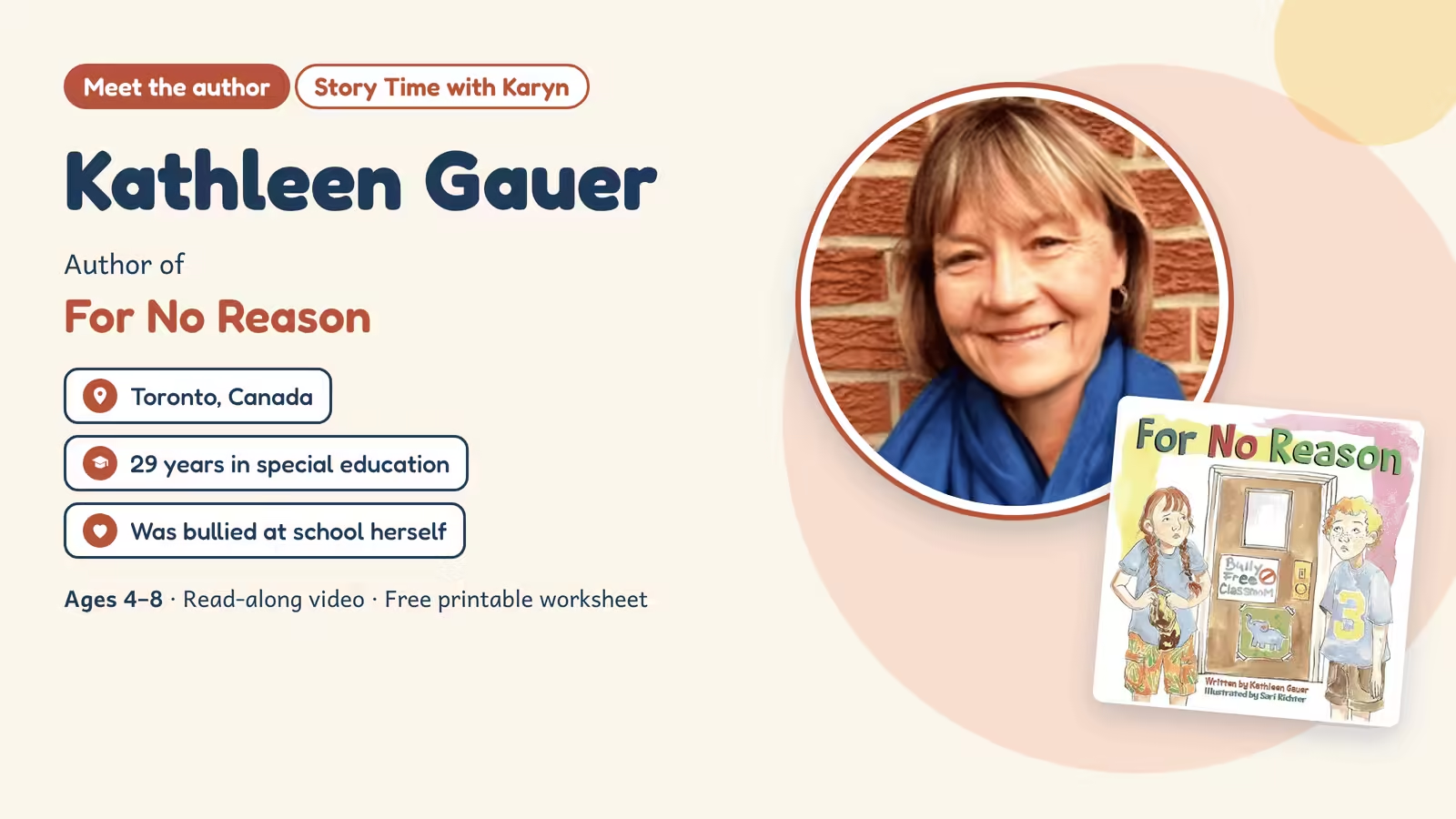
Kathleen Gauer is a Toronto children’s author who spent 29 years as a special education teacher’s assistant with the Toronto District School Board. She told us how the book got its name:
“I came up with the idea for For No Reason while reading in my backyard one summer. I overheard a neighbour whining to his mom, ‘Christian pushed me into the pool, for no reason!’ I thought, that sounds like a great title for a book about bullying.”
Her own story also has a twist:
“Life has a way of coming full circle. Years ago, I was bullied by a classmate at school. Decades later, I ended up teaching at that same school. The real surprise came when over 50 years later, I ran into my childhood bully at a book fair. She apologized and admitted she had anger issues back then. She even purchased all of my books—including For No Reason about bullying! As an educator and author, I always tell children you never know when your paths will cross again so you had better be kind to everyone.”
Kathleen’s advice for children: walk away calmly, then tell a trusted grown-up. Bullying, she explains, gives children who bully “a false sense of power and control—one that relies entirely on getting a reaction of fear or anger. By walking away calmly, you deny them that power.” And “reporting the behavior to a trusted authority is always the right thing to do.”
For No Reason on our book club · Buy the book · Visit Kathleen’s website
Jane Escapes to the Jungle of Individuality by Jennifer Nestor
Jane is a gifted little girl who is bullied by a boy called Eric and feels sad about being different. Then, in the colourful Jungle of Individuality, she meets animals who have learned to love what makes them different, and learns her own special phrase: “My individuality makes me strong.”
- SEL focus: self-awareness as well as social awareness.
- Try this on Odd Socks Day: make a class banner that says “Our individuality makes us strong”, then ask each child to add one thing that makes them unique. Jennifer’s own message for the banner: “My uniqueness is my superpower.”
What’s in the free worksheet: 14 questions and a drawing activity on one page. After that, children draw themselves celebrating what makes them unique in the Jungle of Individuality, with Jane’s phrase at the bottom: “My individuality makes me strong.” Questions include the following:
- “What does individuality mean?”
- “Is it normal to have hard days, even if you are strong?”
- “Imagine you saw someone being bullied like Eric bullied Jane. What would you say to them?”
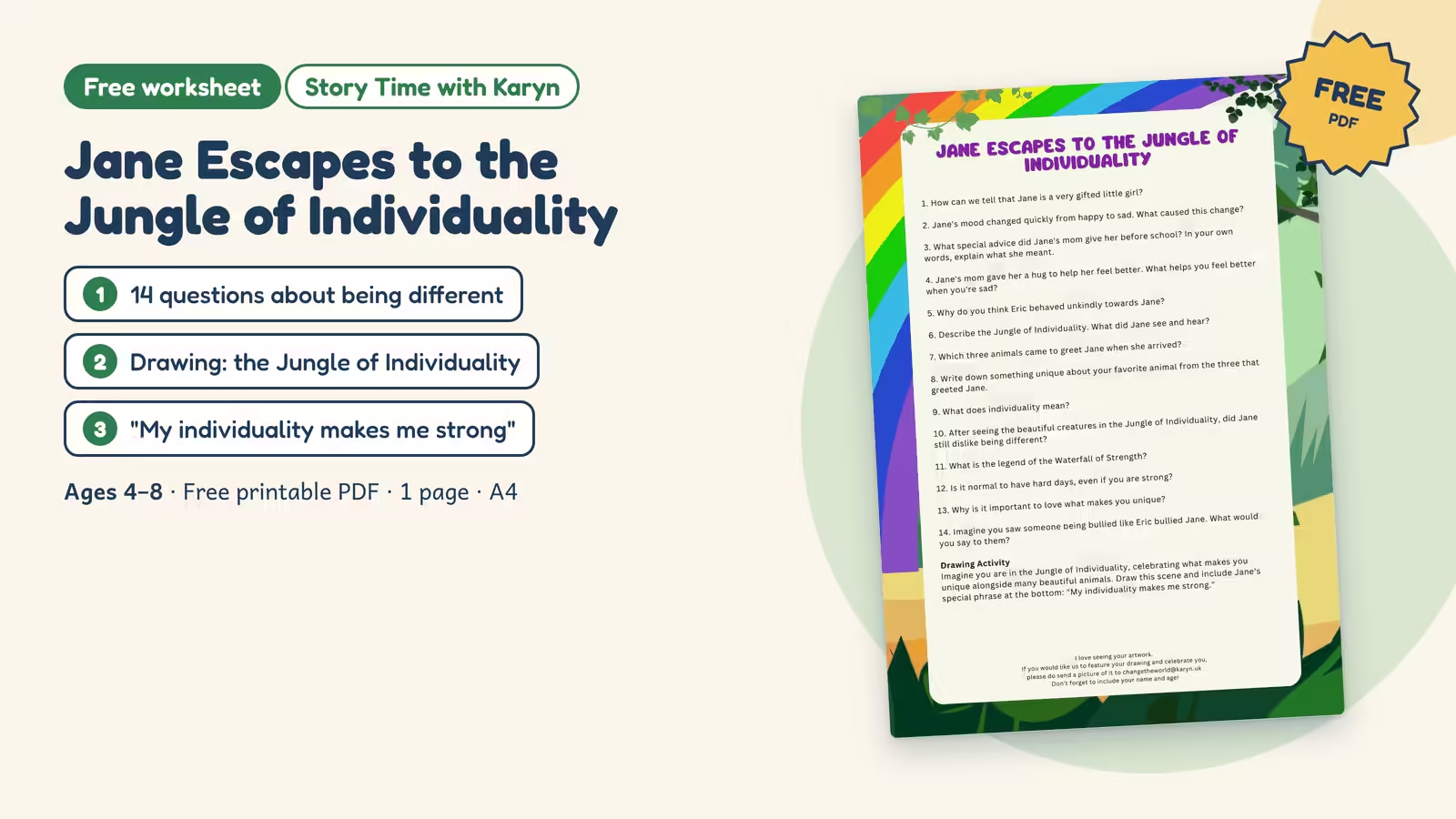
Free printable worksheet
Download the free Jane worksheet (PDF, 1 page)
Meet the author: Jennifer Nestor
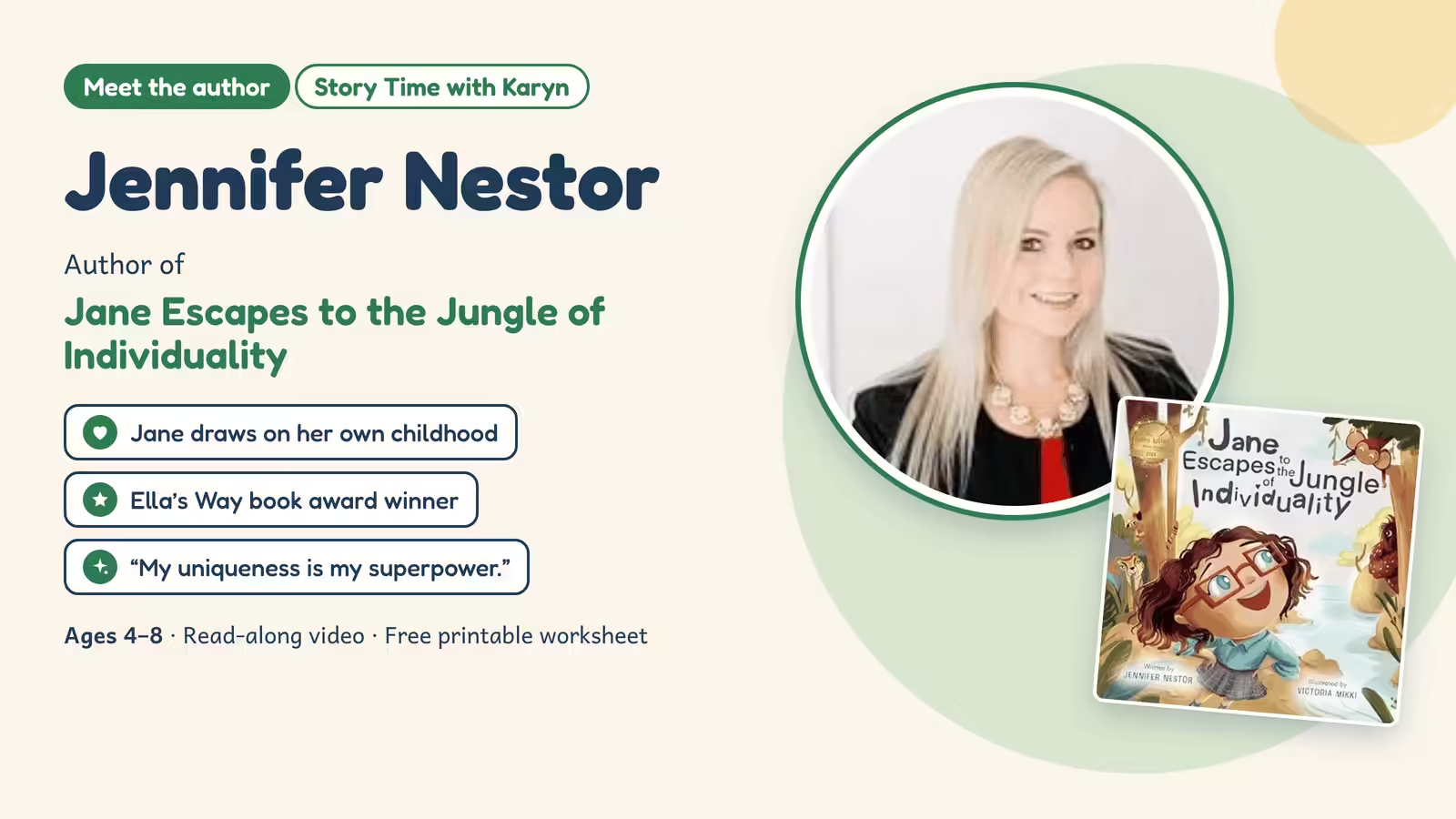
Jennifer Nestor drew on her own experiences as a little girl, and on things she has seen others go through, to write Jane’s story. Looking back, she says:
“I wish someone had told me back then that the things that made me different were actually a superpower, not something I should be ashamed of.”
Jennifer’s tip for parents: “I think when parents create a safe space and have regular conversations with their kids, it allows them to feel comfortable to speak up more and be honest.”
Award news: Jane Escapes to the Jungle of Individuality recently won an Ella’s Way “Certificate of Excellence” Children’s Book Award, for children’s literature that promotes acceptance, kindness and inclusion. Ella’s Way, a US non-profit that promotes kindness through children’s literature, told Jennifer the book has “planted the initial seeds of understanding in the hearts of children”, so it’s a natural pick for your Anti-Bullying Week activities.
Jane on our book club · Buy the book from Jennifer’s shop
Dottie’s Tall Tales by Vicky Phillips
Dottie tells wonderful tall tales about her adventurous mum, because she’s afraid to share a secret. When her friends start asking questions, she finally tells them the truth: she is being fostered. Then her friends help her see that being different is nothing to be ashamed of. In other words, it’s Break the Silence in story form.
- SEL focus: self-awareness as well as relationship skills.
- Try this: tell a tall tale that everyone knows is pretend, then share one true thing about yourself, and talk about the difference.
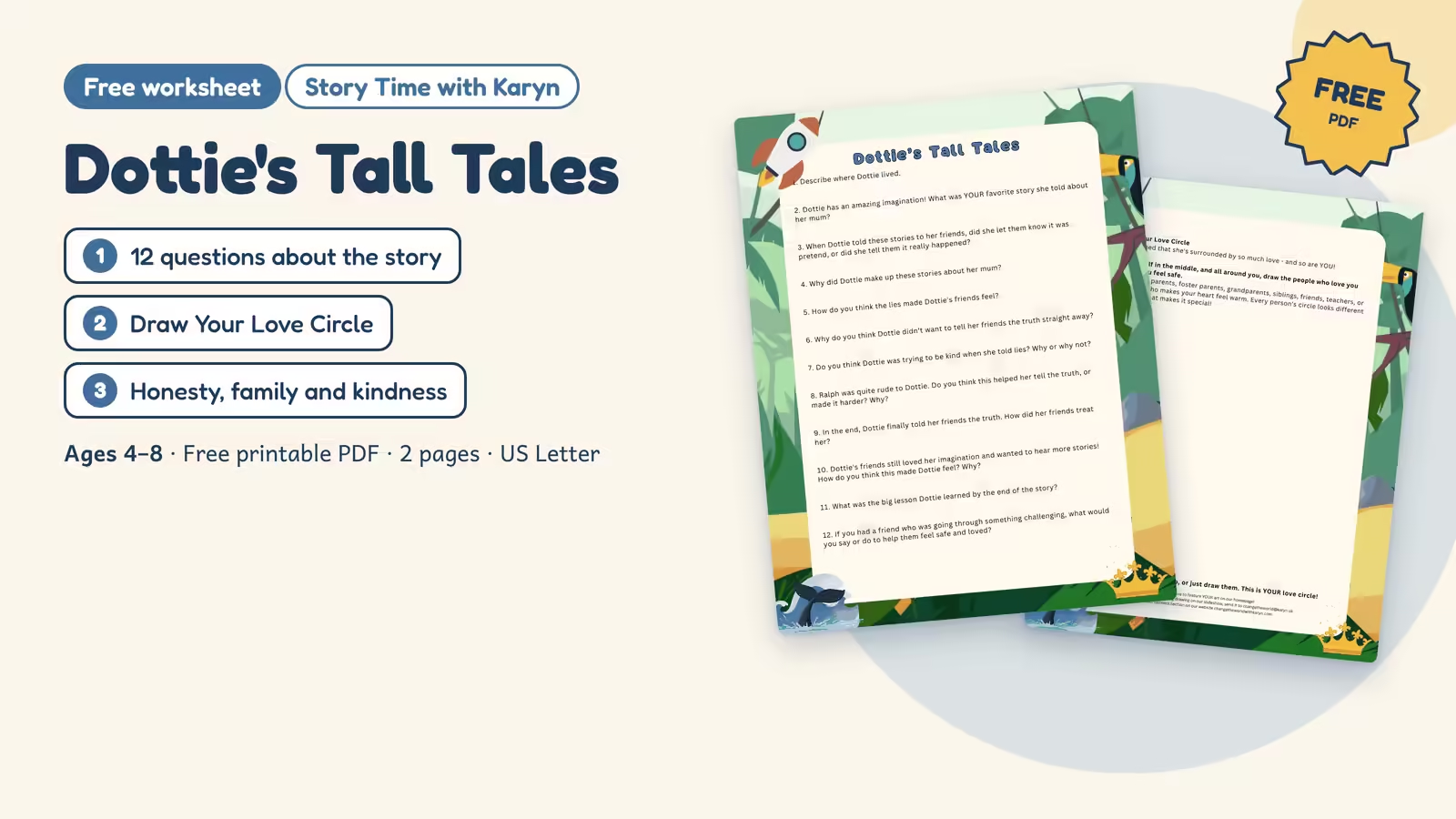
What’s in the free worksheet: 12 questions about the story, then a “Draw Your Love Circle” page, where children draw themselves in the middle and the people who love them all around. Questions include the following:
- “Why did Dottie make up these stories about her mum?”
- “Ralph was quite rude to Dottie. Do you think this helped her tell the truth, or made it harder? Why?”
- “If you had a friend who was going through something challenging, what would you say or do to help them feel safe and loved?”
Free printable worksheet
Download the free Dottie’s Tall Tales worksheet (PDF, 2 pages)
Meet the author: Vicky Phillips
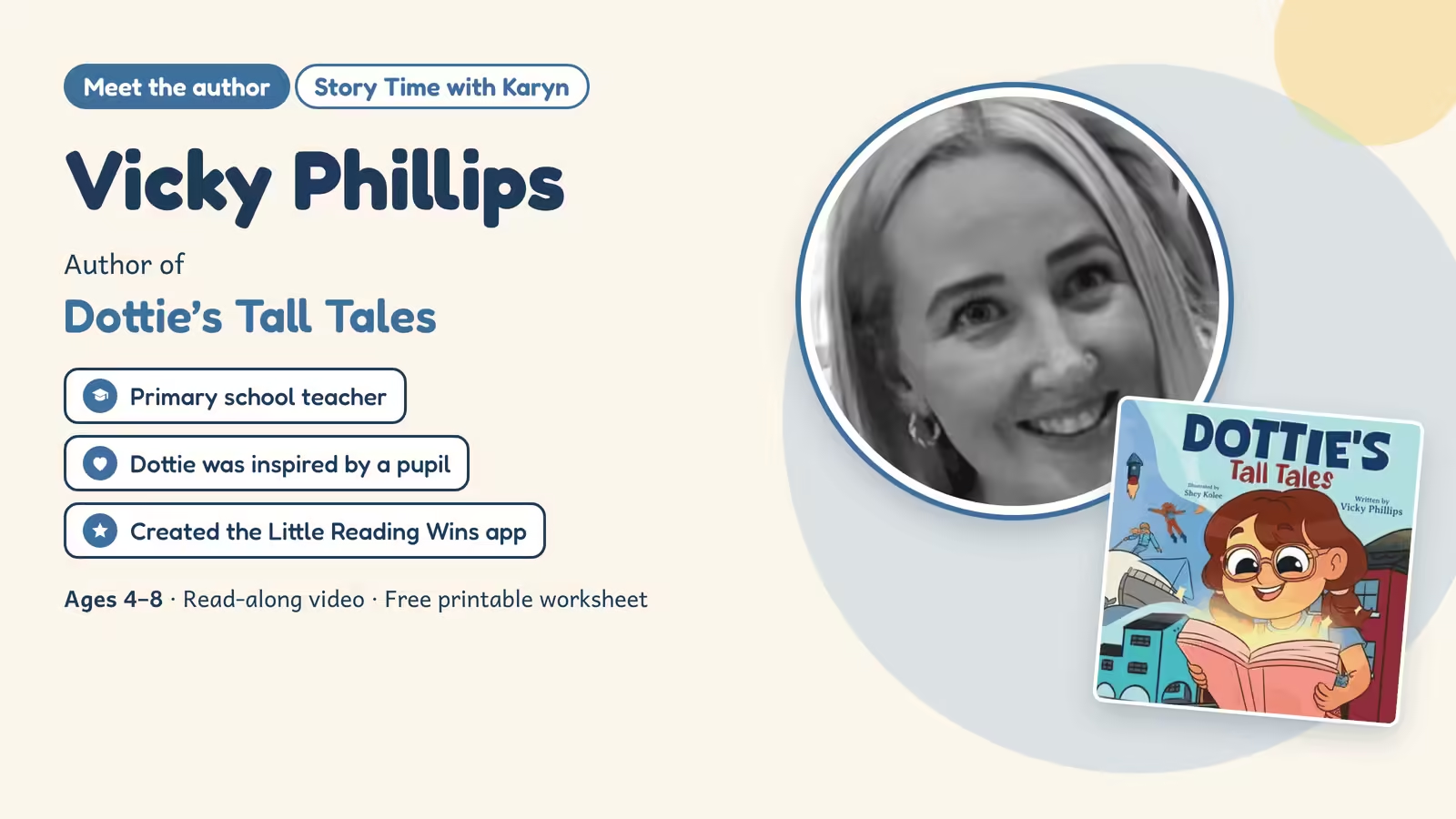
Vicky Phillips is a primary school teacher, and all her characters are based on children she has taught. She told us:
“Dottie was inspired by a lovely little girl in my class, but who struggled to accept herself for who she was, due to being fostered. She will always hold an extra special place in my heart, and was the inspiration behind Dottie’s tall tales.”
Vicky’s message for children: “Everyone’s family life is different, and that’s nothing to be ashamed of. Be proud of who you are!” In her own classroom, she says, “We talk regularly about celebrating our differences, and accepting each other for who we are.”
Vicky also created Little Reading Wins, a reading app for schools and families, with personalised daily reading challenges and a digital dashboard that replaces paper reading logs.
Dottie’s Tall Tales on our book club · Buy the book
The Fairytale Witch and the Quest for Her Sparkle by Leanne Weston
Bon is a little witch whose Coven sparkles, but she doesn’t. So she sets off on a rhyming quest to find her own sparkle, the thing that helps her feel safe, happy and truly herself. Bon is autistic, and the story shows both unkindness and real kindness towards her.
- SEL focus: social awareness as well as self-awareness.
- Try this: a class “sparkle wall”, where children draw or write what helps them feel most like themselves.
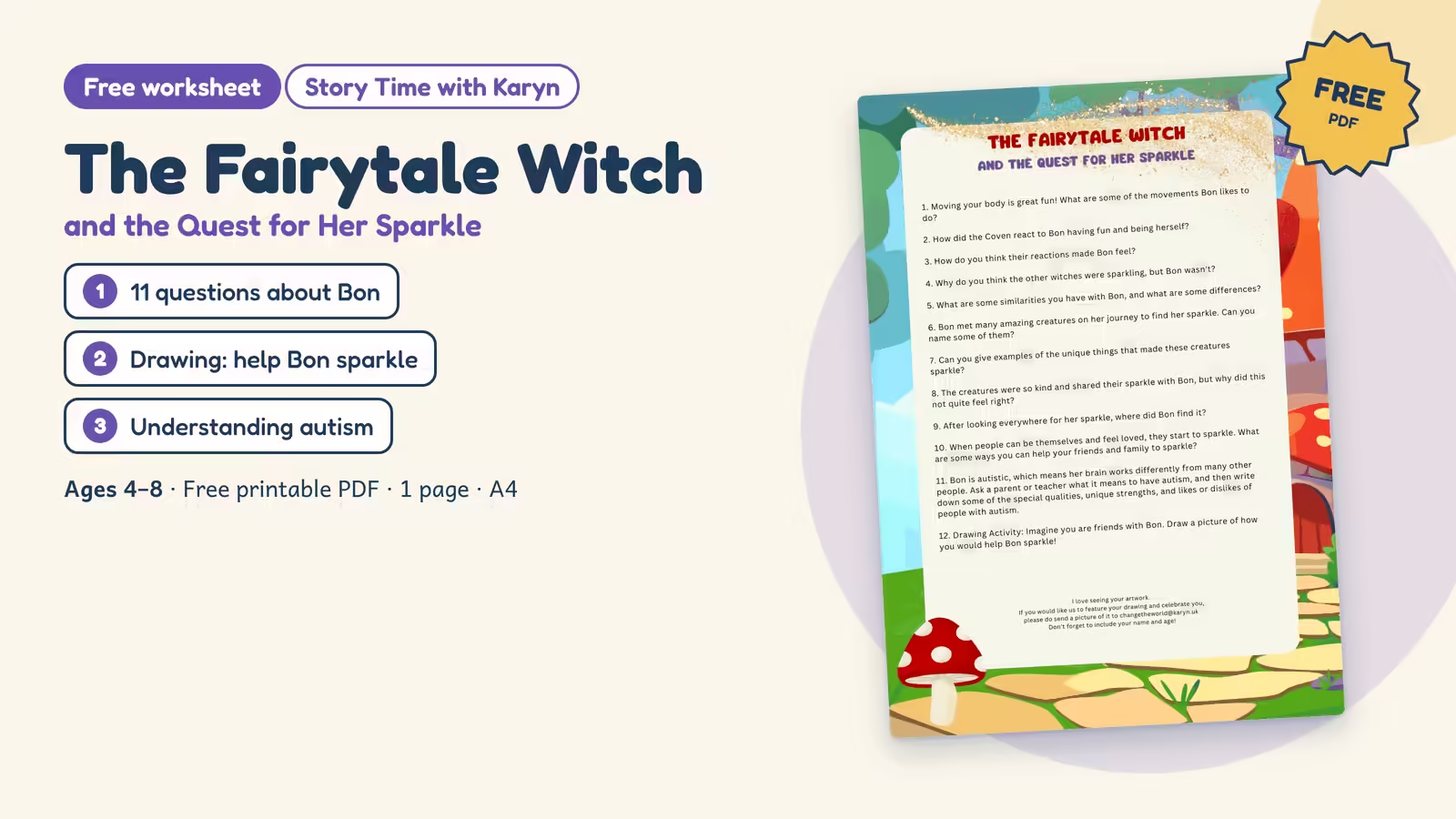
What’s in the free worksheet: 11 questions and a drawing activity on one page: imagine you’re friends with Bon, and draw how you would help her sparkle. One question also invites children to ask a parent or teacher what autism means. Questions include the following:
- “How did the Coven react to Bon having fun and being herself?”
- “What are some similarities you have with Bon, and what are some differences?”
- “What are some ways you can help your friends and family to sparkle?”
Free printable worksheet
Download the free Fairytale Witch worksheet (PDF, 1 page)
Meet the author: Leanne Weston
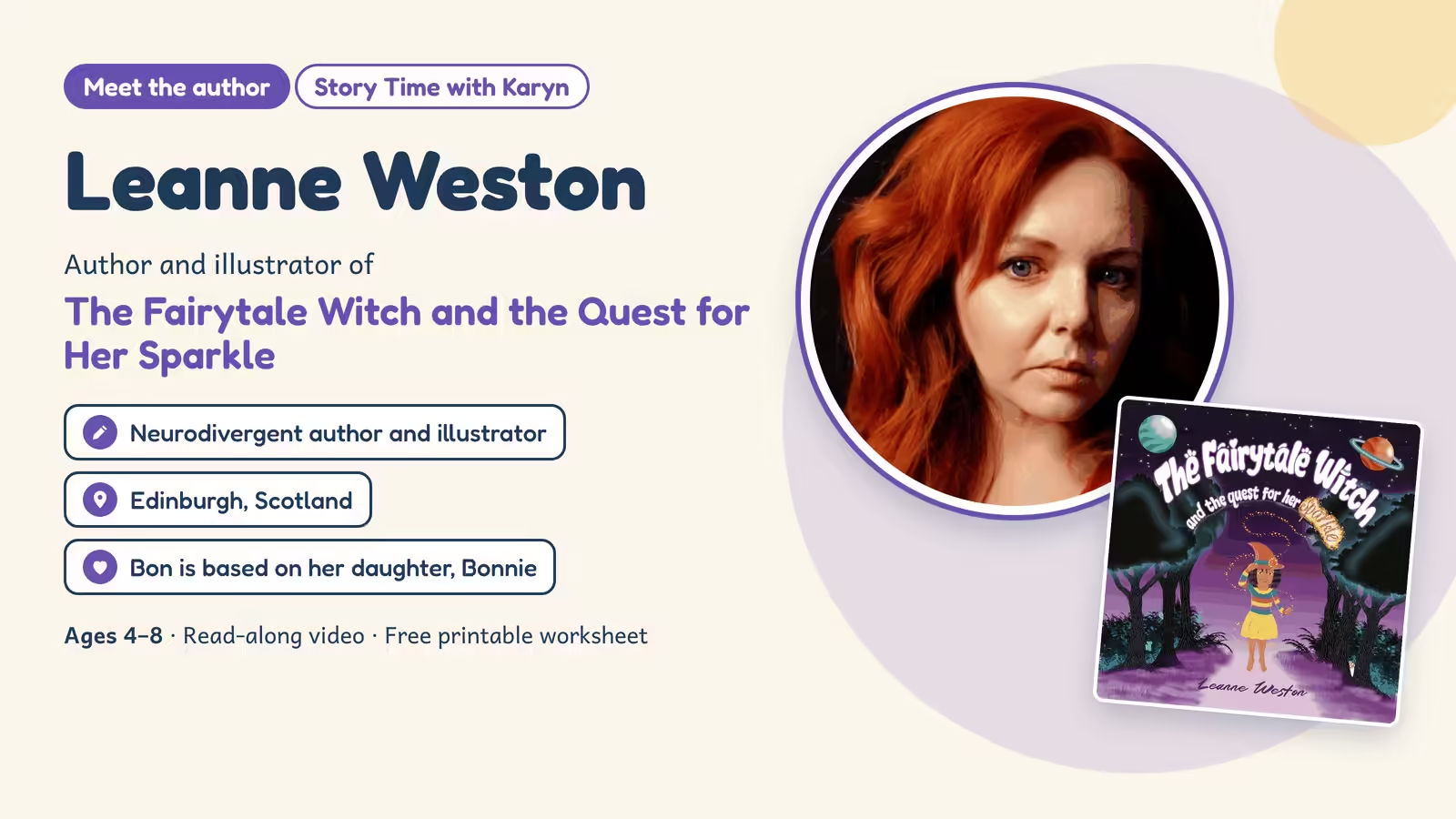
Leanne Weston is a neurodivergent author and illustrator from Edinburgh, and Bon is based on her autistic daughter, Bonnie. As Leanne explains:
“There weren’t any books for young children that I could find that explained autism and so I created one so that Bonnie’s friends and nursery classmates could learn about autism and have honest discussions with their parents and teachers about how they can help to include and support autistic children.”
Loved in classrooms: Leanne says the book has found its way into classrooms across the UK:
“All of her friends refer to the story as ‘Bonnie’s book’ and read it regularly. It’s also been included in countless classrooms across the UK as part of the curriculum to help children understand autism, and that is such an amazing thing to be part of, knowing that Bonnie’s story is helping children understand Autism and helping autistic children across the UK to be recognised, included and supported by their peers. It’s more than I ever could have hoped for.”
The Fairytale Witch on our book club · Buy the book
The Ballad of Levi Locust by Janice Hostetter
Levi loves playing his banjo, but the other bugs keep shooing him away. He keeps searching until he meets a Grasshopper who loves him just as he is. So it’s a gentle way into talking about being left out.
Prefer sign language? Then watch the ASL version of Levi’s story.
- SEL focus: social awareness as well as self-management.
- Try this: practise asking “Can I join in?” and answering “Yes, come and play!”
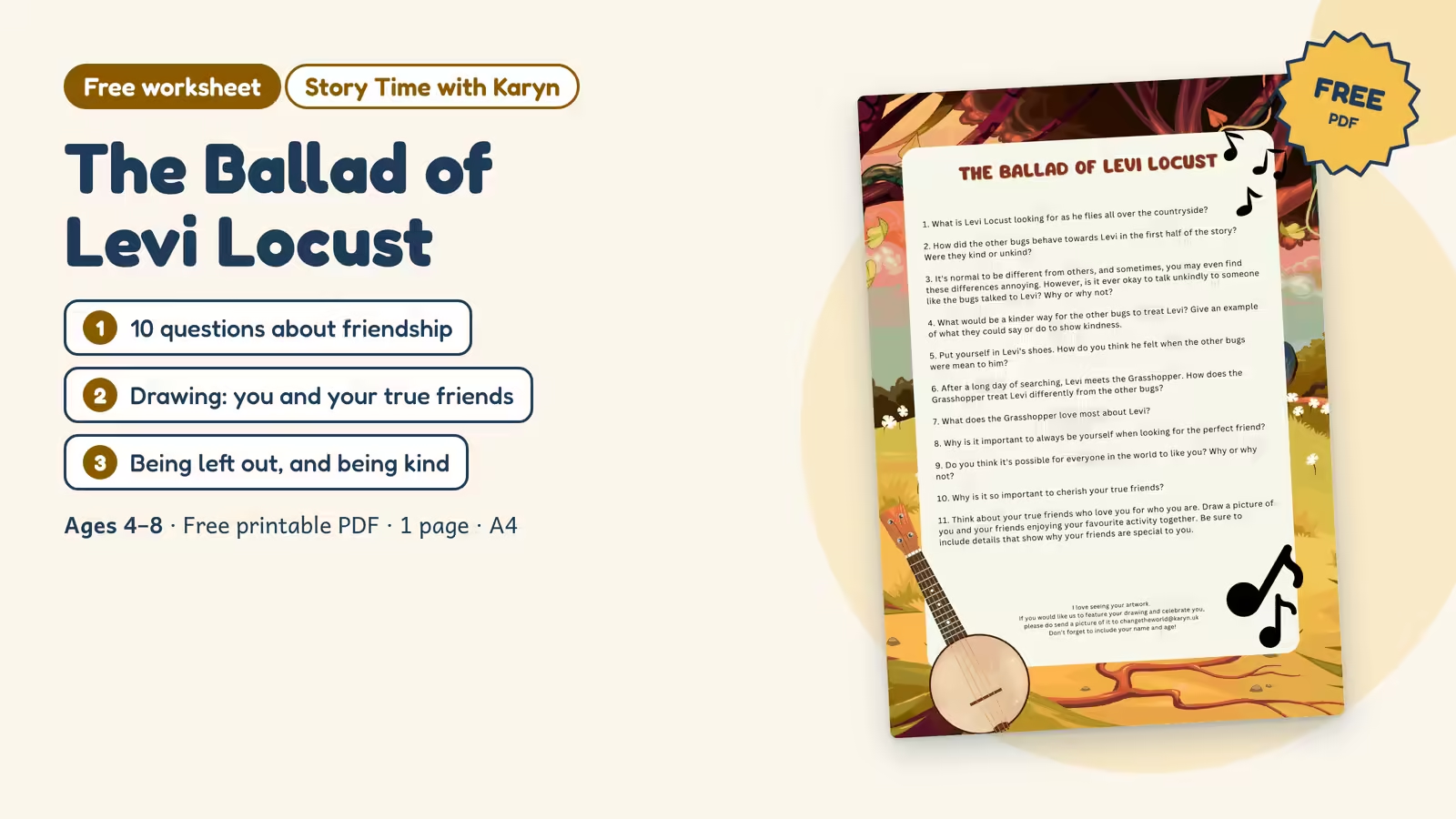
What’s in the free worksheet: 10 questions and a drawing activity on one page: draw yourself and your true friends enjoying your favourite activity together. Questions include the following:
- “Put yourself in Levi’s shoes. How do you think he felt when the other bugs were mean to him?”
- “What would be a kinder way for the other bugs to treat Levi?”
- “Do you think it’s possible for everyone in the world to like you? Why or why not?”
Free printable worksheet
Download the free Levi Locust worksheet (PDF, 1 page)
Meet the author: Janice Hostetter
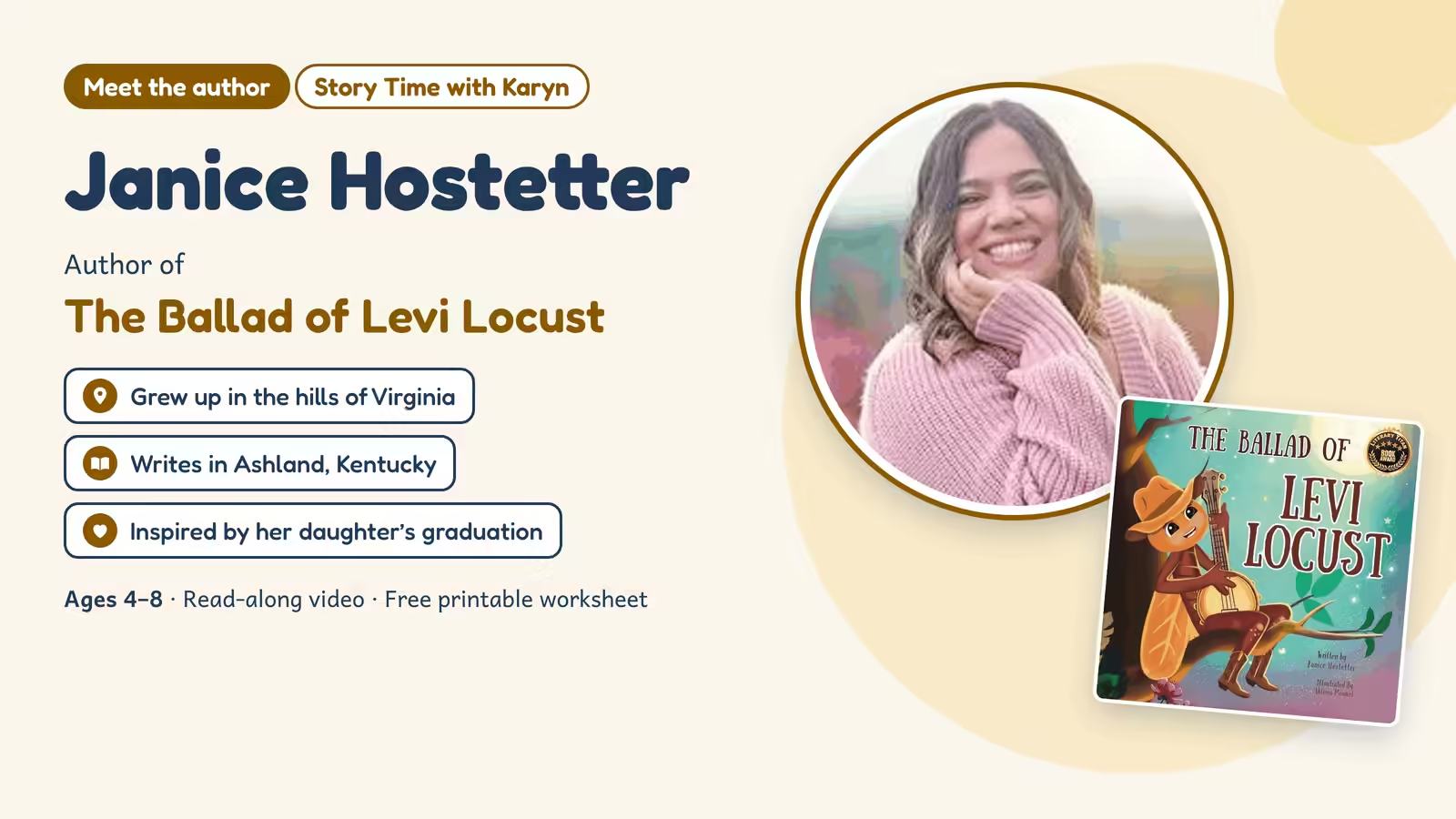
Janice Hostetter, a mum of five, grew up in the hills of Virginia and now writes picture books in Ashland, Kentucky. According to The Ashland Beacon, Levi’s story draws on her own experience of seeing her eldest daughter graduate from high school and set off to find her own place in the world.
Levi Locust on our book club · Buy the book
Maisy and Daisy Move House by Michelle De Robillard
Maisy uses a wheelchair called Daisy, and they can’t wait to explore their beautiful new home, until they find they can’t easily get inside. Written by a physiotherapist who has worked with children and families, this rhyming story is a lovely starting point for talking about disability, access and fairness.
- SEL focus: social awareness as well as responsible decision-making.
- Try this: become access detectives and look around school for what helps everyone get around, and what could be better.
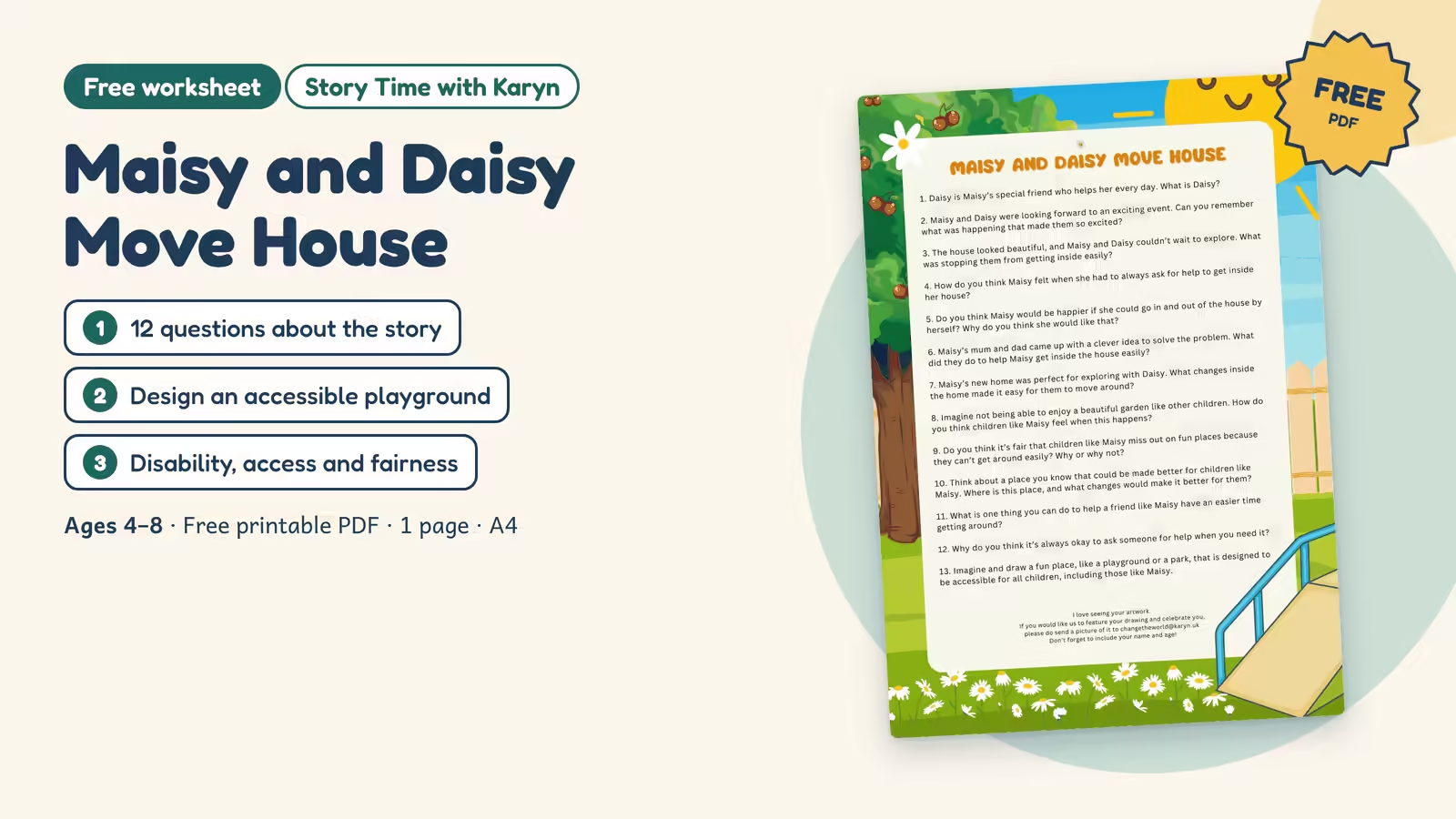
What’s in the free worksheet: 12 questions and a drawing activity on one page: imagine and draw a playground or park designed for every child, including children like Maisy. Questions include the following:
- “How do you think Maisy felt when she had to always ask for help to get inside her house?”
- “Do you think it’s fair that children like Maisy miss out on fun places because they can’t get around easily? Why or why not?”
- “What is one thing you can do to help a friend like Maisy have an easier time getting around?”
Free printable worksheet
Download the free Maisy and Daisy worksheet (PDF, 1 page)
Meet the author: Michelle De Robillard
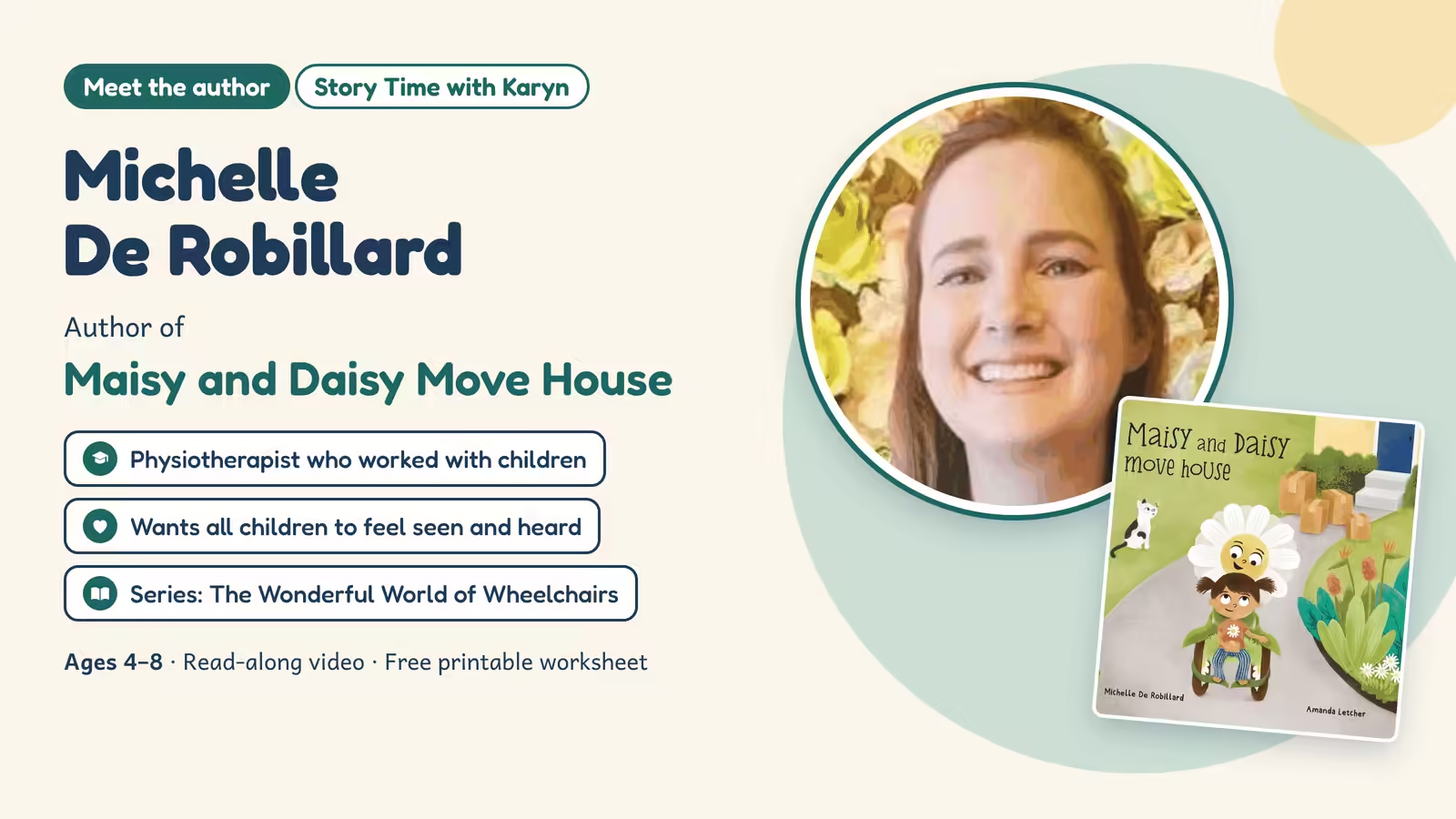
Michelle De Robillard is a mum and a physiotherapist who has worked with children and their families. She created The Wonderful World of Wheelchairs series so that all children feel seen and heard, through fun stories about how every child can be included with the right assistive technology and changes to the places around them.
Maisy and Daisy on our book club · Buy the book
What Is Bullying? How to Explain It to Young Children
For little ones, try this: bullying is when someone hurts you on purpose, again and again, and it’s hard to make it stop. That’s a child-friendly version of the Anti-Bullying Alliance’s definition, which describes bullying as repeated, intentional hurting where there is an imbalance of power, face to face or online (as shared by Bridgelea Primary School).
The ABA definition has four parts, so you can turn it into four simple questions:
| Part of the definition | Question a child can ask |
|---|---|
| Hurtful | Did it hurt my body or my feelings? |
| Repeated | Has it happened again and again? |
| On purpose | Did they mean to do it? |
| Imbalance of power | Is it hard for me to make it stop? |
For example, bullying can look like pushing or hitting, name-calling or teasing, hiding someone’s things, or leaving someone out on purpose. Being left out on purpose counts too, and it’s easy to miss, so name it clearly.
However, not every unkind moment is bullying. A bump in the corridor, a one-off falling out or a squabble over a toy still needs kindness and a grown-up’s help, but it isn’t bullying. That’s what the STOP sort in Pack 3 practises:
- One-off: “You can’t play, the game’s full” said once, when the game really is full.
- Bullying: “You can’t play” said every day, to the same child, followed by laughing.
Words that help:
- Talk about “bullying behaviour” rather than calling a child “a bully”: behaviour can change, and labels stick.
- “Telling to keep someone safe is always OK. That’s not telling tales.”
- “It’s never your fault if someone is unkind to you.”
If a Child Tells You They’re Being Bullied: What to Do
Stay calm, listen, thank them for telling you, make sure they know it isn’t their fault, and then act. Breaking the silence takes courage, so how a grown-up responds really matters.
- Listen and stay calm, even if you feel upset or angry. Let them tell it in their own words, at a time when you can give them your full attention (NSPCC).
- Thank them and reassure them, because bullying is never their fault (StopBullying.gov).
- Don’t promise to keep it a secret. Explain gently who you’ll need to tell so you can help. For school staff, this isn’t optional: the statutory RSHE guidance says staff should never promise not to tell.
- Don’t tell them to either ignore it or fight back. StopBullying.gov lists both as mistakes to avoid.
- Make a plan together. Ask what would help them feel safe, and agree one grown-up they can go to if it happens again.
- Keep checking in. Bullying doesn’t always stop overnight, so follow up and keep following through.
For teachers: follow your school’s anti-bullying and safeguarding procedures, and speak to your designated safeguarding lead if you’re worried about a child’s safety. Avoid asking the children involved to “sort it out” face to face: StopBullying.gov notes that conflict resolution and peer mediation don’t work for bullying, because it isn’t a disagreement between equals.
For parents: start with the class teacher, ask for the school’s anti-bullying policy, and keep a note of what happened and when. Resist the urge to contact the other child’s parents yourself, because it can make things worse; instead, the school can act as the go-between.
Where to get help
| Who | Where to turn |
|---|---|
| Children in the UK | Childline on 0800 1111: free, confidential, any time of day or night, with a section for under-12s |
| Grown-ups in the UK | The NSPCC Helpline on 0808 800 5000, and the Anti-Bullying Alliance’s advice for parents |
| Families and schools in the US | StopBullying.gov |
If a child is in immediate danger, call 999 in the UK or 911 in the US.
For Parents: Signs of Bullying, and What to Do If Your Child Is the Unkind One
Many children don’t tell anyone, so look for changes rather than waiting for words. In fact, US school data shared by StopBullying.gov shows only about one in five bullying incidents were reported, and not every child who is bullied shows signs (StopBullying.gov).
Signs to look out for
- Tummy aches, headaches or feeling poorly before school, or not wanting to go
- Lost or damaged belongings, or injuries they can’t explain
- Changes in eating or sleeping, including nightmares
- Seeming nervous, withdrawn or less confident than usual
- Suddenly losing friends or avoiding playdates and parties
These signs can have other causes too, so start with a calm, curious chat rather than a big question. Some children find it easier to draw or write their feelings first (NSPCC). If your child seems very distressed or talks about hurting themselves, get help straight away from your doctor or emergency services.
If your child is the one being unkind
It’s a hard thing to hear, but it doesn’t make your child “a bad kid”. Young children are still learning how their words and actions land. StopBullying.gov suggests:
- Make sure they understand what the hurtful behaviour was, and why it hurt.
- Show you take it seriously, calmly, and model the respect you want to see.
- Get curious about what’s behind it. Children sometimes act out because something else is going on, and some have been bullied themselves.
- Help them put it right, for example with a sorry note or drawing, or a kind act for the child they hurt.
- Work with the school, and keep praising kind choices afterwards.
The Story Time videos above are a gentle way in: watching For No Reason together lets you talk about why Brad changed, without your child feeling put on the spot.
Kathleen Gauer, who wrote it, puts it simply: “In the story, Brad struggles with anger issues and needs guidance to build positive, non-aggressive friendships.” Children who bully, she adds, “need to know their behavior is unacceptable but that they can change for the better.”
How to Use These Anti-Bullying Week Activities: Levels, Inclusion and Printing
Start with the level that feels comfortable, keep sessions short, and let children say their answers before they write them.
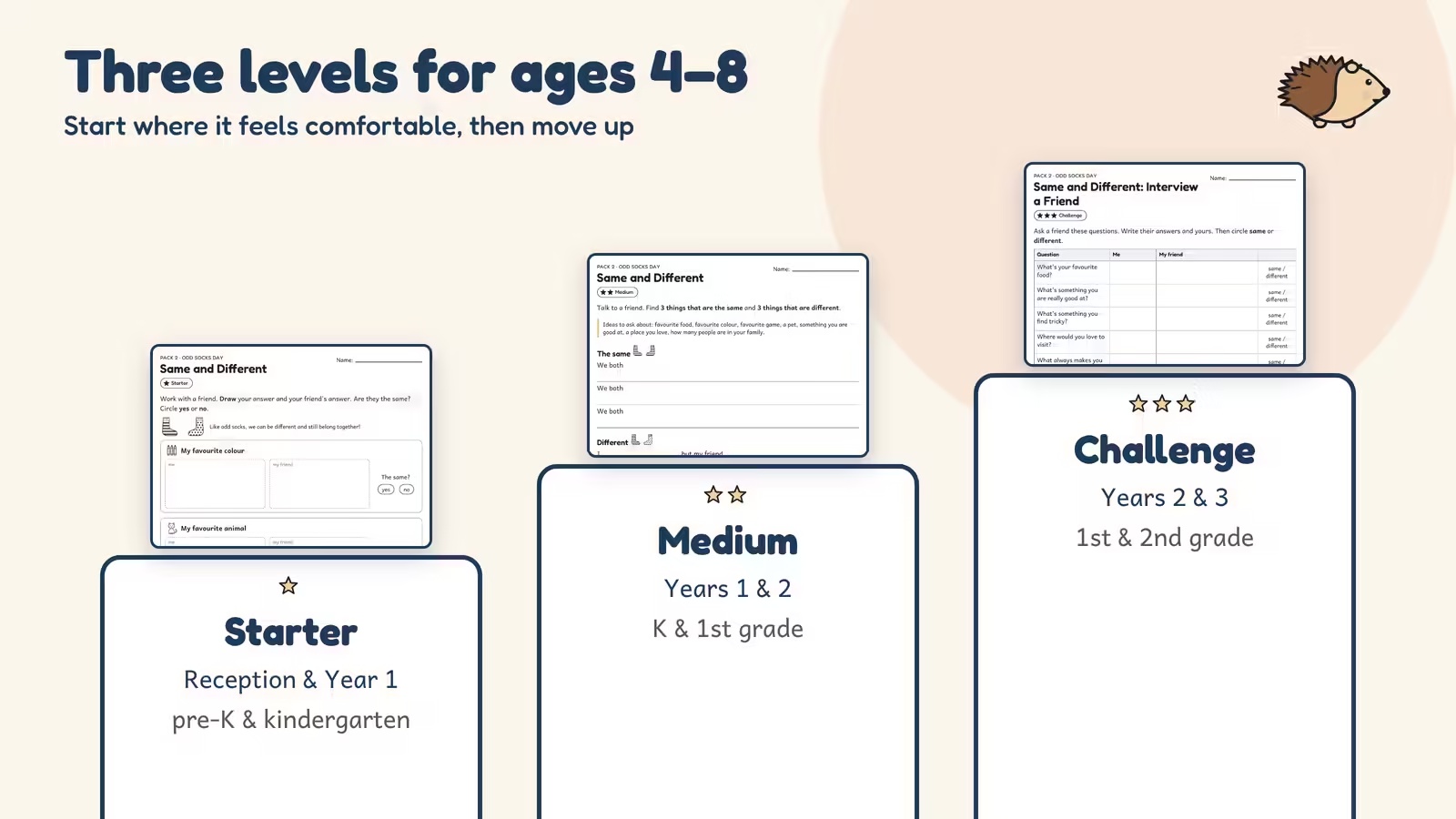
Choose a level: ★ suits Reception and Year 1 (pre-K and kindergarten), ★★ suits Years 1 and 2 (kindergarten and 1st grade), and ★★★ suits Years 2 and 3 (1st and 2nd grade). Children can move up as soon as a level feels easy.
Fitting Anti-Bullying Week activities into your day
- Circle time: the STOP sort, the sock-puppet talk cards and Who Could You Tell?
- Reading and writing time: Pack 1, Same and Different and Kind Online.
- Afternoons: odd sock designs, the bunting, the worry monster and the class promise.
- Early finishers: the compliment fortune teller and Be Kind to You.
Making the activities work for every child
- SEND: the RSHE guidance notes that pupils with SEND may be more vulnerable to bullying, so use the picture-supported ★ sheets, allow extra thinking time, and let children answer with puppets, pictures or pointing. There’s also an ASL version of The Ballad of Levi Locust.
- Every kind of family: the activities talk about “a grown-up at home” rather than “mum and dad”, so children living with grandparents, foster carers or one parent see themselves too. The RSHE guidance also asks schools to show many family structures positively.
- Sensitive children: keep it calm, never role-play the hurtful part, and have a quiet corner ready in case it’s needed. Our box breathing video on Learn with Karyn helps when feelings get big, and When Things Get Too Loud on our book club is a gentle story about sensory overload.
- Reading-friendly design: we follow the British Dyslexia Association’s style guide, including a clear sans-serif font, generous spacing and left-aligned text.
Printing and sharing
Every pack comes in both A4 with UK spelling and US Letter with US spelling. Print at 100% (actual size). The line art is also black and white to save ink, and the answers are at the back of each pack.
The worksheets are free for both classroom and home use. Please share the link to this page rather than the files, so everyone gets the latest versions, and please don’t resell them or upload them elsewhere.
Curriculum Links for Anti-Bullying Week: RSHE in England and SEL in the US
In England, these Anti-Bullying Week activities support statutory Relationships Education, and the updated RSHE guidance applies from 1 September 2026. The table paraphrases the primary content in the statutory guidance, so check the exact wording before quoting it in a plan.
| What primary pupils should know (paraphrased) | Where it shows up here |
|---|---|
| Types of bullying, its impact, what bystanders should do (mainly tell an adult) and how to get help | Pack 3, Kind Online, For No Reason, Jane Escapes to the Jungle of Individuality |
| How to be assertive and express their needs | Sock-puppet talk cards, What Could You Say? |
| Respecting others, including people who are different | Odd Socks Day, Curious and Kind, The Fairytale Witch, Maisy and Daisy Move House |
| Welcoming friendships that don’t leave others lonely or excluded, and no shame in feeling lonely | Pip Speaks Up, Friendship Recipe, The Ballad of Levi Locust |
| Other children’s families may look different, and those differences deserve respect | Dottie’s Tall Tales |
| How to ask for help, and to keep trying until they are heard | Who Could You Tell?, the Worry Monster post box |
| Bullying can affect mental wellbeing, and how to seek help | The worry monster, Be Kind to You, box breathing |
For Reception classes, the activities also support the EYFS goals for personal, social and emotional development. Similarly, in Wales, Scotland and Northern Ireland, they fit Health and Well-being (Wales), Health and Wellbeing (Scotland), and Personal Development and Mutual Understanding (Northern Ireland).
In the US, every activity links to at least one of the five CASEL competencies: self-awareness, self-management, social awareness, relationship skills and responsible decision-making. The reading and writing sheets also list their Common Core codes in each pack table.
Why These Anti-Bullying Week Activities Work: What the Research Says
School anti-bullying programmes do work, though the effects are modest, and some ingredients seem to matter more than others. Here’s what we drew on, and what it doesn’t tell us.
- Anti-bullying programmes: a Campbell review of 100 evaluations, with children typically aged 4 to 18, found that school programmes reduced bullying by roughly 18–19% and being bullied by roughly 15–16% (Gaffney, Ttofi and Farrington, 2021). However, the authors call the effects modest, and they vary a lot between programmes.
- The ingredients that seem to help: a follow-up analysis of the same evaluations linked bigger reductions in bullying to classroom rules, information for parents, classmates getting involved, anti-bullying policies, a whole-school approach and support for children who are bullied (Gaffney, Ttofi and Farrington, 2021). For that reason, this hub includes a class promise, a section for parents and plenty of upstander practice.
- Social and emotional learning: a meta-analysis of 213 school SEL programmes with 270,034 students from kindergarten to high school found better social and emotional skills, attitudes and behaviour, plus an 11-percentile-point gain in achievement. How well programmes followed recommended teaching practices also made a difference (Durlak and colleagues, 2011).
What the research doesn’t tell us: none of these studies tested our worksheets. The programmes they reviewed were mostly structured courses of lessons or whole-school approaches, so a week of activities is a good start, not a programme. Use these together with your school’s own anti-bullying policy and approach.
Sources
- Gaffney H, Ttofi MM and Farrington DP (2021), Effectiveness of school-based programs to reduce bullying perpetration and victimization: An updated systematic review and meta-analysis, Campbell Systematic Reviews 17(2), e1143.
- Gaffney H, Ttofi MM and Farrington DP (2021), What works in anti-bullying programs? Analysis of effective intervention components, Journal of School Psychology.
- Durlak JA, Weissberg RP, Dymnicki AB, Taylor RD and Schellinger KB (2011), The impact of enhancing students’ social and emotional learning: A meta-analysis of school-based universal interventions, Child Development 82(1), 405–432.
Kindness All Year: Unity Day, Pink Shirt Day and More
These Anti-Bullying Week activities work well beyond November, so bookmark this page for October and February too.
| When | What | Where |
|---|---|---|
| October, including Unity Day on a Wednesday that month | National Bullying Prevention Month. On Unity Day, people wear and share orange for kindness, acceptance and inclusion | US |
| 13 November, every year | World Kindness Day | Worldwide |
| Monday 16 to Friday 20 November 2026 | Anti-Bullying Week, starting with Odd Socks Day | UK |
| February | Random Acts of Kindness Day | Started in the US |
| The last Wednesday of February (24 February 2027) | Pink Shirt Day: wear pink to stand against bullying | Canada |
- Unity Day was started in 2011 by PACER’s National Bullying Prevention Center as the signature event of National Bullying Prevention Month. Orange socks count, so Pack 2 works a treat.
- Pink Shirt Day began in Nova Scotia in 2007, when two high school students organised a “pink protest” after a younger student was bullied for wearing pink (University of Toronto). For No Reason is by a Toronto author, Kathleen Gauer, so it’s a lovely fit.
- Random Acts of Kindness Day is a February counterpart to World Kindness Day that many UK schools use too (Awareness Days), and the Kindness Passport works just as well then.
More Free Kindness and Anti-Bullying Resources We Love
From us
- Join our free online kids book club for more read-alongs and worksheets, filterable by theme.
- Subscribe to Story Time with Karyn for calm, animated read-alongs, as well as Learn with Karyn for interactive lessons with Bobbie the robot dog.
- Read our guide to practical ways to teach kids empathy and emotional intelligence.
- Our community helpers worksheets pair nicely with Who Could You Tell?, because they’re all about the people who help us.
- The full write-up of The Fairytale Witch is in our fall reading comprehension and SEL worksheets.
From others (we link to them with credit)
- The Anti-Bullying Alliance: official Anti-Bullying Week films, lesson plans and assemblies, as well as advice for parents.
- The NSPCC: practical advice for parents dealing with bullying.
- Childline: free, confidential help for children, any time.
- PACER’s National Bullying Prevention Center: elementary activities such as the Unity Tree, and KidsAgainstBullying.org for children.
- StopBullying.gov: US government advice on warning signs and what to do.
FAQs About Anti-Bullying Week Activities
When is Anti-Bullying Week 2026?
Anti-Bullying Week 2026 runs from Monday 16 to Friday 20 November, starting with Odd Socks Day on Monday 16 November.
What is the theme for Anti-Bullying Week 2026?
The theme is Break the Silence. It encourages children and adults to talk about bullying, speak up and ask for help, and it was shaped by more than 200 children and young people.
What is Odd Socks Day?
Odd Socks Day opens Anti-Bullying Week, when children and grown-ups wear odd socks to celebrate what makes everyone unique. Nobody needs to buy anything, so everyone can join in.
Are these anti-bullying worksheets free?
Yes. Every pack of Anti-Bullying Week activities is a free PDF with no sign-up. Please share the link to this page rather than the files, and please don’t resell them.
What ages are these Anti-Bullying Week activities for?
They’re for ages 4–8, which is Reception to Year 3 in the UK, or pre-K to 2nd grade in the US. Most worksheets also come at three levels.
How do I explain bullying to a five-year-old?
Try: “Bullying is when someone hurts you on purpose, again and again, and it’s hard to make it stop. If it happens, tell a grown-up you trust.”
What’s the difference between bullying and falling out?
Bullying happens again and again, on purpose, and it’s hard for the child to make it stop. A one-off falling out still needs a grown-up’s help, but it isn’t bullying. The STOP sort in Pack 3 also helps children tell the difference.
What should I do if a child tells me they’re being bullied?
Stay calm, listen, thank them for telling you, make sure they know it isn’t their fault, and don’t promise to keep it secret. Teachers should also follow their school’s procedures. Children in the UK can call Childline on 0800 1111, and adults can call the NSPCC Helpline on 0808 800 5000.
Can I use these activities outside Anti-Bullying Week?
Yes. They also suit National Bullying Prevention Month in the US in October, World Kindness Day on 13 November, Pink Shirt Day in Canada in February, or any week you want to build a kinder class.
Do the worksheets come in A4 and US Letter?
Yes. Every pack comes in both A4 with UK spelling and US Letter with US spelling. Print at 100% (actual size).
What is Learn with Karyn?
Learn with Karyn is our sister YouTube channel of interactive lessons, where Bobbie the robot dog and I get children pointing, moving and joining in. For this week, try Box Breathing and Positive Affirmations, What Do My Friends Eat? and Community Helpers. You’ll also find all our lessons on our Learn with Karyn page.
Join the Free Online Kids Book Club
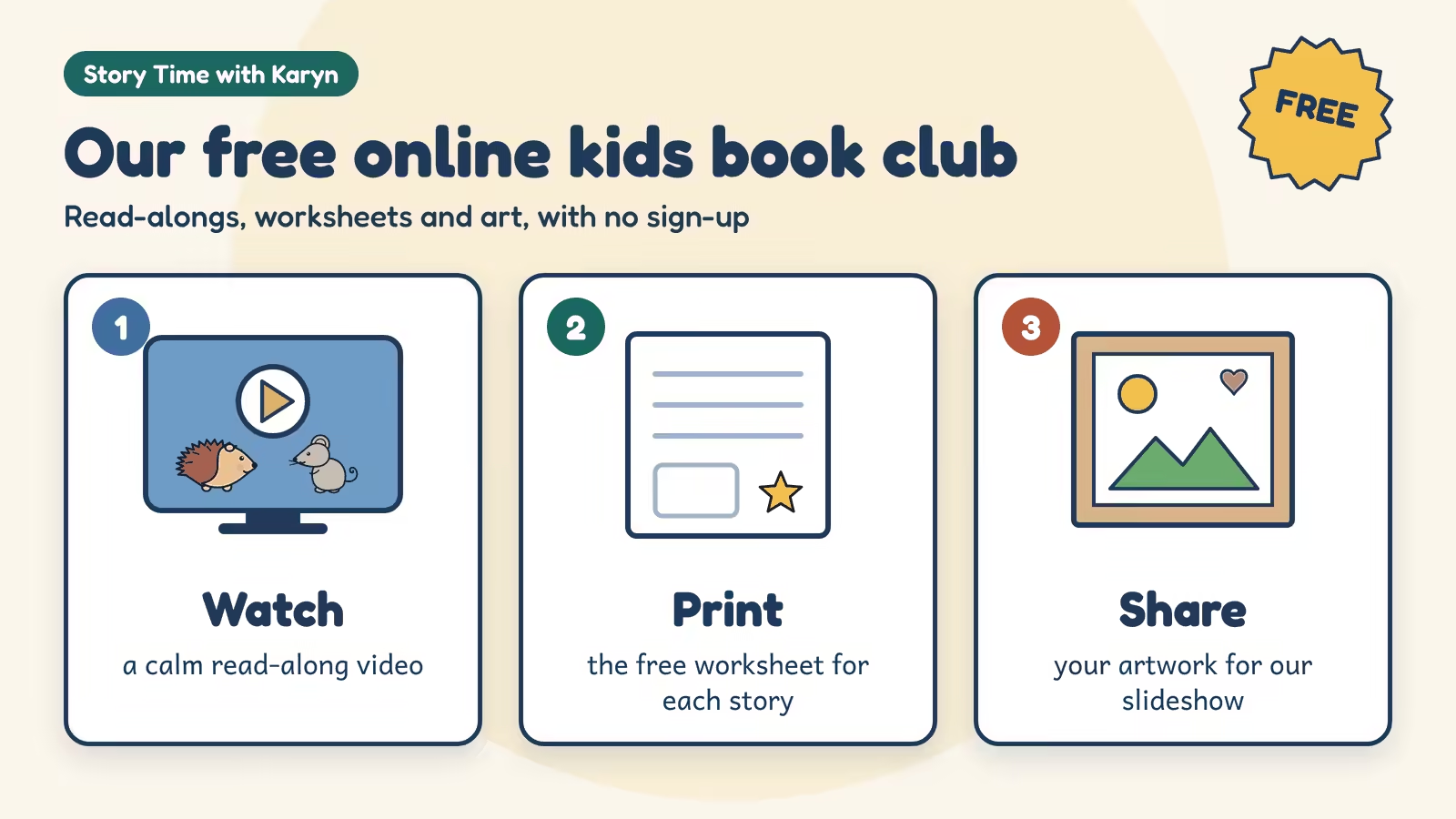
If you love these Anti-Bullying Week activities, the best way to keep them coming is to join our free online kids book club. Watch the read-alongs on Story Time with Karyn, download each story’s free worksheet at changetheworldwithkaryn.com, and then explore Learn with Karyn for interactive lessons with Bobbie the robot dog.
Share your odd socks! Did your class design odd socks, build a kindness washing line or make a friendly worry monster? If so, ask a grown-up to send a photo of the artwork (no faces, please) through our Connect page, with the child’s first name and age. We’d love to feature it in our artwork slideshow.
About Story Time with Karyn: I’m Karyn, an actress turned creative director and children’s book author. On Story Time with Karyn, I bring picture books by independent authors to life with calm, low-stimulation animation, always with the author’s permission, and pair each one with a free worksheet. Meanwhile, on our sister channel, Learn with Karyn, Bobbie the robot dog and I bring curriculum-style topics to life. If you love a story, please support its author by buying the book.
Wishing you a kind, brave and wonderfully odd-socked week!
With magic, Karyn