In this article
- At a Glance: Free AI Worksheets for Pre-K to 2nd Grade
- What AI Literacy Means for Ages 4 to 8
- Pre-K and Kindergarten AI Worksheets (Ages 4-6)
- 1st Grade AI Worksheets (Ages 6-7)
- 2nd Grade AI Worksheets (Ages 7-8)
- AI Standards Map: Worksheets and Learn with Karyn Episodes
- How to Use and Print the AI Worksheets
- What the Research Says About AI Literacy for Young Children
- You Might Also Enjoy: Story Time with Karyn
- FAQ: AI Worksheets for Kids
- Sources
At a Glance: Free AI Worksheets for Pre-K to 2nd Grade
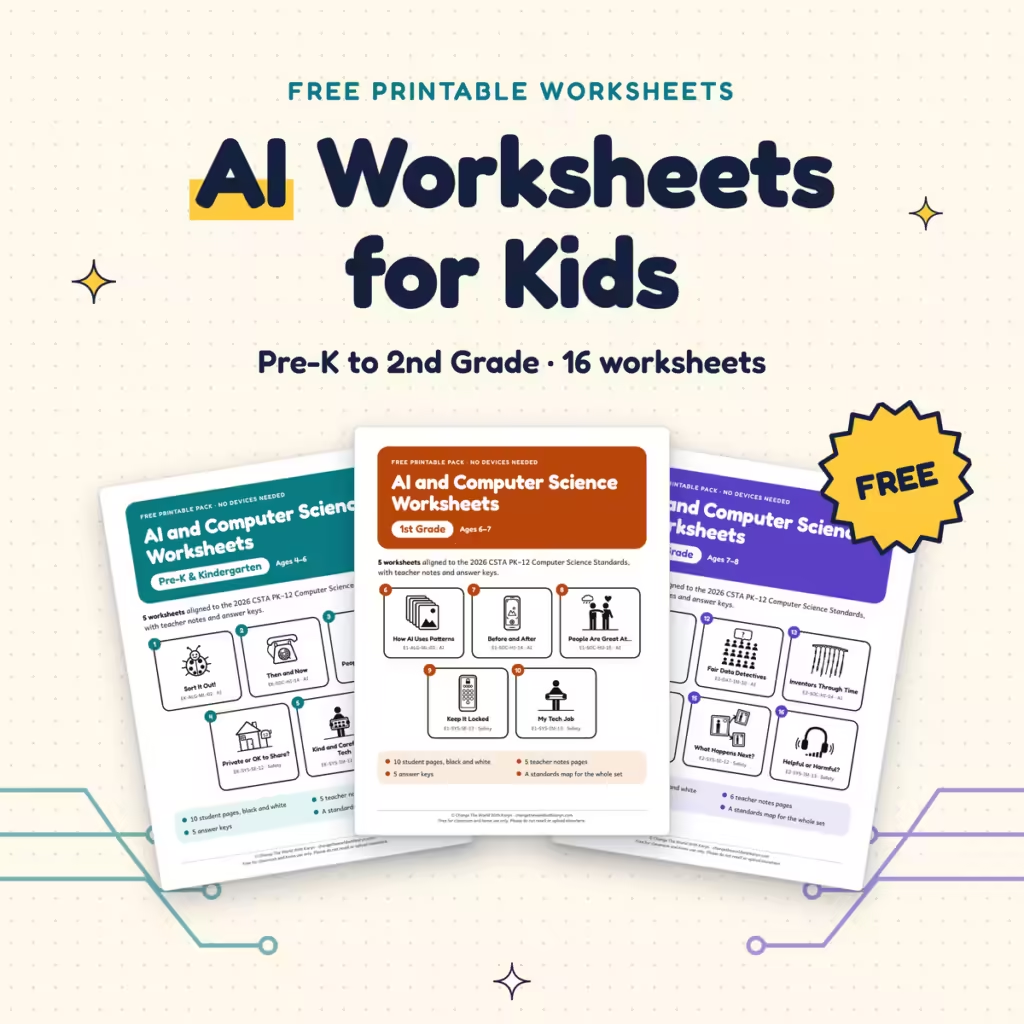
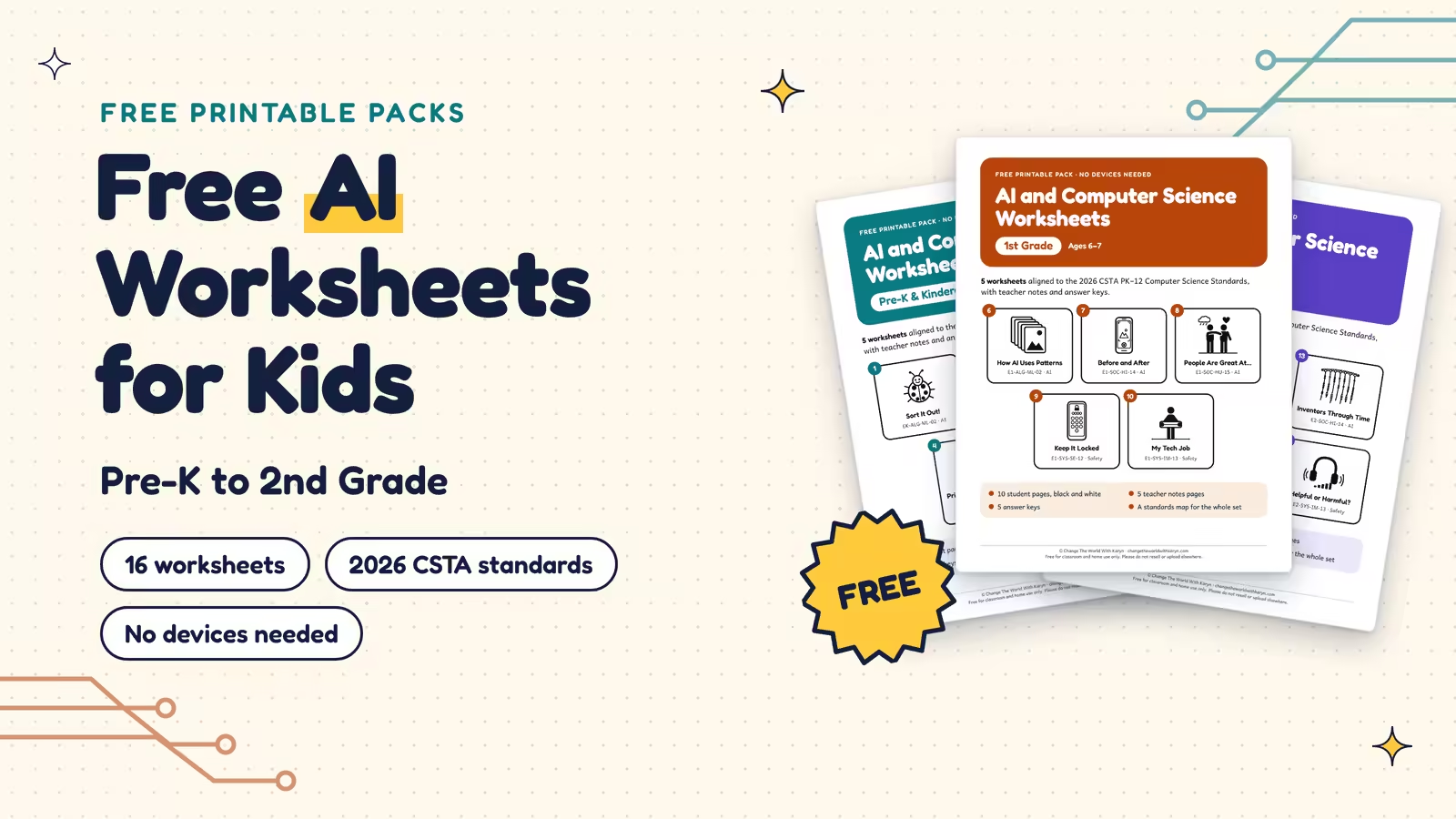
Three free packs hold 16 worksheets, and each worksheet teaches one 2026 CSTA computer science standard. Every pack has two student pages per worksheet, teacher notes, answer keys and a one-page standards map. The pages are black and white, US Letter, and need no devices.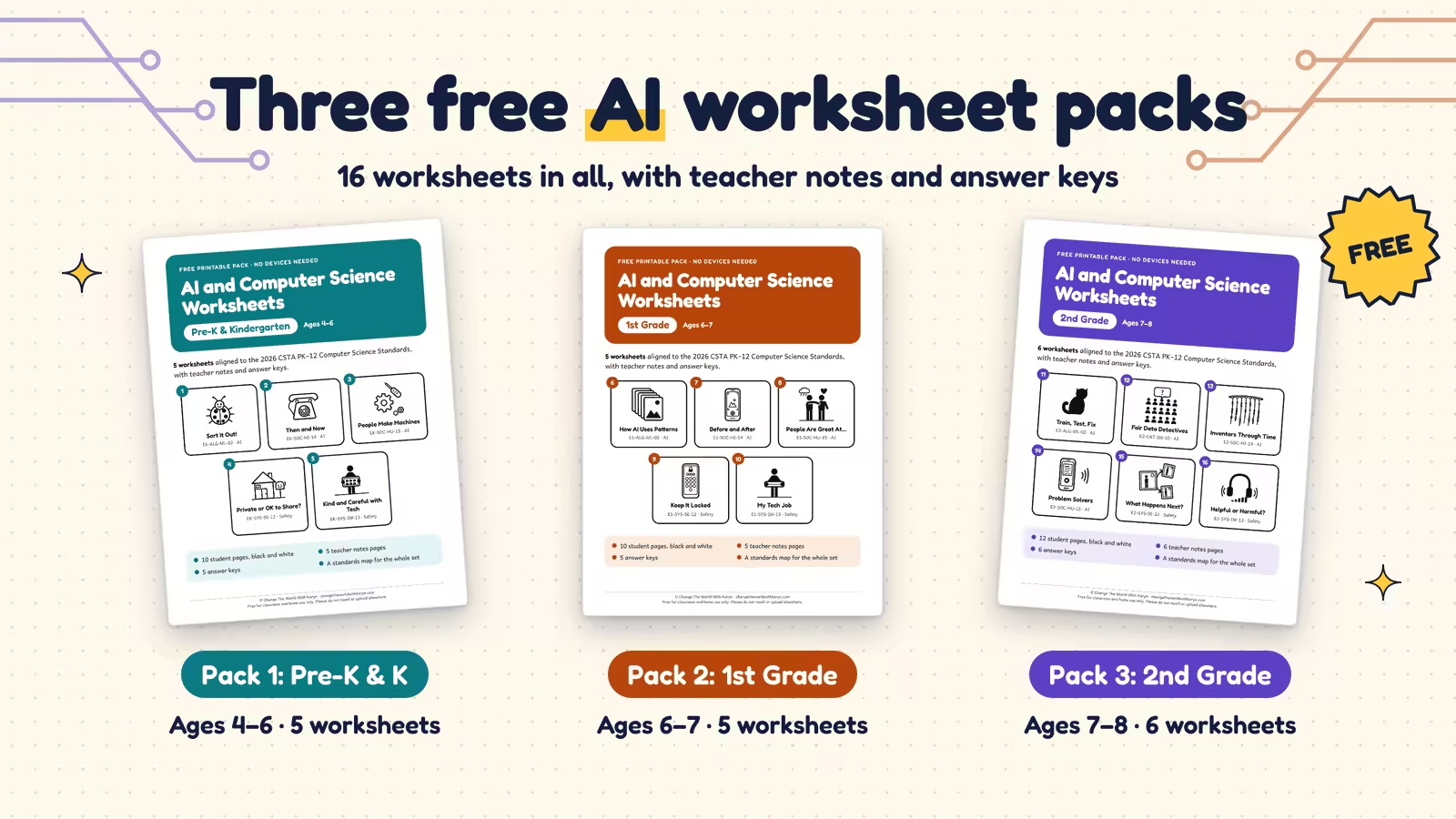
| Pack | Ages (England) | Worksheets | Standards covered | Download |
|---|---|---|---|---|
| Pre-K & Kindergarten | 4-6 (Reception, Year 1) | 5 | EK-ALG-ML-02, EK-SOC-HI-14, EK-SOC-HU-15, EK-SYS-SE-12, EK-SYS-IM-13 | Download Pack 1 |
| 1st Grade | 6-7 (Year 2) | 5 | E1-ALG-ML-02, E1-SOC-HI-14, E1-SOC-HU-15, E1-SYS-SE-12, E1-SYS-IM-13 | Download Pack 2 |
| 2nd Grade | 7-8 (Year 3) | 6 | E2-ALG-ML-02, E2-DAT-IM-10, E2-SOC-HI-14, E2-SOC-HU-15, E2-SYS-SE-12, E2-SYS-IM-13 | Download Pack 3 |
What AI Literacy Means for Ages 4 to 8
At this age, AI literacy means knowing that people make AI, that it learns from examples and can get things wrong, and that we use tech safely and kindly. The 2026 CSTA PK-12 Computer Science Standards build AI-related learning into every part of computer science instead of treating it as a separate subject (CSTA). Each of our worksheets teaches one standard. The table shows how the big ideas grow from Pre-K to 2nd grade; (AI) marks the standards CSTA tags as AI-related.| Big idea | Pre-K & K (ages 4-6) | 1st Grade (ages 6-7) | 2nd Grade (ages 7-8) |
|---|---|---|---|
| How AI learns | Sort things into groups using clues (EK-ALG-ML-02, AI) | How AI uses patterns in data (E1-ALG-ML-02, AI) | How data trains an AI model (E2-ALG-ML-02, AI) |
| Fair data | Not in this set | Not in this set | Fair and unfair ways to collect data (E2-DAT-IM-10, AI) |
| Tech through time | How everyday tools changed over time (EK-SOC-HI-14, AI) | How an everyday activity changed with new tech (E1-SOC-HI-14, AI) | Inventors from many places and times (E2-SOC-HI-14, AI) |
| People and computers | People plan, build and test machines (EK-SOC-HU-15, AI) | What people and computers each do well (E1-SOC-HU-15, AI) | How people made tech to solve problems (E2-SOC-HU-15, AI) |
| Privacy and safety | Tell private information from OK-to-share (EK-SYS-SE-12) | Keep devices and accounts locked (E1-SYS-SE-12) | Online actions have real-world results (E2-SYS-SE-12) |
| Using tech well | Use tech in kind, careful ways (EK-SYS-IM-13) | My jobs when I use tech (E1-SYS-IM-13) | Benefits and harms of using tech (E2-SYS-IM-13) |
Pre-K and Kindergarten AI Worksheets (Ages 4-6)
Pack 1 has five worksheets for ages 4 to 6 (Reception and Year 1), with big pictures for pre-readers and a read-aloud box on every sheet. Allow about 15 to 20 minutes per worksheet.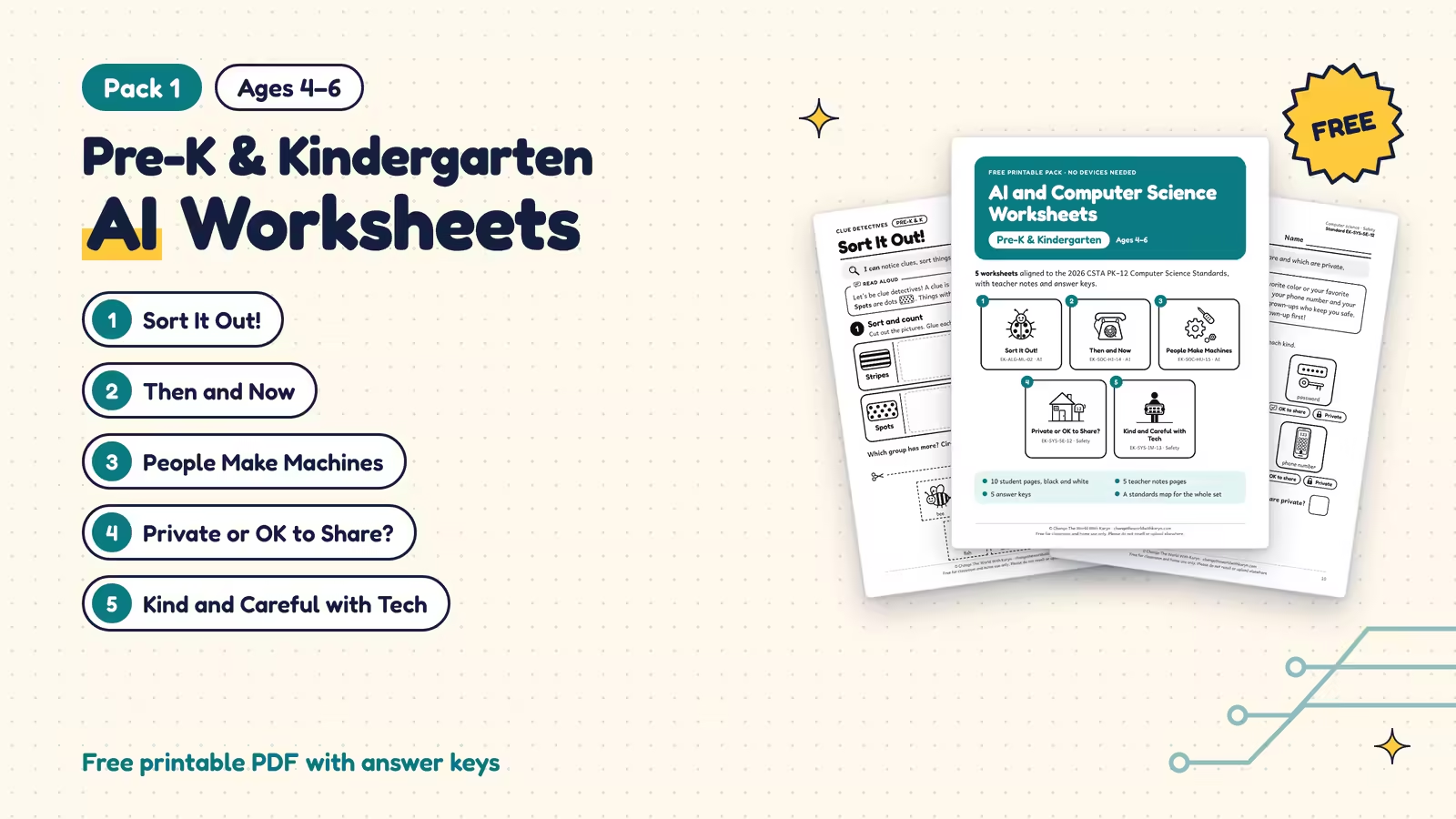
Download: Pre-K & Kindergarten pack, 23 pages, US Letter
1. Sort It Out! (EK-ALG-ML-02)
Children cut out seven picture cards, sort them by a clue (stripes or spots) and count which group has more. Then they decide where new things go, which is the first idea behind how AI learns from examples. It needs scissors and a glue stick.2. Then and Now (EK-SOC-HI-14)
Children match long-ago tools to today’s, such as a dial phone to a smartphone, and sort tools into Long ago or Today. A take-home prompt asks a grown-up what tech they used as a child.3. People Make Machines (EK-SOC-HU-15)
Children put four steps in order (idea, plan, build, test), design a machine of their own and circle the things people made. It shows that computers and robots are made by people, not grown.4. Private or OK to Share? (EK-SYS-SE-12)
Children sort six things into OK to share and Private, such as a favorite color and a home address. If a game asks for something private, they learn to stop and ask a grown-up first.5. Kind and Careful with Tech (EK-SYS-IM-13)
Children give a thumbs up or down to habits like carrying a tablet with two hands or putting a drink by the laptop. Then they color a tech promise and sign it.1st Grade AI Worksheets (Ages 6-7)
Pack 2 has five worksheets for ages 6 to 7 (Year 2). Children start reading short instructions themselves, with a read-aloud box for support. Allow about 20 to 25 minutes per worksheet.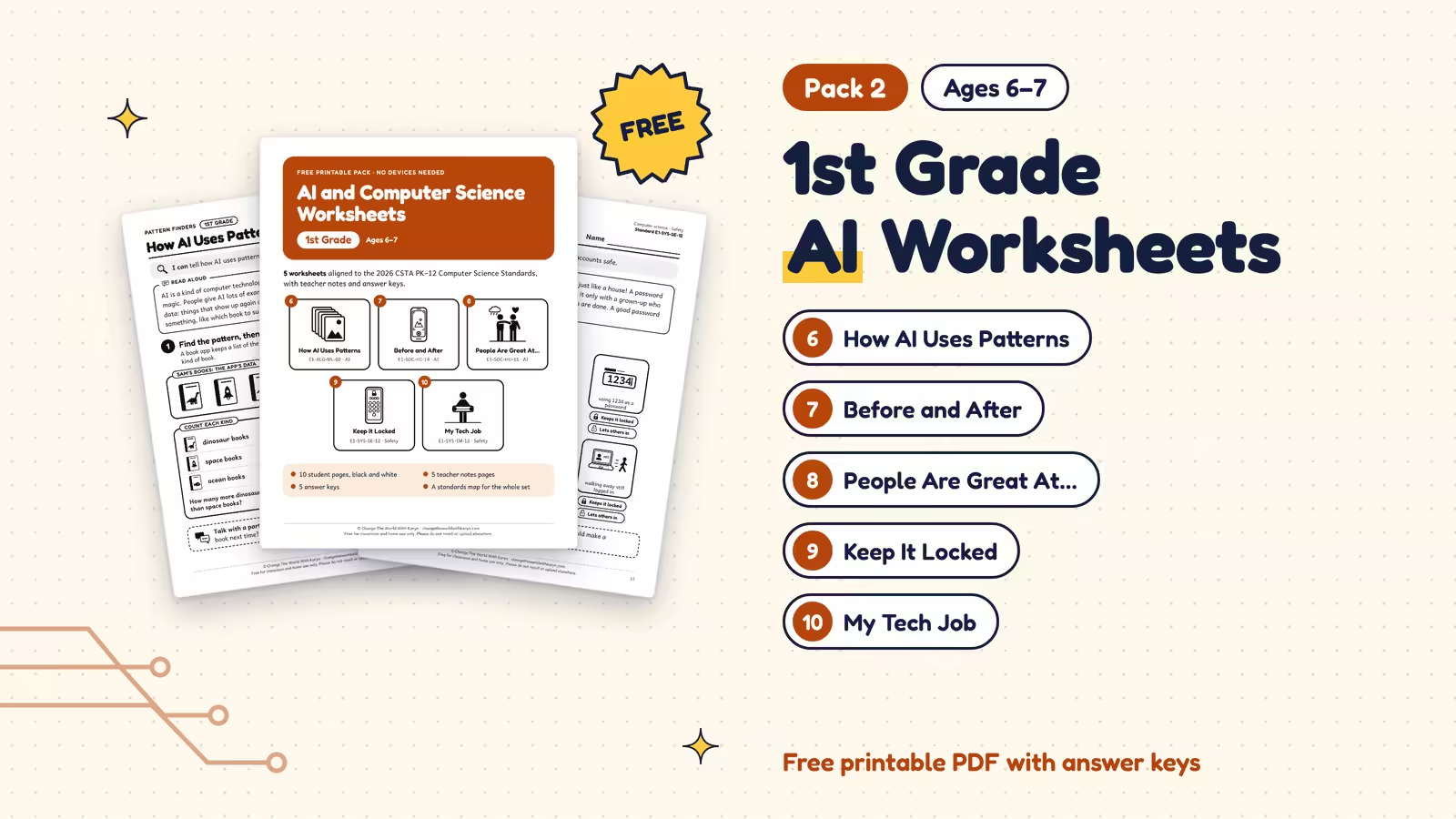
Download: 1st Grade pack, 23 pages, US Letter
6. How AI Uses Patterns (E1-ALG-ML-02)
A book app’s data is the seven books Sam borrowed. Children count each kind, predict the book the app will suggest next, then draw a new house that follows a pattern, the way AI makes something new. It also practices data in three groups (Common Core 1.MD.C.4).7. Before and After (E1-SOC-HI-14)
Children compare taking photos with a film camera and a phone camera, and checking the weather in the newspaper and with a smart speaker. They also find what stayed the same.8. People Are Great At… (E1-SOC-HU-15)
Children decide who is great at each job, people or computers, from cheering up a sad friend to adding big numbers fast. Then they draw a person and a computer doing a job together.9. Keep It Locked (E1-SYS-SE-12)
Children sort habits that keep devices locked, like logging out, from ones that let others in, like using 1234 as a password. Then they join three random words into a pretend strong password, a tip from the UK’s National Cyber Security Centre.10. My Tech Job (E1-SYS-IM-13)
Children match pictures to four tech jobs (take care of tech, use kind words, follow the tech rules, tell a grown-up). Then they make a badge for the job they think matters most.Meet the people who build our world. In STEM Day by Amy Doslich, Hannah’s Career Day turns into a tour of 11 STEM jobs, from a robotics engineer to a cryptographer. It’s one of the calm, animated read-alouds in our free online kids book club, and like every story there, it comes with a free printable worksheet. Pair it with the 2nd grade inventors and problem-solvers worksheets below. Watch STEM Day and get the worksheet, then explore the club for more free educational resources.
2nd Grade AI Worksheets (Ages 7-8)
Pack 3 has six worksheets for ages 7 to 8 (Year 3), with more reading, writing and real-world cases. Allow about 25 to 30 minutes per worksheet.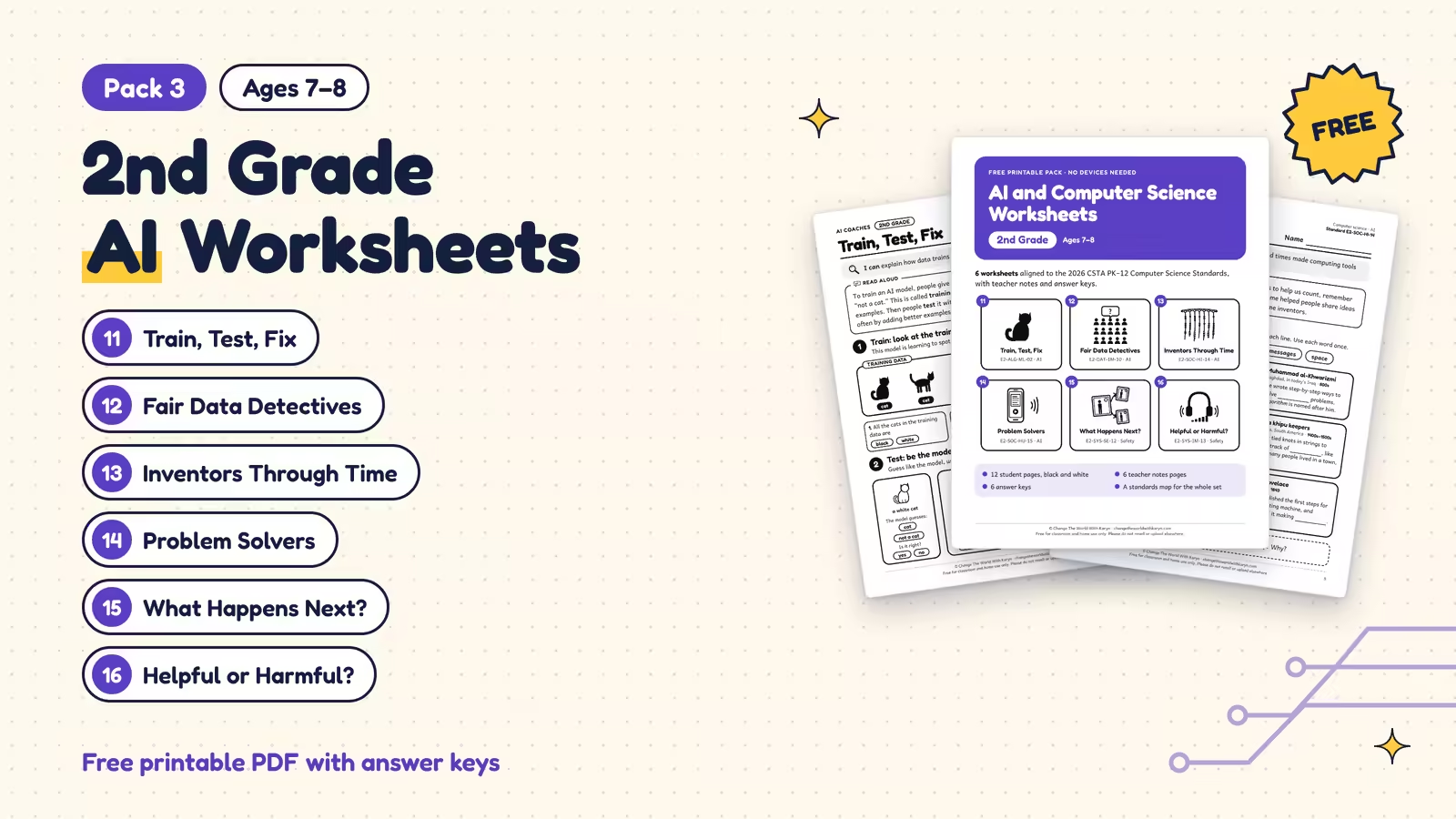
Download: 2nd Grade pack, 27 pages, US Letter
11. Train, Test, Fix (E2-ALG-ML-02)
Children look at a cat-spotting model’s training data and find the hidden pattern: every cat is black. They test the model the way it would guess, then choose better pictures to fix it.12. Fair Data Detectives (E2-DAT-IM-10)
Children sort fair and unfair ways to collect data, graph Mia’s soccer-field survey and decide whether her claim is fair. A voice app that learned only from grown-ups shows why fair data matters for AI.13. Inventors Through Time (E2-SOC-HI-14)
Children meet six inventors, from Inca khipu keepers to Ada Lovelace, Katherine Johnson and Fei-Fei Li, and put them on a timeline. Then they make an inventor card for a tool of their own.14. Problem Solvers (E2-SOC-HU-15)
Children read a real case file: Saqib Shaikh, who is blind, helped make Seeing AI, a free app that reads words out loud. They answer reporter questions, match problems to tools and plan a tool of their own.15. What Happens Next? (E2-SYS-SE-12)
Children predict what happens in real life after four online actions, such as tapping “Buy” in a game or posting a friend’s photo. Then they use three stop-and-think questions to decide Go or Stop.16. Helpful or Harmful? (E2-SYS-IM-13)
Children sort six ways people use tech into helpful and harmful, and write one tool’s two sides. Then they choose helpful fixes, like checking an AI helper’s answer in a book.AI Standards Map: Worksheets and Learn with Karyn Episodes
Each worksheet matches one 2026 CSTA standard, and four of them pair with a Learn with Karyn episode for a video lesson. The same map is page 3 of every pack.| Standard | Our worksheet | Learn with Karyn episode | Episode worksheet | England |
|---|---|---|---|---|
| EK-ALG-ML-02 (AI) | 1. Sort It Out! | Episode 1: What Is a Computer? | Episode 1 activities | Reception, Year 1 |
| EK-SOC-HI-14 (AI) | 2. Then and Now | — | — | Reception, Year 1 |
| EK-SOC-HU-15 (AI) | 3. People Make Machines | Episode 1: What Is a Computer? | Episode 1 activities | Reception, Year 1 |
| EK-SYS-SE-12 | 4. Private or OK to Share? | — | — | Reception, Year 1 |
| EK-SYS-IM-13 | 5. Kind and Careful with Tech | — | — | Reception, Year 1 |
| E1-ALG-ML-02 (AI) | 6. How AI Uses Patterns | Episode 2: What Is Smart Technology? | — | Year 2 |
| E1-SOC-HI-14 (AI) | 7. Before and After | Episode 2: What Is Smart Technology? | — | Year 2 |
| E1-SOC-HU-15 (AI) | 8. People Are Great At… | — | — | Year 2 |
| E1-SYS-SE-12 | 9. Keep It Locked | — | — | Year 2 |
| E1-SYS-IM-13 | 10. My Tech Job | — | — | Year 2 |
| E2-ALG-ML-02 (AI) | 11. Train, Test, Fix | — | — | Year 3 |
| E2-DAT-IM-10 (AI) | 12. Fair Data Detectives | — | — | Year 3 |
| E2-SOC-HI-14 (AI) | 13. Inventors Through Time | — | — | Year 3 |
| E2-SOC-HU-15 (AI) | 14. Problem Solvers | — | — | Year 3 |
| E2-SYS-SE-12 | 15. What Happens Next? | — | — | Year 3 |
| E2-SYS-IM-13 | 16. Helpful or Harmful? | — | — | Year 3 |
How to Use and Print the AI Worksheets
Print the student pages, read the box aloud together and keep the teacher notes and answer keys for yourself.- Pick the pack for the child’s grade, or their year group in England (see the At a Glance table).
- Print at 100% (“Actual size”) on US Letter. On A4 paper, choose “Fit to page”: every page is laid out to fit A4, so the copy is about 3% smaller and nothing is cut off.
- Print just the student pages for each child: pages 4 to 13 in the Pre-K & K and 1st Grade packs, pages 4 to 15 in the 2nd Grade pack. Teacher notes and answer keys are at the back.
- Start with the “Read aloud” box, then work through the parts in order. Each worksheet ends with “Show what you know” and a face for children to color.
- Allow about 15 to 20 minutes per worksheet for Pre-K & K, 20 to 25 for 1st grade and 25 to 30 for 2nd grade (our estimates, not yet tested in class).
- No devices needed. Children need a pencil and crayons; worksheet 1 also needs scissors and a glue stick. The pages are black and white, so they print well on any printer.
- Add a video if you like: four worksheets pair with a Learn with Karyn episode in the standards map, and every worksheet works on its own.
- Share their drawings. Several worksheets ask children to draw, from a machine of their own to an inventor card. Send a photo through our Connect page and we’ll add it to the Kids’ Art Gallery (a first name is enough).
What the Research Says About AI Literacy for Young Children
Children as young as 4 can learn how AI works, and early lessons shape how they see the AI around them. Four studies sit behind the way these worksheets are built.- Children aged 4 to 6 can learn AI ideas. In a study of 80 Pre-K and kindergarten children near Boston, children trained and played with simple robots, and the median score on the AI test was 70%. Pre-K children were far more likely than kindergartners to see robots as toys (80% versus 15%). (Williams, Park and Breazeal, 2019)
- Children form ideas about smart devices early. When 26 children aged 3 to 10 played with Alexa, Google Home, a robot toy and a chatbot, many older children said the devices were smarter than them, judging by how much each one knew. (Druga and colleagues, 2017)
- AI literacy has a working definition. Long and Magerko define it as a set of competencies to critically evaluate AI, communicate and collaborate with it, and use it as a tool, and they list 17 competencies. (Long and Magerko, 2020)
- Teachers need support too. A review of AI literacy in early childhood education names teachers’ lack of AI knowledge, skills and confidence as a key challenge, and finds that AI learning can build young children’s AI literacy. That is why every worksheet comes with plain-words teacher notes. (Su, Ng and Chu, 2023)
You Might Also Enjoy: Story Time with Karyn
 When it’s time for a story, come over to Story Time with Karyn on YouTube. I bring picture books to life as calm, gently animated read-alouds, then chat with the characters about the story’s big ideas, and some stories have ASL versions too.
Every story in our free online kids book club comes with a free printable worksheet that builds reading comprehension and SEL (social and emotional learning). Children answer questions about the story, talk about feelings and choices, and finish with a drawing or art activity. Try For No Reason for kindness and standing up to bullying, or Jane’s Carnival Adventure for a growth mindset. Reading closely and talking about feelings fit well with AI literacy, because both ask children to slow down, notice details and think about how their choices affect others.
FAQ: AI Worksheets for Kids
What is AI, in words a young child understands?
AI is computer technology that people make. It looks at lots of examples, finds patterns and uses them to decide things or make new things. It isn’t alive or magic, and it can be wrong.Are the worksheets free?
Yes. All three packs are free for classroom and home use. Please share a link to this page instead of uploading the PDFs elsewhere.Do children need a computer or tablet?
No. Every worksheet is unplugged. Children need a pencil and crayons, and worksheet 1 also needs scissors and a glue stick.Which standards do the worksheets cover?
They cover 16 standards from the 2026 CSTA PK-12 Computer Science Standards, one per worksheet. Ten are tagged AI-related by CSTA; the other six are each grade’s privacy and responsible-use standards.What age should children start learning about AI?
They can start in Pre-K. The CSTA standards begin there, and a study found that 4- to 6-year-olds could learn simple AI ideas through play (Williams, Park and Breazeal, 2019).Do the worksheets work without the videos?
Yes. Each worksheet has a read-aloud box and teacher notes, so it stands on its own. The Learn with Karyn episodes add a video lesson if you want one.Can I use them in the UK?
Yes. Print on A4 with “Fit to page”. Each worksheet’s teacher notes link it to Reception, KS1 or KS2 goals, and England’s new curriculum adds AI literacy from 2028.Are there answer keys?
Yes. Every worksheet has a page of teacher notes and an answer key at the back of its pack.Looking for screen-free fun? Our Space flipbook notebooks, including Laika the Spacedog, have a joke and a fascinating fact at the top of every page, plus a flipbook animation in the corner that comes alive with a flick of the thumb. They’re perfect for sparking curiosity while kids write and draw, and they make great gifts for car trips, waiting rooms or anywhere you’d rather skip the charging cable. Find the Space notebooks on Amazon UK.
Sources
- CSTA, About the 2026 PK-12 Computer Science Standards
- Department for Education, Government response to the Curriculum and Assessment Review (November 2025)
- Schools Week, New curriculum to be introduced in 2028 as review published (4 November 2025)
- Williams, Park and Breazeal, A is for Artificial Intelligence, CHI 2019
- Druga and colleagues, “Hey Google is it OK if I eat you?” Initial Explorations in Child-Agent Interaction, IDC 2017
- Long and Magerko, What is AI Literacy? Competencies and Design Considerations, CHI 2020
- Su, Ng and Chu, Artificial Intelligence (AI) Literacy in Early Childhood Education: The Challenges and Opportunities, Computers and Education: Artificial Intelligence, 2023
- Microsoft News, Saqib Shaikh on technology and inclusion (2019), and University of Warwick Library, Seeing AI
- Idaho STEM Action Center, Computer Science Education Week (December 7 to 13, 2026)
- CASEL, What Is SEL?