Free Needs and Wants Worksheets for Kids (Ages 5–7) – With Video and Teaching Guide
Looking for free needs and wants worksheets for kids? We’ve created a complete pack of seven printable PDF worksheets for children aged 5–7 – from a cut-and-paste sorting activity to a spending choices scenario and a saving goal tracker. Every worksheet is curriculum-aligned, works as a standalone classroom or home activity, and the pack includes a full teaching guide with answer keys.
Whether you’re a KS1 teacher, a first grade social studies teacher, a homeschool parent, or a family learning together at home, just download, print, and go.
Download the free PDF worksheet pack →
🎬 Even better with the video! These worksheets work perfectly on their own, but they’re designed to pair with our free interactive video on the Learn with Karyn YouTube channel. Children follow a fun story about earning money, sorting needs from wants, and making smart spending choices — then the worksheets reinforce everything they’ve learned. Watch the video →
What’s Included in the Free Printable Worksheet Pack
The pack takes children on a complete learning journey — from understanding where money comes from, through sorting needs and wants, to making spending choices and setting a saving goal. Seven printable worksheets, each using a different activity format, building skills progressively. Download the PDF, print the pages you need, and you’re ready to teach. Here’s what’s inside.
Worksheet 1 — Where Does Money Come From?
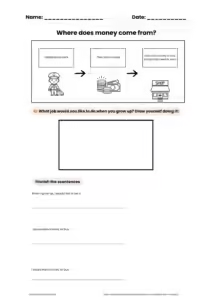
Before children can understand needs and wants, they need to know where money comes from. This worksheet opens with a three-step visual sequence showing how people do something valuable, earn money, and use it to buy things they need and want. Children then draw what they’d like to do when they grow up and complete sentences about earning and income – connecting to the video where Karyn gets her very first job.
Activity type: Draw and complete Curriculum link: PSHE KS1 L15 · TEKS K.5(C) · BC Social Studies K
Worksheet 2 — Need or Want? (Cut-and-Paste Sort)
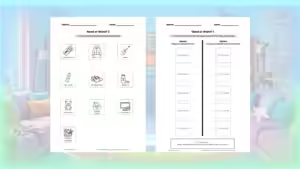
The classic needs and wants sorting activity. Children cut out ten picture cards and sort them into two columns: “Needs — Things we must have to live” and “Wants — Things we would like but can live without.” This printable worksheet comes as two pages: a sorting mat and a separate page of large cut-out cards sized for small hands. Items include curriculum-standard examples like fruit and vegetables, water, a warm coat, and medicine alongside wants like a chocolate bar, a video game, and a guitar.
Activity type: Cut and paste Curriculum link: PSHE KS1 L12 · TEKS K.5(B) · C3 Framework
Worksheet 3 — Need, Want, or It Depends?
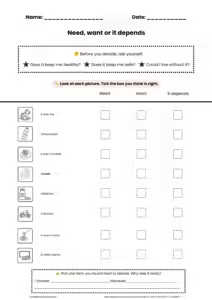
This is the worksheet that goes beyond basic sorting. Children use a “thinking toolkit” of three questions — Does it keep me healthy? Does it keep me safe? Could I live without it? — to categorise eight items as a need, a want, or “it depends.” Two items are deliberately ambiguous: a pair of shoes (a need if you have none, a want if they’re your fifth fancy pair) and a bicycle (a need if it’s your transport, a want if it’s just for fun). A writing prompt asks children to explain why one item was hard to decide.
Most needs and wants packs stop at the binary sort. This worksheet develops genuine critical thinking — the skill that stays with children long after the lesson ends.
Activity type: Tick-box grid with writing prompt Curriculum link: PSHE KS1 L12 · TEKS K.5(B) · Young Money 5–7
Worksheet 4 — Same Needs, Different Needs
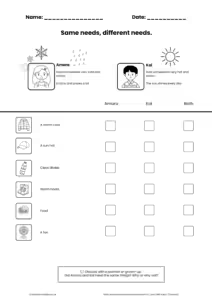
Do all people need the same things? Children meet two characters — Amara, who lives somewhere very cold and snowy, and Kai, who lives somewhere very hot and sunny. For each of six items, they decide who needs it: Amara, Kai, or both. A warm coat? Amara. A sun hat? Kai. Clean water? Both. This teaches children that needs can be different depending on where you live — but some needs, like food and water, are the same for everyone.
Activity type: Comparison grid with discussion prompt Curriculum link: Young Money 5–7 · BC Social Studies K · C3 Framework
Worksheet 5 — What Would You Buy?
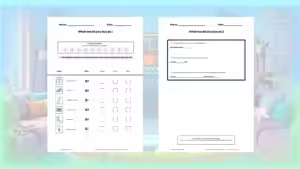
Children visit a shop with six items and only $10 (or £10) to spend. They can’t buy everything — so what will they choose? Items include a mix of needs (a loaf of bread, a bottle of water, medicine) and wants (a toy car, a comic book, an ice cream) at different prices. Children circle their choices, identify whether each item is a need or a want, and explain what they had to leave out and why. With all three needs costing $6, children discover they have just $4 left for wants — and can’t buy them all. Some may even notice they have money left over to save, which leads naturally into the next worksheet.
Activity type: Scenario with circling, budgeting, and sentence completion Curriculum link: PSHE KS1 L11, L12 · CEE Standard 1 (Scarcity) · C3 Framework
Worksheet 6 — My Saving Goal
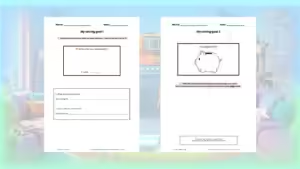
Sometimes we can’t buy what we want right now — but we can save up for it. Children draw what they’re saving for, write how they plan to save, and use a large open piggy bank outline to track their progress over time by drawing a coin inside each time they save real money. This is the only printable worksheet designed to go home — print it, stick it on the fridge, and fill it in together as a family over the coming weeks.
Activity type: Draw, write, and ongoing tracking Curriculum link: PSHE KS1 L11, L13 · CEE Saving Topic · Young Money 5–7
Worksheet 7 — What Did I Learn?
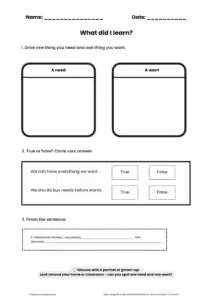
The final worksheet is a gentle reflection and assessment. Children draw and label one need and one want in two large boxes, answer two true-or-false questions about what they’ve learned, and complete the sentence “If I had some money, I would buy ___ first because ___.” A closing discussion prompt asks children to look around their home or classroom and spot one need and one want — taking the learning off the page and into the real world. Teachers can use this as evidence of learning; parents can use it to see how much their child has taken in.
Activity type: Draw, true or false, and sentence completion Curriculum link: PSHE KS1 L11, L12 · TEKS K.5(A)(B) · Young Money 5–7
More About the Companion Video
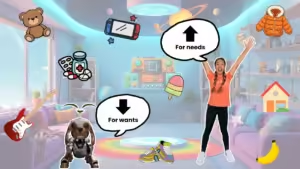
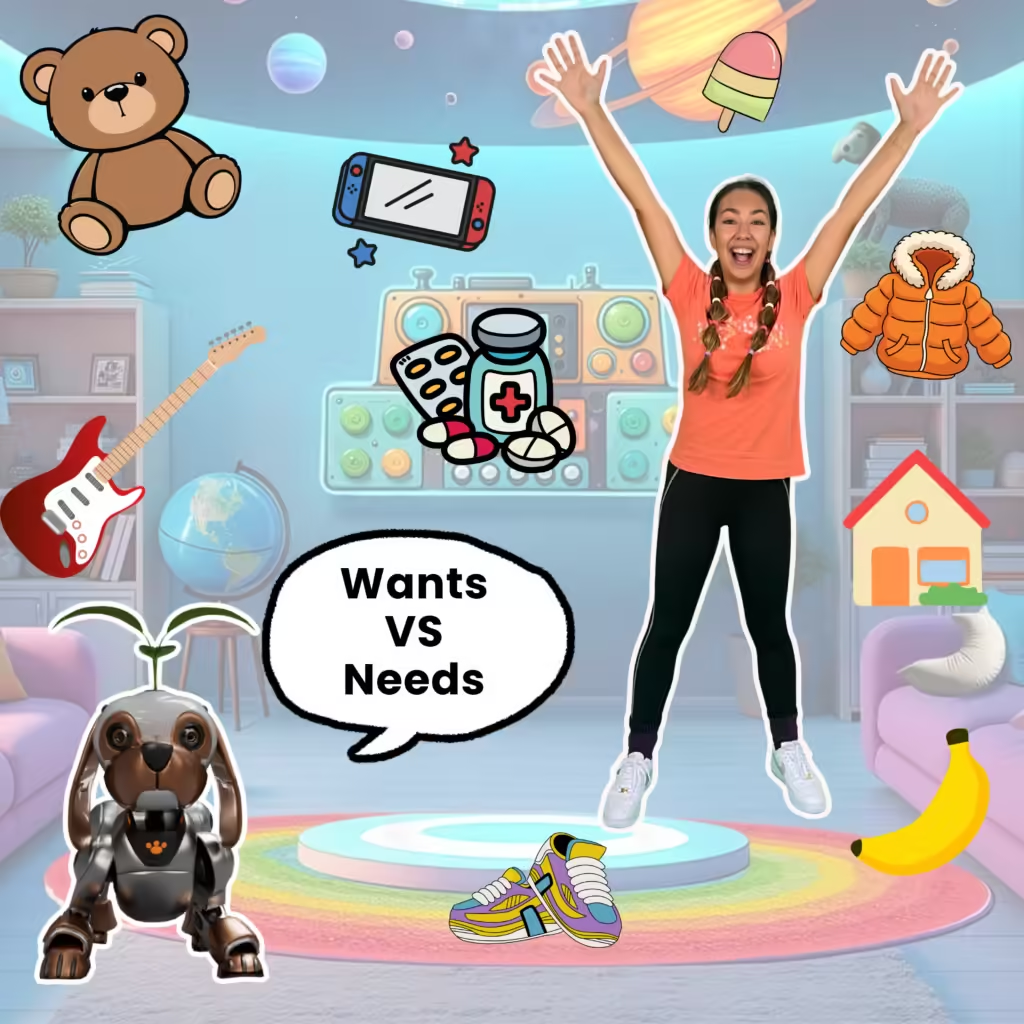
In the video, Karyn gets her first ever job, earns money, and rushes to fill a shopping cart with everything she wants — a guitar, fancy running shoes, a teddy bear, and more. But the total is way more than she earned! With the help of Bobbie the robot dog, she learns the difference between needs and wants, plays an interactive sorting game where children point up for needs and point down for wants, makes smart spending choices by putting needs first, and starts saving for a bigger goal.
It’s a complete money lesson wrapped in a story, and every worksheet in the pack reinforces a different part of it. We recommend watching the video as a class, with a parent, or as a family before starting the worksheets — but the worksheets also work perfectly on their own.
Watch the full video on YouTube →
Help Us Keep These Resources Free
Every worksheet, video, and teaching guide on Learn with Karyn is completely free — no paywalls, no email gates, no hidden costs. We believe every child deserves access to quality learning resources, and the ad revenue from our videos is what makes that possible.
If you’ve found these resources useful, here’s how you can help us keep creating more:
Subscribe to Learn with Karyn on YouTube so you never miss a new educational video. Like and share the needs and wants video with other teachers, parents, and carers who might find it helpful. Every subscribe, like, and share tells the algorithm to show our content to more families and classrooms — which means we can keep doing what we do.
It costs nothing but makes a huge difference. Thank you for being part of this.
How to Use These Worksheets
In the Classroom
The seven worksheets follow a learning sequence — each one builds on the last. Work through them in order across several lessons, or pick individual sheets to support a specific topic. Each worksheet fits within a 15–20 minute activity slot and is designed for Reception through Year 2 (Kindergarten through 2nd Grade).
For PSHE leads: the pack maps directly to PSHE Association KS1 learning opportunities L10–L13 and L15, covering economic wellbeing, money, needs and wants, spending choices, and saving. Curriculum codes are listed on every worksheet footer.
Download the PDF and print just the pages you need — the worksheets work with Google Classroom, Seesaw, and interactive whiteboards, or simply print and go.
At Home
Watch the video together first, then print one or two worksheets as a follow-up activity. The sorting game in the video naturally leads into Worksheet 2, and the budgeting scene leads into Worksheet 5. Worksheet 6 (the saving goal) is specifically designed as a take-home piece that families can use together over time.
For Homeschooling
The pack covers a complete unit on needs, wants, earning, spending, and saving — all aligned to curriculum standards across the US, UK, Canada, and Australia. Use the printable PDF worksheets as a standalone social studies or financial literacy unit, or integrate them into broader economics, maths, or PSHE teaching.
Curriculum Alignment
Every worksheet in the pack aligns to recognised education standards across four countries.
United Kingdom — PSHE Association Programme of Study KS1: L10 (what money is), L11 (spending and saving choices), L12 (difference between needs and wants), L13 (looking after money), L15 (jobs and earning). Supports Kapow Primary Year 2 Economic Wellbeing and the Young Money Financial Education Planning Framework for ages 5–7.
United States — Texas TEKS K.5(A–C), Virginia SOL 1.8, C3 Framework for Social Studies (Dimension 2: Economics), CEE Voluntary National Content Standards (Standard 1: Scarcity), and Jump$tart National Standards for Personal Financial Education (Spending and Saving topics).
Canada — British Columbia Social Studies Kindergarten (“needs and wants of individuals and families”), Ontario Grade 1 Social Studies Strand B, and Alberta Grade 2 Social Studies (Systems strand).
Australia — Australian Curriculum V9 HASS Economics and Business rationale, supporting Foundation to Year 2 learning. The explicit needs and wants content descriptor appears at Year 5 (AC9HS5K08), but the concepts are widely taught from Foundation year in state syllabi across NSW, Victoria, and Queensland.
Free Teaching Guide and Answer Key
The PDF pack includes a comprehensive teaching guide for teachers, homeschool parents, and carers. For each of the seven worksheets, the guide provides the learning objective (using curriculum-exact language from the Young Money framework), curriculum links, a description of the activity, suggestions for how to introduce it, specific things to look for in children’s responses, and the answer key — all in one place.
There’s also a printable vocabulary page with curriculum-aligned definitions of key terms: need, want, money, earn, income, spend, save, and choose. Print it as a reference sheet or cut it up and display it as a classroom word wall.
Download the full PDF pack including the teaching guide →
What Are Needs and Wants?
If you’re introducing this topic for the first time — or if your child is asking questions after watching the video — here’s a simple explanation.
A need is something we must have to live. Food, water, shelter, clothing, and medicine are all needs. Without them, we can’t stay healthy, safe, or alive. These are the things every person requires, no matter where they live or how old they are.
A want is something we would like to have but can live without. Toys, treats, video games, and fancy clothes are all wants. They make life fun, but they’re not essential.
The important lesson — and it applies to children and adults alike — is that we can’t have everything we want. Money is limited, so we have to make choices. The smartest approach is to take care of our needs first, then choose our most important wants with what’s left, and save for bigger goals over time. That’s exactly what these worksheets teach.
Download the Free Worksheet Pack
The complete pack — seven printable PDF worksheets, a vocabulary page, a curriculum alignment table, and a comprehensive teaching guide with answer keys — is free to download.
Whether you’re a KS1 teacher planning PSHE economic wellbeing lessons, a first grade teacher covering social studies and economics, a homeschool parent looking for free printable financial literacy worksheets, or a family wanting to help your child understand why they can’t have everything they want, this needs and wants worksheet pack gives you everything you need in one place.
No email sign-up. No paywall. Just free, curriculum-aligned printable resources for children aged 5–7.
Download the free PDF worksheet pack now →
If these resources help your teaching or your family’s learning, please consider subscribing to Learn with Karyn on YouTube and sharing this page with colleagues and friends. It’s the best way to help us keep creating free resources for every child.
You Might Also Enjoy: Storytime with Karyn
If your children love learning through stories, check out our sister YouTube channel, Storytime with Karyn. It’s a separate channel where we bring children’s books to life through gentle, low-stimulation animation — and then discuss each book’s lessons with the characters themselves.
Every storytime video comes with its own free printable reading comprehension worksheets and book activities, available through the Change the World with Karyn Free Kids Book Club. It’s a growing library of free reading resources, guided reading activities, and book comprehension worksheets for children aged 5–7 — perfect for classroom book clubs, guided reading groups, or bedtime story follow-ups at home.
Visit Storytime with Karyn on YouTube → Explore the Free Kids Book Club →
Frequently Asked Questions
What is the difference between needs and wants for kids?
A need is something we must have to live — food, water, shelter, clothing, and medicine. A want is something we would like to have but can live without — toys, treats, and fancy things. Teaching children this difference is the foundation of financial literacy and helps them understand why we have to make choices about how we spend money.
What are examples of needs and wants?
Common examples of needs include fruit and vegetables, clean water, a warm coat, a place to live, and medicine. Common examples of wants include sweets, video games, toys, fancy running shoes, and a guitar. Some items — like a pair of shoes — can be a need or a want depending on the situation. If you don’t have any shoes, they’re a need. If you already have several pairs and want a fancier one, they’re a want. Our printable worksheet pack includes activities that help children work through these “it depends” scenarios.
At what age should you teach needs and wants?
Research from the University of Cambridge (Whitebread and Bingham, 2013) found that the foundations of financial behaviour are largely formed by age seven. Most curricula introduce needs and wants between ages 5 and 7 — Reception to Year 2 in the UK (PSHE KS1), Kindergarten to 2nd Grade in the US (Social Studies), and equivalent years in Canada and Australia. Our worksheets are designed specifically for this age range.
How do you explain needs and wants to a child?
The simplest approach is to start with things they already know. Ask “Could you live without food?” (no — it’s a need) and then “Could you live without a new toy?” (yes — it’s a want). Using concrete, everyday examples that children can see and touch works far better than abstract definitions. Our companion video uses an interactive sorting game where children point up for needs and point down for wants, making the concept physical and fun before the printable worksheets reinforce it.
Is needs and wants in the national curriculum?
In the UK, needs and wants is covered within PSHE education at Key Stage 1 under the “Living in the Wider World — Economic Wellbeing” strand (PSHE Association learning opportunities L11 and L12). While PSHE is non-statutory in maintained schools in England, it is widely taught and is statutory in independent schools. In the US, it appears in Social Studies standards from Kindergarten (Texas TEKS K.5, Virginia SOL 1.8, C3 Framework). In Canada, it features in British Columbia Kindergarten Social Studies and Alberta Grade 2. In Australia, the HASS Economics strand covers it formally from Year 5, though it is commonly taught informally from Foundation year.
What are good activities for teaching needs and wants?
The most effective activities for ages 5–7 are hands-on and visual: cut-and-paste sorting into “needs” and “wants” columns, scenario-based spending choices (“If you had $10, what would you buy first?”), drawing and labelling their own examples, and discussion prompts that connect the concept to real life. Our free PDF worksheet pack includes all of these formats across seven progressive activities, ready to print and use. For a story-based approach to similar themes, our sister channel Storytime with Karyn brings children’s books to life with free reading comprehension worksheets and activities.
Why is it important to teach children about money?
Understanding that money is limited — and that we have to choose between the things we need and the things we want — is one of the earliest and most lasting financial lessons a child can learn. It builds the foundation for budgeting, saving, and responsible spending that children will use throughout their lives. Starting these conversations at ages 5–7, when financial habits are still forming, gives children the best chance of developing a healthy relationship with money.
Can I use these worksheets without the video?
Yes. Every printable worksheet works as a standalone activity and includes clear instructions, curriculum codes, and a teaching guide entry. However, watching the video first gives children the story context, vocabulary, and interactive sorting game that makes the worksheets even more effective. We recommend watching the video as an introduction, then using the PDF worksheets to reinforce and assess the learning.
Learn with Karyn creates free educational videos and printable worksheets for children aged 5–7. Our sister channel, Storytime with Karyn, brings children’s books to life with free reading comprehension worksheets and activities. Visit changetheworldwithkaryn.com for all of our free resources.